
Understanding the Significance of Mitochondrial Genetics Research in the Meisel Laboratory
Learning more about why mitochondrial dysfunction research is important, the people it impacts, and the expert behind it.
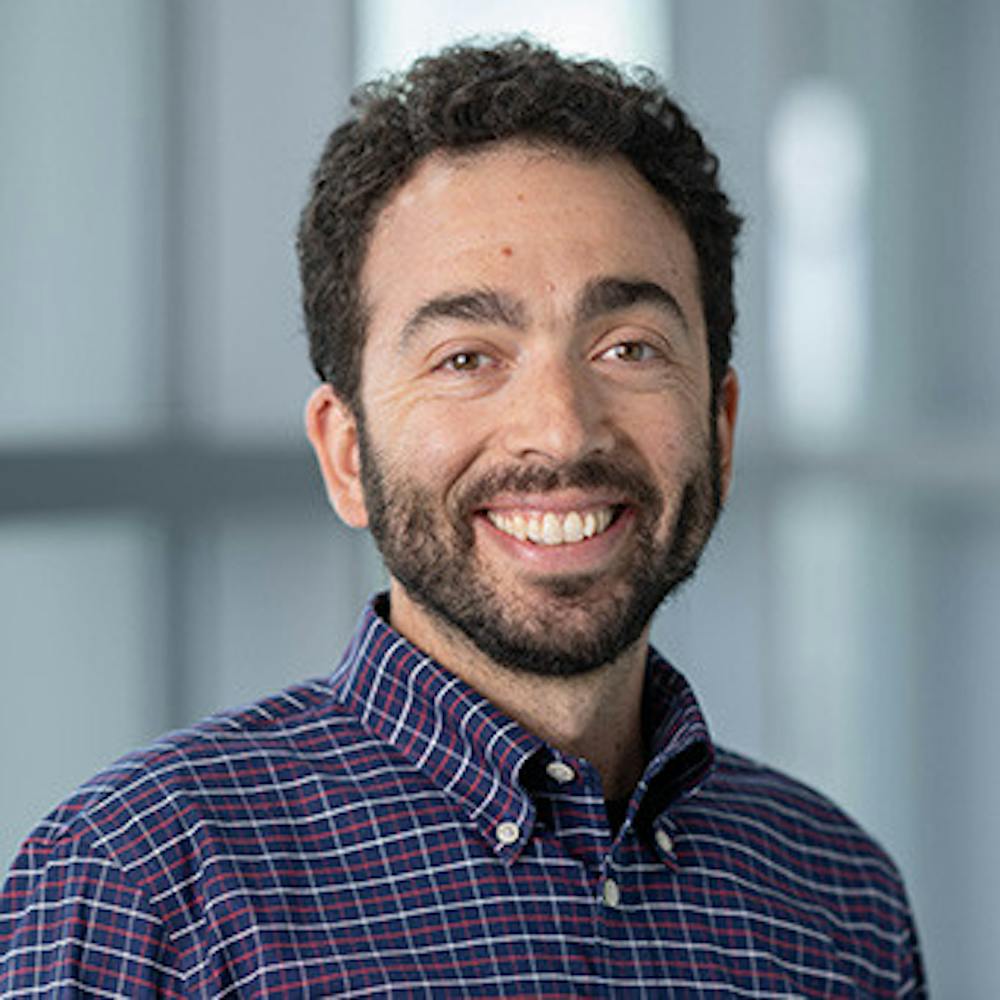
While walking to Rosenstiel Basic Medical Sciences Research Center, strolling down the hills, I reflected on how daunting research can seem. If you join a lab as an undergrad, you’ll be surrounded by experts in their field, all while learning how to work with a microscope or use a pipette for the first time. It can feel nothing short of intimidating.
As I step into the building and walk past the labs, I think about all the things unknown to me: the tanks filled with gas, incubators and glassware are unfamiliar. Making my way to my interviewee’s office, I am surrounded by an inviting space. Sitting on the table are two adorable Lego cacti plants and a C. elegans plushie. Across from me, with a welcoming smile on his face, is Assistant Professor Joshua Meisel, PhD.
After growing up in Brookline, Massachusetts and attending Brookline High School, Meisel made the move across the country to Stanford University in California to double major in Biology and English. There, he diligently worked on DNA damage and repair in a cancer lab. After graduating from Stanford with a Master’s in biological sciences, he obtained a Fulbright scholarship to research the Great Barrier Reef at the University of Queensland in Australia.
After Australia, Meisel worked as a research technician at the Whitehead Institute at the Massachusetts Institute of Technology, working with flatworms, specifically the genus planaria. He later earned a PhD at Massachusetts Institute of Technology, focusing on host pathogens in Caenorhabditis elegans and eventually “fell in love with worms,” he said in a Sept. 11 interview with The Justice.
Why worms? Despite the clear physical differences between a human and a worm, C. elegans are an excellent model for human genetics. Approximately one third to half of human genes have orthologs, which are similar genes in C. elegans and share basic cellular functions. In a lab setting, C. elegans have short lifespans, populate fast and are easy to genetically manipulate using CRISPR-Cas9. Furthermore, these worms have been involved in studies run by scientists that have won four Nobel prizes related to discoveries in programmed cell death (apoptosis), RNA interference (RNAi), microRNA and Green Fluorescent Protein (GFP).
For his postdoctoral studies, Meisel worked at Massachusetts General Hospital, developing his interests in working with C. elegans and researching mitochondrial dysfunction. He highlighted his unique experience with having two laboratories to work with, the Ruvkun Lab, notable for their Nobel prize winning work on microRNA using C. elegans, and the Mootha Lab, a world leader on researching mitochondria.
Going back to his hometown in Brookline, Meisel fondly recalls that his mother went to Brandeis and his parents married in one of the chapels on campus. While seeking a collegiate space with “top-tier research, interactions with students in the lab, and a tight knit community,” he found Brandeis fit that profile perfectly.
When he first arrived at his lab space, he was met with a blank slate. It can be intimidating but also opens doors for unimaginable possibilities as a young scientist. Meisel shared he was “trained well to do science, to write, and to mentor. But I never before had to order a freezer.” As a Principal Investigator, or a PI, Meisel was now responsible for getting microscopes, freezers, incubators and equipment. However, he wasn’t alone. One of his favorite aspects of working with Brandeis is the community within the faculty and staff. He has received mentorship from another C. elegans laboratory PI, Piali Sengupta, PhD and many other researchers. It took Meisel roughly six months to a year before it really felt like a functioning lab. Now, two years later, he has an enthusiastic research group doing experiments and making discoveries with mitochondria.
If you turn to ask your friends or family what mitochondria is, they’d most likely respond with the famous catchphrase: “Mitochondria is the powerhouse of the cell.” It is commonly understood that these organelles are crucial to driving cellular energy in all animals, plants and fungi. But what happens when one genetic mutation causes these powerhouses to lose their function?
Meisel, alongside researchers in the Meisel Laboratory, aim to utilize C. elegans to investigate the mechanisms behind mitochondrial dysfunction and identify therapeutics for the diseases it causes. In particular, the Meisel Lab studies a rare genetic disorder caused by an alteration of a gene named FXN. This disease is known as Friedreich’s ataxia (FA). It impacts approximately 1 in 50,000 persons worldwide and is the most common inherited ataxia in children.
By impacting the spinal cord, FA disrupts the flow of sensory information to the brain’s cerebellum, responsible for balance, movement and coordination. This means children progressively lose their ability to move and speak — potentially also developing diabetes or heart disease.
In a personal case shared by Biogen, Sam Bridgman shared his journey to find out he has Friedreich's ataxia. As a 12-year-old boy, he noticed his worsening physical abilities, like struggling to catch a baseball or walking without tripping. Eventually, after three years, his parents noted how prominent these issues were, and he was given an FA diagnosis through blood test. As he was starting high school, he avoided sharing information about his condition with his friends. Now, Sam believes in raising awareness surrounding FA. Sam tattooed ‘Seek a Miracle’ on himself, as he seeks a miracle to cure his disease. He is not the only person impacted by FA looking for a treatment. Although surgeries and medication can help maintain the symptoms, there is no cure for Friedreich’s ataxia.
What is happening on a molecular level to cause this disease? Think of DNA as a page in a notebook, filled with a story to make a genome. Most patients diagnosed with FA present with a genetic change located on chromosome 9, or page nine, where the FXN gene contains a repeat sequence GAA in intron 1. Instead of having: “THE SKY IS BLUE AND THE GRASS IS GREEN,” FA patients carry the sentence: “THE SKY IS BLUE AND AND AND AND AND AND AND AND…”
This change leads to a disrupted part of the story in their book. Alleles in healthy individuals typically carry up to 40 GAA repeats. Mutated alleles can have over 1,000 GAA repeats. This repeat expansion lessens the expression of the FXN gene, leading to a lack of frataxin protein in mitochondria. The role of frataxin is to promote mitochondrial iron-sulfur cluster synthesis. Without it, mitochondria may not produce enough energy in the cell, build iron-sulfur clusters cofactors and regulate iron.
Additionally, frataxin is in cells throughout the body, and the cells containing the most frataxin protein are found in the heart, spinal cord, liver, pancreas, and muscles. This prevalence indicates frataxin’s importance in the human body.
As co-author and lead of an innovative paper in Nature, Meisel remarkably showed two forms in which the negative effects of the FXN mutation can be suppressed. Since C. elegans are genetically accessible, they were used to model the FXN mutation in an ortholog gene, frh-1. Meisel found the worms had little to no growth in a regular oxygen setting, as expected with the lack of the frataxin protein in the mitochondria. But what about placing them in a low oxygen setting?
Surprisingly, in a hypoxic state, they appeared to be healthy, as if with no mutated FXN. This outcome is most likely due to an increase in the iron-sulfur cluster levels, allowing for more electrons through complexes to transfer into oxygen. Nevertheless, the Meisel lab is still investigating the biology behind it.
Interestingly, another way the FXN mutation was rescued is through introducing a mutation in another gene, FDX2. It is still a question of whether the FDX2 protein would inhibit iron-sulfur cluster production. Further analysis is being done by the Meisel lab by measuring iron-sulfur clusters. A clearer picture is needed of why altered FDX2 helped FXN. The Meisel lab is working to expand on the mechanisms behind the rescue of the FXN mutation and to understand if the FDX2 mutation is truly harmless.
Meisel shared his future visions for his work surrounding FA. Since his methodology rescued the effects of FXN, he expressed his interest towards further understanding and applying it to other mitochondrial mutants. Additionally, Meisel strives to continue to find new therapeutic targets and learn more about the basic biology behind mitochondrial dysfunction. As co-founder of Falcon Bio, along with Gary Ruvkun, PhD, and Vamsi Mootha, PhD, he is working to develop drug therapies to treat Friedreich's ataxia. Meisel explained the company is still in an early phase but is hoping for clinical trials in the future.
In the lab, Meisel and his team have placed a focus on understanding the “detailed molecular mechanisms underlying the rescue and also find new ways to rescue FA or different mitochondrial diseases.” Individually, mitochondrial diseases can be considered rare, but as a group, mitochondrial disorders are considered common. Diseases like Alzheimer's and Parkinson's disease, amongst many others, show that the mitochondria dysregulation plays a role in their mechanisms.
Our conversation ended with a memory he shared from his graduate years. He studied C. elegans that expressed green fluorescent protein in two neurons, located in the head of the worm. But when placing them on a different bacterial lawn (which is their food), the GFP became mysteriously expressed in other neurons of the worm. That wasn’t supposed to happen. It became the basis of his PhD at MIT. In the interview, Meisel described the feeling of surprising results as if “getting struck by lightning.” Those moments are most precious to him in research.
Before meeting with Meisel, I reflected on how much I did not know. By taking a deeper look into his variety of experiences in science, understanding what research means for him and for those affected by it, I realize there is a sense of fascination for the unexplored in the research community. Meisel couldn’t have said it better: “The best part of science is the unexpected discoveries.”

Please note All comments are eligible for publication in The Justice.