
Alleviate overcrowding in residence halls
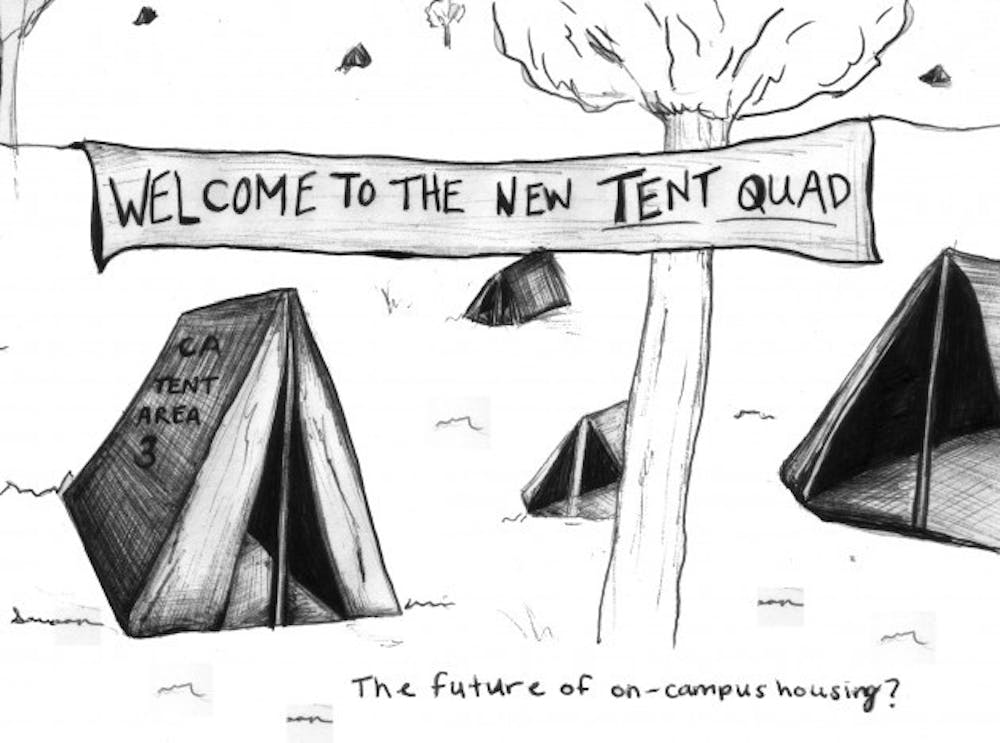
This year, our university housing system became much more crowded. The Brandeis Class of 2015 is one of the biggest in the school's history, currently estimated at 972 students, 108 of whom will join the class as midyears this January. As a result, the Class of 2015 is also experiencing a significant housing squeeze. This year, the Department of Community Living designated 75 rooms to be "lofted triple rooms," the polite term for rooms commonly known as "forced triples." These 75 rooms house 225 first-year students, which is slightly over a quarter of all first-year fall enrollment students. I find this statistic very distressing and am somewhat doubtful that the consequences of admitting so many students were thoroughly considered.
I see three main consequences of overcrowding in first-year dormitories. The first and most obvious consequence is the mediocre living experience that many first-year students will likely have in forced triples. In an article from last week's issue of the Justice, Senior Director of Community Living Jeremy Leiferman acknowledged this difficulty in an email. "We do [recognize] that living in a triple is not an easy situation and requires a little more effort on the students behalf to manage a tighter space and additional relationships," he wrote.
In my opinion, however, he understated how difficult it could be for first-years. The space of a double room must now be divided among three students, resulting in a significant decrease personal space for everyone.
For instance, double rooms only have two closets, which can result in one student not getting adequate storage space for personal belongings. First-year students must also deal with the politics of having two unfamiliar roommates instead of one. Making decorative or organizational changes to the room require additional consent, and managing sleep schedules can get complicated. Additionally, social situations can become awkward if two of the three roommates become good friends.
The second consequence is the potential effects of the housing shortage on rising juniors and seniors. In last week's issue of the Justice, Leiferman stated that the policy of guaranteeing housing for a student's first 2 years would not change as a result of the large first-year class. However, he also acknowledged that this could possibly lead to fewer housing options for juniors and seniors. As housing for upperclassmen is already difficult to obtain, it is likely that a much greater number of juniors and seniors will have to find housing off campus next year.
Lastly, the creation of such a large number of forced triples reinforces the idea to administrators that forced triples are an acceptable and reasonable method of alleviating the persistent overcrowding problem in first-year dorms. I'm confident that most first-year rooms were not designed to hold three people at a time, and the first implementation of a forced triple many years ago was probably not very popular. However, it has now become a standard practice over the years, with those students who decide to matriculate at Brandeis later than other students getting into the forced triples. This year, the practice has seemingly reached a new low, having impacted a quarter of current first-years. There needs to be a point at which the administration recognizes that the practice is not sustainable.
I do understand that administrators needed to improve Brandeis' financial condition and that accepting additional students in the first-year class was a reliable method to do so. However, enrolling 100 additional students strikes me as ill advised, especially considering that we already have a housing shortage in first-year dorms. Perhaps we should have tried to admit more transfer students, who would have joined classes with lower enrollments, or admitted first-year classes with 35 to 50 extra students for a couple of years to stagger the impact of the housing shortage.
At this point, we can only find ways to ameliorate the housing problem for the coming academic year. Bearing in mind that there is a finite amount of realistic off-campus housing available, it is in Brandeis' best interest to make on-campus housing available to as many students as possible.
One possible solution would be to temporarily allow extra students into the larger dormitories of Usen Castle to help meet the 2-year housing guarantee. Usen Castle has many rooms of above-average size that could accommodate additional residents, which would ease the strain on upper-class housing.
As sophomores are more familiar with college life and have established their own social circles, they would be able to judge whether they could manage an extra person in their dormitories and who that would be.
I am hopeful that Brandeis will be more cautious with its housing practices in the future and will be able to find comprehensive solutions to the problems we face in the coming year.

Please note All comments are eligible for publication in The Justice.