
Crown Center teach-in discusses the United States, Israel, Iran and the Middle East at war
The teach-in, led by scholars and professors, provided various insights and perspectives on the unfolding situation in the Middle East.
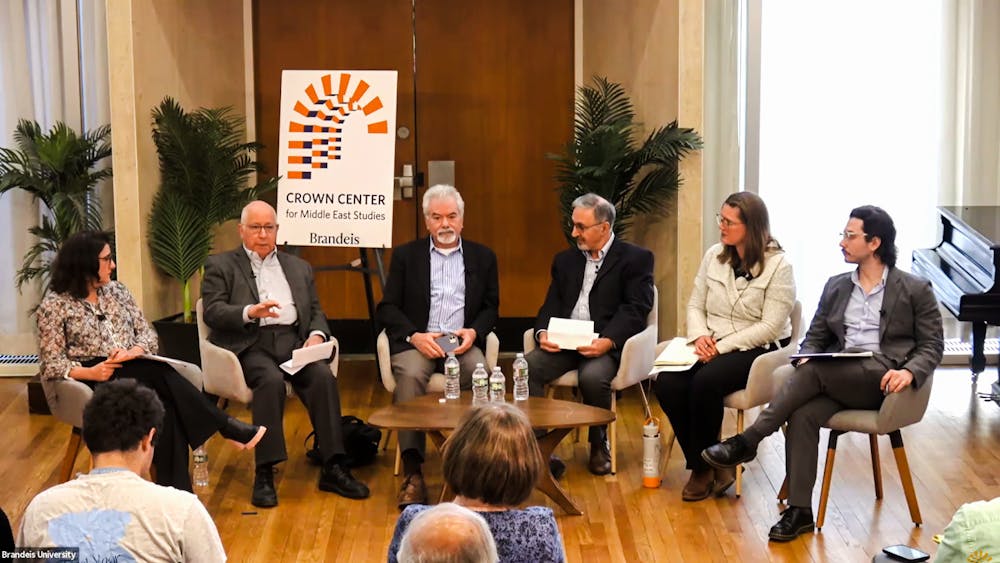
On March 11, the Crown Center for Middle East Studies hosted a teach-in event that provided context and analysis of the current conflict in the Middle East. Six scholars from the Crown Center participated in a discussion about military developments, Iranian domestic politics, Israel’s strategic objectives and the economic consequences of the war. The event aimed to help the Brandeis community better understand the geopolitical implications of the conflict.
Prof. Gary Samore (POL), Crown Family director and professor of the practice of politics, gave the opening remarks of the event. Samore served as former President Barack Obama's White House Coordinator for Arms Control and Weapons of Mass Destruction and President Bill Clinton's Senior Director for Non-proliferation and Export Controls. Prof. Samore said that the discussion would focus on “the Israeli-American war against Iran, which is entering the 12th day at the cost of about 1,800 lives and considerable property damage, especially in Iran and Lebanon.” He then introduced the event’s speakers: Prof. Shai Feldman (POL), Prof. Naghmeh Sohrabi (HIST), Prof. Nader Habibi (ECON), Prof. Elizabeth Derderian (ANTH) and Dr. Kerem Ussakl. He proceeded to explain the successes of the military campaign and the uncertainty of U.S. war objectives.
Prof. Samore explained that the U.S. and Israeli attacks seemed effective “in terms of killing much of the Iranian leadership, including the Supreme Leader, eliminating Iran’s air defense system, limiting Iran’s missile and drone force and production capabilities, sinking much of the Iranian Navy and attacking so-called regime targets, which is the euphemism for IRGC [Islamic Revolutionary Guard Corps] facilities and bases.” He said that there are fewer attacks on nuclear targets and energy infrastructure in Iran, with the exception of Israel’s attack on fuel depots in Iran. Prof. Samore stated that the attack caused a serious environmental problem, and the United States government asked Israeli authorities to halt attacks on energy infrastructure.
However, Prof. Samore said that despite the U.S. and Israel’s military success, Iran can still launch drones and missiles, mainly targeting U.S. bases in the region. He added that Iran has some strategic advantages: “The one big card Iran still has is the ability to limit transit through the Straits of Hormuz, and that has led to a significant increase in oil and gas prices.”
Concerning the U.S.' final objectives, Prof. Samore divided them into three categories: regime change, the Venezuelan model and President Donald Trump unilaterally declaring the end of the war. He elaborated that at the beginning of the war, Trump hoped that the attacks would motivate the Iranian public to overthrow the Islamic Republic. When that didn’t happen, the Venezuelan model was pursued, meaning that “the Islamic Republic would replace the Supreme Leader with a more compliant ruler. The system would remain in place, but the new Supreme Leader would be willing to acquiesce to the U.S. demands on Iran’s nuclear missile program, support for proxies and so forth.” In light of recent events, Samore explained that the third objective is for Trump to eventually declare the war to end, as the U.S. has significantly reduced Iran’s nuclear missile drone capability. However, Samore concluded that the U.S. objectives may change depending on Iran’s domestic scene, which Prof. Sohrabi elaborated on.
Prof. Sohrabi is the director for research at the Crown Center and the Charles (Corky) Goodman Professor of Middle East History. She has written the book “Taken for Wonder: Nineteenth Century Travel Accounts from Iran to Europe,” and is currently working on a book about the history of the 1979 revolutionary generation in Iran. Prof. Sohrabi clarified the assumptions and misconceptions about Iran. “If there has been one constant in the past 47 years about Iran, it is that it is a system. And I use the word ‘system’ here very carefully. It is a system that first and foremost protects itself in its survival and it’s resilient. That is the number one constant for the past 47 years,” she said.
Prof. Sohrabi also stated that there is a difference between the terms government, state and system; these differentiations can explain the domestic scene in Iran. She provided an example from 1989, when Ruhollah Khomeini died, but the Islamic Republic persisted. “But it was not the end because the system keeps adapting to the moment. The system keeps transforming both itself, but in the relationship between state and society, which is a very important point,” Prof. Sohrabi explained.
After the panel elaborated on Iranian domestic politics, Prof. Feldman, the founding director of the Crown Center and a professor of politics, described Israel’s perspective. Prof. Feldman described Israel’s three principal objectives, which are to “downgrade, if not obliterate, the Iranian capacity down the line to produce nuclear weapons,” to “degrade as much as possible Iran’s capacity to launch missiles against Israel” and to “degrade the capacity of the other members of the so-called Axis of Resistance that were based on the support of Iran.” He also added a fourth Israeli objective, which is Prime Minister Benjamin Netanyahu’s objective of regime change in Iran. Prof. Feldman said that for Prime Minister Netanyahu, the issue of who controls weapons of mass destruction is “critically important.”
Prof. Feldman added that historically, Israeli objectives have been crucial in determining the state’s course of action. In 1982, Israel, with the U.S. government, supported the regime in Iran. “It was called the Iran-Contra Affair, which had Israelis and Americans in the White House cooperating in a scheme that involved essentially delivering weapons to Iran and using the money that was obtained from Iran to support the Contras in Nicaragua that were fighting the Sandinistas and so on,” he said.
He also mentioned that in recent years, Israel’s national security strategy has been motivated by two drivers: the Holocaust and October 7. Prof. Feldman explained that the Holocaust is “something that Israelis grew up with in kindergarten, in elementary school, in high school and so forth. And a lot of it revolves around the never-again scene, and especially when you talk about unconventional weapons. We had the same thing with the first Gulf War when it was a danger of Iraq using chemical weapons against Israel.”
Prof. Nader Habibi, a Henry J. Leir Professor of the Economics of the Middle East, discussed the economic implications of the conflict and shared his perspective on how the oil and natural gas markets have changed globally amid the ongoing war. He said that the Persian Gulf region is a major supplier of both oil and natural gas, which has affected Europe and Asia. “India and China are both dependent on oil from the Persian Gulf, from the Hormuz trade for about 40% of their supply,” Prof. Habibi explained. He warned that there will be both short- and long-term implications globally. “So what is happening is affecting the global market in the short term. It’s resulting in inflation, and it can also become stagflation if it continues for more than a month because of the impact on the cost of production,” he said.
Prof. Habibi also discussed how economic pressure could influence U.S.' decision-making in the conflict: “So perhaps this growing pressure, in my opinion, might force the United States either to rapidly escalate the military operations in hope of destroying Iran’s capacity to continue the blockade of Hormuz, or President Trump declaring some kind of victory and substantially de-escalating the conflict.”
After Prof. Habibi’s remarks, Prof. Derderian, an assistant professor of the Renée and Lester Crown Chair for Modern Middle East Studies, spoke about how the war has affected the lives of everyday people in Arab countries of the Gulf, specifically in the United Arab Emirates. “As my interlocutors and colleagues reported to me, there are about 20 missiles a day that are intercepted over UAE airspace. Some folks were reporting that it actually felt kind of like COVID because everyone was told to stay home from work,” she said. Prof. Derderian mentioned there was a large number of Americans residing in the region, who had difficulties leaving the country.
“So it became very challenging for people who did want to leave, who the U.S. government advised to leave, who are American citizens. They could not actually find those commercial flights to get out. We have reports of people who are living in Doha who drove to Riyadh to catch a flight from Saudi Arabia to try and get back,” she reported.
Additionally, Prof. Derderian explained that Gulf governments place great emphasis on pacifying their populations, a focus that can play a significant role in U.S. relations with Gulf countries. “So the Gulf governments are currently our allies, but at some point, staying with us is going to cost them. They are going to have to give things to their population, to keep them happy and to keep them from speaking out. And this will ultimately, I think, also play out in U.S. diplomatic relations with the Gulf countries,” she said.
The last speaker in the first part of the event was Dr. Ussakl, who shed light on the current situation in Iraq. Dr. Ussakl, a political anthropologist, is a junior research fellow at the Crown Center. He said that Iraq is “the only country that has been bombed by both sides,” which makes Iraqi territory central to the regional dimension of the conflict. He also explained that although Iraq is a major oil producer, many Iraqis do not benefit from its oil wealth domestically.
“Most of the oil and gas used in Iraq for domestic production actually comes from Iran. This is an effect of the U.S. invasion and the politics that have happened ever since,” he elaborated.
Dr. Ussakl also warned that energy shortages in Iraq could create instability ahead of the country’s coming summer elections. “And given the fact that the government has not been formed yet since the last election, there is highly worrying foresight that when the summer heatens and the electricity is not working, people are going on their feet,” he elaborated.
During the second half of the event, the audience asked the panelists relevant questions. A student asked why it is so difficult to stop Iran from closing the Strait of Hormuz, despite the U.S. and Israel's military superiority. Prof. Samore explained that Iran maintains short-range anti-ship missile bases along the straits and can still threaten ships even without an Air Force or a Navy. Other panelists added that Iran’s military strategy relies on attrition as a result of the lessons learned from the prolonged Iran-Iraq War.
Another student raised the question of the likelihood that a ground invasion will take place in Iran. Dr. Ussakl said that this is very unlikely, as the countries of the Gulf “have organized military but not in numbers that would actually buy any meaningful way to help in the war.” He explained that the only country that has the capacity for ground invasion is Turkey, but the nation has been anti-war in this situation.
The event concluded with additional questions from students about the potential political, economic and humanitarian consequences of the conflict.


Please note All comments are eligible for publication in The Justice.