
Faculty meeting sheds light on University's marketing plan, future of Brandeis Core
This month’s faculty meeting introduced the University's new marketing strategy and honored Provost Carol Fierke as she announced the end of her term.
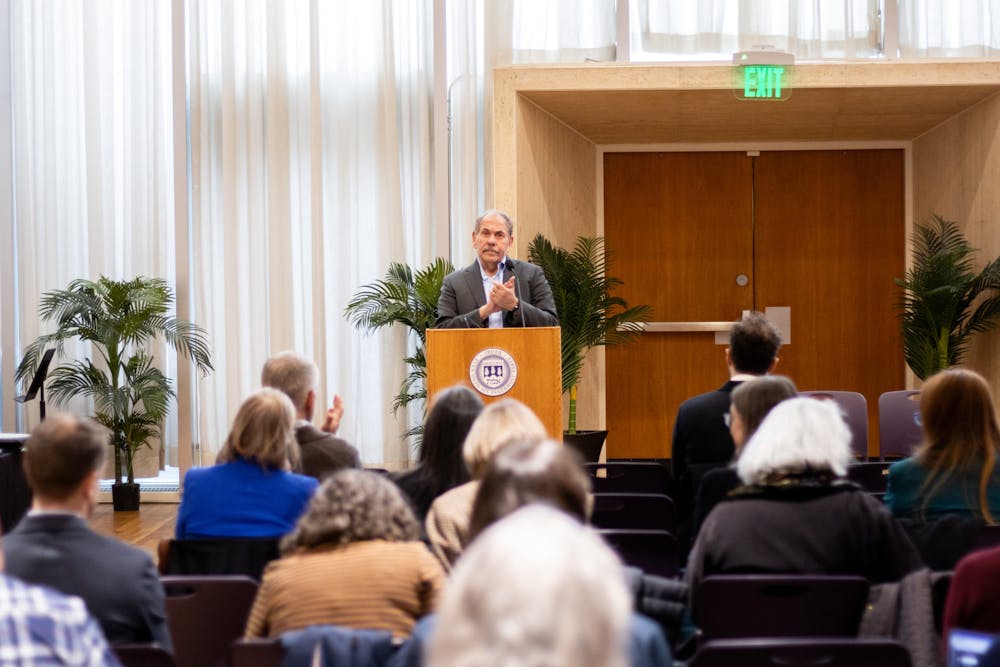
On Friday, March 13, the monthly faculty meeting was called to order at 2:00 p.m. in the Rapaporte Treasure Hall. Prof. Jeffrey Lenowitz (POL) began the meeting by addressing the results of the voting that had happened during the February faculty meeting. The faculty had voted to pass several changes to Brandeis’ core requirements and to establish a new finance major, but had struck down a motion that would have reduced the world language requirement to two semesters, with a notable 72.2% of faculty having voted against it.
The first item on the agenda included remarks from President Arthur Levine ’70. Levine announced that on June 30, Provost Carol Fierke will be stepping down after a five-year term as provost. He praised Fierke’s leadership, particularly during the transition back onto campus after the COVID-19 pandemic and during the recent transition between University presidents. Levine also mentioned Fierke’s involvement in the creation of an undergraduate engineering program and called her a “tireless advocate” for faculty. He then announced that Prof. Linda Bui (ECON) would be taking her place as interim provost and thanked her for her willingness to take the position.
Following Levine’s remarks, Fierke briefly addressed the attendees of the meeting. She articulated the honor of being provost over the past five years, a time she called “turbulent” for Brandeis and general higher education. Fierke also spoke about her work on campus, including contributing to the Brandeis Plan for restructuring the University. Moving forward, Fierke plans to continue contributing to the Brandeis community as a faculty member. She said that she looks forward to continued leadership from Levine and Interim Provost Bui, and she received a standing ovation as she closed her remarks.
Bui then introduced herself and described her enthusiasm as she steps into the role of interim provost. In her words, “we are going to figure this out, and we are going to get to a better place.”
Lenowitz also gave a brief statement, highlighting Fierke’s dedication to faculty relationships and taking their concerns seriously. He added that some of his colleagues from other universities think he is joking when talking about the positive faculty-administration relationships at Brandeis.
At 2:15 p.m., the meeting transitioned into a presentation from Adam Beaver, the director of the Center for Teaching and Learning. As Beaver articulated, the CTL is a resource for instructors who are looking to improve or who would like support addressing various aspects of their teaching or curriculum design. Beaver is trained as a Renaissance historian but discovered his passion for pedagogical support structures through his experiences as a member of dissertation committees and a mentor to early-career graduate students.
Additionally, Beaver reviewed the different types of support the CTL offers. The center offers individual consultations for instructors looking for support with a broad range of issues, such as course design and delivery, processing student feedback and restructuring assignments. Beaver noted that while they offer these consultations, they hope to foster a community where faculty support each other. The CTL also offers various institutional projects and partnerships, as well as a website with advice guides. These guides cover topics including ChatGPT and the overall use of artificial intelligence, incorporating active learning into the classroom.
Vice Provost for Undergraduate Affairs Jeffrey Shoulson then spoke briefly about the next steps in the process of revising the Brandeis Core. Currently, a committee consisting of one professor from each school is reviewing proposals for classes that will satisfy the new “Teamwork and Collaboration” core competency. There is also work underway to ensure that the updates to the Brandeis Core are represented on the Brandeis website and registrar. Shoulson stated that next fall the University is planning to incrementally recertify courses that are carrying older designations. Shoulson also mentioned that he plans on dedicating more attention to the Health and Wellness requirement, including the possible incorporation of a career module into the program.
Dean of Admissions Emily Roper-Doten gave an update on recent undergraduate admissions activity. The most recent Inside Deis program for admitted students had an 87% attendance rate, with around 250 students attending. Roper-Doten stressed that around 90% of these students were still in the decision-making process, which makes these events a crucial opportunity to encourage them to attend Brandeis. She and the admissions team are currently working to implement feedback from Inside 'Deis and plan on reorganizing the academic fair and providing food in future years.
Additionally, Roper-Doten pointed out the new aesthetic changes across campus. As she explained, the University hired a visiting consultant to evaluate their Inside Deis experience and was advised to implement more visual reminders of Brandeis’ brand and school spirit. This advice has translated into the addition of several new banners and large floor mats across campus.
Following Roper-Doten’s presentation, University Archivist Kate Neptune, and Program Director for University Records Management Marren Sanders gave a joint presentation on the resources provided by University Records Management and the University Archives.
URM is responsible for all Brandeis records and provides support for digitizing them. The department offers guidance to faculty on records retention and maintenance. Sanders gave reasons to prioritize good records management, including general organization, the preservation of Brandeis’ history, the minimization of storage costs and requirements, as well as the reduction of risks in litigation and government investigations.
The purpose of the University Archives is to collect, preserve and provide access to university records with enduring historical, administrative and research value. Neptune gave a brief history of the archives, and gave faculty pertinent advice about being aware of the records their office produces, knowing the relevant retention rules, destroying inactive records promptly when indicated and contacting the archives about the discovery or usage of historical records.
Vice President of Marketing Communications Sheila Georger provided updates concerning Brandeis’ marketing campaign. The current goal, she explained, is to efficiently convey the new and compelling changes being made to the University to audiences such as prospective undergraduate students, parents and donors. The team is focusing on the intersection between what has always been true about Brandeis and the new values that are currently being implemented.
Given these goals, Georger unveiled the selling line of this campaign: “One foot in the classroom. One foot in the street.” The street, she explained, represents the world beyond the classroom, such as labs, nonprofit organizations, studios and business startups. She debuted numerous promotional materials based on this selling line, including a short video and mock-ups of outdoor pole banners. These materials included energetic new art for the website featuring bright colors and abstract shapes. They also heavily embraced the career-readiness aspect of Brandeis’ changes. Several of them use a “from vision to voice” template, for example, “From classroom depth to career agility” and “From lab bench to hospital floor.”
Georger shared that when these career-forward materials were tested with parent and student audiences, they were not entirely well-received. Many worried that the promises in the advertisements were too good to be true, that there had to be a catch and that they made Brandeis seem like another institution that promises much but delivers little. In Georger’s eyes, this response is a challenge to better advertise the Brandeis promise and the belief that higher education should “go further.”
In the near future, Georger stated, the marketing team is looking to invest in more video advertising on social media platforms, as well as targeted media networks such as Spotify and other podcast platforms. Georger ended her presentation by encouraging faculty to reach out to her with ideas.
Several faculty members had questions and comments following Georger’s presentation. Prof. Kene Piasta (BIOL) highlighted the “from lab bench to hospital floor” line. He pointed out that one of the biggest complaints in the undergraduate science community is the difficulty in finding labs to join and worried that the wording would reinforce the misconception that students need to do research to get into medical school.
Prof. Sabine von Mering (CGES, WGS) stated in response to the presentation that “elite,” a word which was used to describe the desired standing for the University, to her, does not possess a positive connotation. She also pointed out that the negative feedback from students did not sound like a “challenge,” but instead like a normal negative response.
Georger responded that the feedback from students was useful and that concerns were very low in terms of the general concepts presentation.
Prof. Isaac Krauss (CHEM) reiterated Piasta’s concerns about the “from lab bench to hospital floor” line. He specifically cautioned that over-promising the availability of lab positions for undergraduates could cause a big problem for the University.
Lastly, Prof. Catherine Theobald (ROMS) pointed out the lack of information about study-abroad in the promotional materials. She advised that study-abroad opportunities should be emphasized, as they are an important part of the Brandeis experience for many students.
Lenowitz adjourned the meeting at 3:30 p.m.
— Correction: An earlier version of this article Sheila Georger's first name as "Shelia." The spelling has since been corrected.

Please note All comments are eligible for publication in The Justice.