
Faculty discusses revisions to Brandeis Core and debates reducing foreign language requirement
The meeting, which took place on Feb. 13, revolved around present and future academic standards for undergraduate students.
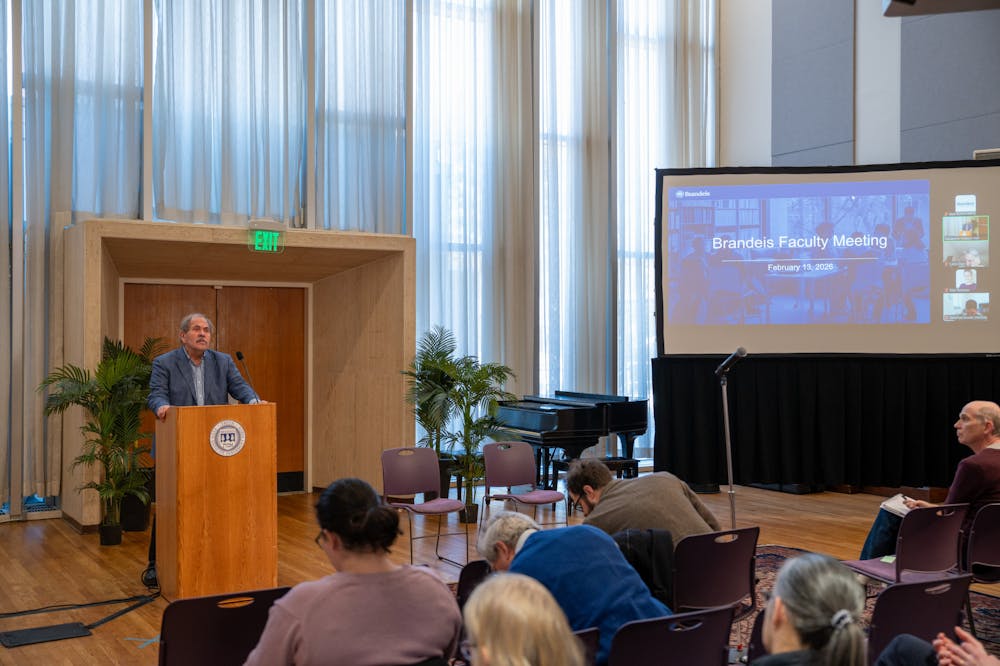
At 2 p.m. on Friday, Feb. 13, the faculty senate convened in Rapaporte Treasure Hall for their monthly meeting. Senate Chair Prof. Jeffrey Lenowitz (POL) noted during his opening remarks that the meeting was unusually populated. His opening remarks included other orders of business, such as reminders for faculty to order commencement regalia and an announcement that teaching award nominations are currently underway. He then asked for corrections to the minutes of the Dec. 5, 2025 meeting, of which there were none.
President Arthur Levine ’70 was invited to give remarks to start the meeting. He began by lauding the faculty’s support of the administration, as when he assumed his position as president, he was warned that faculty-administration relations were tenuous. Levine then spoke about the results of Brandeis’ early retirement program, sharing that it had been offered to 261 people, with 23% (61 people) taking advantage of the program. According to Levine, it could save the University as much as four million dollars per year. However, he added, it will lead to unequal vacancies, leaving a question about what to do in terms of staffing in the time ahead.
Levine then recounted the events of the most recent Board of Trustees meeting. He shared that Brandeis received more applications this year than any other year in the institution's history, which placed the number of applications up 40% from last year. He commended how the University has implemented Early Action to bolster applications, but that the program was only meant to account for a 20% increase in applications. Precisely which factor accounted for the other 20% remains unclear. Levine also announced, however, that Master’s program admissions are down by 50%, noting that this decrease in Master’s admission is currently a widespread problem.
Looking ahead, Levine hopes to focus on revitalizing graduate programs over the next 18 months. In his words, he wants to “look at what they [students] are, what they should be [and] what we would like them to become.” Before transitioning, he alluded to a study that is currently underway to help determine the future of graduate education at Brandeis.
The rest of Levine’s remarks were dedicated to Brandeis’ financial situation. According to him, the capital campaign is ahead of last year’s number, and things are “looking good” in terms of fundraising. Additionally, since the start of 2026, Brandeis has received four gifts totaling $48 million dollars. He also shared that, in an effort to counter the effects of smaller class sizes in recent years, the University will borrow $20 million dollars and has sold Brandeis property in New York City. With this plan, Levine claimed, enough revenue will be generated to prevent staffing cuts. He ended his remarks with a hopeful statement, saying that there is a lot of interest in what Brandeis is doing among other university presidents, and he hopes this will translate to fundraising and more student enrollment.
Levine then took questions about his remarks. One faculty member who did not introduce themself asked, “Given that the stock market did so well last year, did we have to draw from the endowment or did we do better than expected and are drawing less from the endowment?” Levine responded by saying that the University is currently taking 8% per year from the endowment and wants to reduce that number to 5%, though he believes that goal will be left to his successor.
Prof. Dan Perlman (ENVS) asked the next question and expressed concerns that changes to the general curriculum were being rushed. As he sees it, Brandeis could be bolder in creating an environment that will attract students. Levine responded by explaining that attitudes toward general education are volatile and “change every 20 years with the predictability of a metronome.” He continued, “I think it would be terrific if we could create the dream general ed[ucation] program, but that will take a lot of time.”
There were no more questions for Levine, so Lenowitz pushed ahead with the next order of business, which was about debating each of the meeting’s motions. He clarified that voting on full motions would happen electronically after the meeting as long as debate was formally closed during the meeting.
The first motion up for debate, introduced by Prof. Debarshi Nandy (BUS, ECON), concerned the creation of a new finance major. Nandy outlined the increase in demand for finance programs and pointed out that Brandeis was ranked in the top 50 in the country in 2023 despite the University not having an established finance program. Nandy has worked with the Undergraduate Curriculum Committee to curate “finance, technology and society” courses which include math, psychology, legal studies, history and sustainability classes. He strongly believes that a finance major would be a huge attraction for new students. Debate closed after nobody volunteered to speak on the motion.
The next motion directly concerned the Brandeis core and was introduced by Vice Provost of Undergraduate Affairs Jeffery Shoulson. It included a plethora of changes to the Brandeis Core, most of them relating to nomenclature and reorganization. Under the proposed motion, the “Foundational Literacies” requirement would be renamed to “Core Competencies,” while the “Digital Literacy” competency would be renamed to “Technologies” and have its learning goals updated. Similarly, the “Global Engagement” requirement would be renamed to “Global Engagement and Justice” and the learning goals would be updated, and the “Schools of Thought” requirement would be renamed to “Areas of Inquiry.” Its more substantive proposals included adding Teamwork and Collaboration as a new Core Competency with a one-course requirement. The motion also sought to eliminate all double-counting restrictions within the core curriculum, except for those pertaining to first year seminars and 10 and 20 level foreign language courses. Finally, the motion permitted students to take any two Health, Wellness, and Life Skills electives to fulfill the necessary requirement.
The motion previously included a proposition to reduce the three semester language requirement to two semesters. Changes to the language requirement were split into an individual motion to be debated after this one.
Before debating the motion, faculty were given a chance to ask for points of information.
Elena Gonzalez Ros (ROMS) asked “why are we being singled out?” In reference to the proposed language requirement changes being moved to a separate motion. She asked whether this change was to increase the chances of the other changes to the Brandeis core being passed. Shoulson confirmed that they did want the first motion to be passed, as the debate around the language requirement is more contentious and so it would be dealt with in a separate motion.
Prof. Ilana Szobel (NEJS) had a similar concern, stating that she found the decision to split the motion for a more favorable result to be "extremely immoral and unethical,” and advocated to keep the proposal as the faculty had worked on it previously. Shoulson responded by saying that it is very common to split motions in legislative bodies, and that he did not find it unethical or immoral to give special attention to the language requirement without disrupting other elements of the proposal.
On Zoom, a chat briefly flashed across the screen from Prof. Sue Lanser (ENG) asking why the language proposal wasn’t being discussed first. The question was not acknowledged in person.
Prof. John Plotz (ENG) asked if the motion would actually make substantive change. Shoulson responded by admitting that there weren’t many, the biggest changes being the addition of the teamworking competency and the nomenclature revisions.
Lenowitz then opened debate on the motion. Shoulson began with a pro stance, stating that it was important to explicitly say that students were gaining specific competencies from their liberal arts education. He added that students want more intensive learning experiences, necessitating the kind of streamlining that is being proposed by the motion.
Plotz countered, claiming that the language requirement had remained part of a separate motion so that it could become a scapegoat. He also brought up numerous objections made against the whole motion and claimed that crucial debate had not been heard. In his words, “this has not been a proper Brandeis process.” Plotz claimed the plan resembled Northeastern University's three-and-a-half year model, and believed it would be ineffective at Brandeis. He encouraged his fellow faculty members to vote no on the “whole kit and caboodle.”
The meeting continued with three points of information, the first coming from. Prof. Sacha Nelson (BIOL). Nelson asked how the competencies would be assessed and whether it was “just passing a course.” Shoulson responded that competencies should go beyond passing classes, though that wasn’t represented as much as the administration would have liked in this motion. He also mentioned microcredentials as indicators of competencies which will include additional assessments. Prof. Kristen Turpin (ROMS) asked for clarification on which language classes would be allowed to double-count for other competencies. Shoulson clarified that in this proposal, 20 and 30 level languages cannot count for other competencies. Prof. Gowri Vijayakumar (SOC, WGS) asked if proficiency was being defined in a different way, and if the motions being separated pertained to global engagement learning goals. Shoulson said that the question was related to the second motion, and that proficiency was deliberately left ambiguous.
Debate continued with a faculty member who did not introduce himself but was in support of the motion. He clarified that he would be supporting the first motion but not the second one, stating that in order for the University to make meaningful revisions that smaller proposals such as this one need to be made continuously. In his words, “I will vote for it, but with reservations.”
Pearlman then spoke against the motion. Continuing on his earlier statement, he based his opposition due to the opinion that the vote was rushed and that Brandeis could propose higher-quality reforms.
Next, Prof. Olamjumoke Yacob-Haliso (AAAS) spoke in favor of the moment. As a member of the working group who had been debating the proposal for months, she stated that she would be voting in favor with the understanding that the project is just the first in a series of votes that will be used to revise the Core. In her words, “I look forward to future improvements that will be even more groundbreaking.”
There was a brief pause to debate during which Prof. Aida Wong (FA, WGS) brought up a point of information, asking why environmental related competencies were not listed in this motion. Shoulson responded that Brandeis is simply not staffed for an environmental studies competency.
Debate was then restarted. Turpin suggested an amendment to allow 30-level languages to double count for two different core requirements, which passed by a majority vote.
Prof. Liz Hedstrom (BIOL, CHEM) then moved to close debate. The two-thirds threshold was reached and the movement was passed. Lauren Woods (FA) called a court of order, pointing out that there were people on Zoom who had been waiting to speak when the motion to close debate was put forward and did not believe that the call to close debate was in order.
Lenowitz decided to keep debate closed and move forward to the next motion. “Resolved, that the World Languages and Cultures requirement be amended to specify a proficiency level equivalent to one year of college-level study. Students will typically achieve this by successfully completing a second-semester course (normally numbered in the 20s) or demonstrating equivalent proficiency and knowledge acquired prior to Brandeis.” According to Shoulson, this change has already been adopted by other universities and is meant to lighten students’ academic loads.
The first speaker did not introduce themself and was in opposition to the motion. They explained that at one year of language learning, students are at a pre-communicative novice level. The 30 level at Brandeis provides the bare minimum for social interaction and is the lowest threshold at which language can become relevant globally. According to the speaker, the proposed motion would reduce the language requirement to a level that is only enough for students to get frustrated with the language.
Hedstrom then spoke in favor of the movement. She claimed that students should be able to choose what they want to pursue, and that there is a substantial opportunity cost for students who take three semesters of a language. Furthermore, she argued that students who are being forced to do something they don’t want to do will forget what they have learned anyway.
Prof. Catherine Theobald (ROMS) introduced her opposition to the motion by presenting statistics pertaining to the language requirement. Around 75% of Brandeis students take zero to one language classes and only 17% of students take three full semesters. Out of those who do take language courses, two-thirds of those students choose a new language to study. Theobald asked why, if flexibility is an issue, is the administration targeting one of the most flexible requirements? She also pointed out that reducing the language requirement causes a retention issue with language faculty who make an effort to provide extra enrichment for their students, saying that this motion would erode a special piece of liberal arts at Brandeis.
At approximately 3:30 p.m., the meeting’s posted end time, A motion was passed to extend debate to 3:40.
In favor was another faculty member who did not introduce themself. She brought up concern that some students in the sciences cannot explore other opportunities due to the language requirement. She also believed it was okay to teach language to a novice level.
A Classical Studies faculty member who did not introduce themself then spoke in opposition to the movement, claiming that language is culture and taking away the language requirement does a disservice to students. He stated that Brandeis should be defenders of language in a time of increased Artificial Intelligence use, and that language proficiency provides necessary ways for students to put themselves in the shoes of others. He also echoed the first speaker’s point that an intermediate level of language is the bare minimum for critical thinking and global citizenship.
Next, Prof. Sue Paradis (BIOL) spoke in favor of the motion. She spoke about her experience running a research lab and how she has noticed that no matter their major, her students are all doing work to become broadly educated citizens. She cites that some of her best students are also interested in humanities and arts in their own way. In her argument, Paradis brought up pre-health students who have to take on substantial additional coursework and stated that students should be given more of a choice to spend time as they want.
Prof. Aida Wong (FA) then spoke against the motion, pointing out that reducing the language requirement would be detrimental to community building. She quoted a recent article in The Justice that advocated for the retention of the current language program: “Many students go through their three semesters with the same peers in smaller classroom settings, fostering a sense of trust that is vital for anyone hoping to learn a language and retaining friendships through school breaks that strengthen bonds between language learners.”
After Wong’s statement, a motion was put forward to close debate. After the motion passed, the meeting was adjourned. Electronic ballots were sent to faculty members on Feb. 23 and the outcomes of the vote are unknown as of press time.
— Correction: An earlier version of this article misstated President Levine’s class year. It has since been updated to ‘70. Additionally, the original version misspelled Prof. Dan Perlman’s surname. It has since been fixed.

Please note All comments are eligible for publication in The Justice.