
A warmer campus
Students describe how seasonal changes affect campus life, from transportation to mental health.
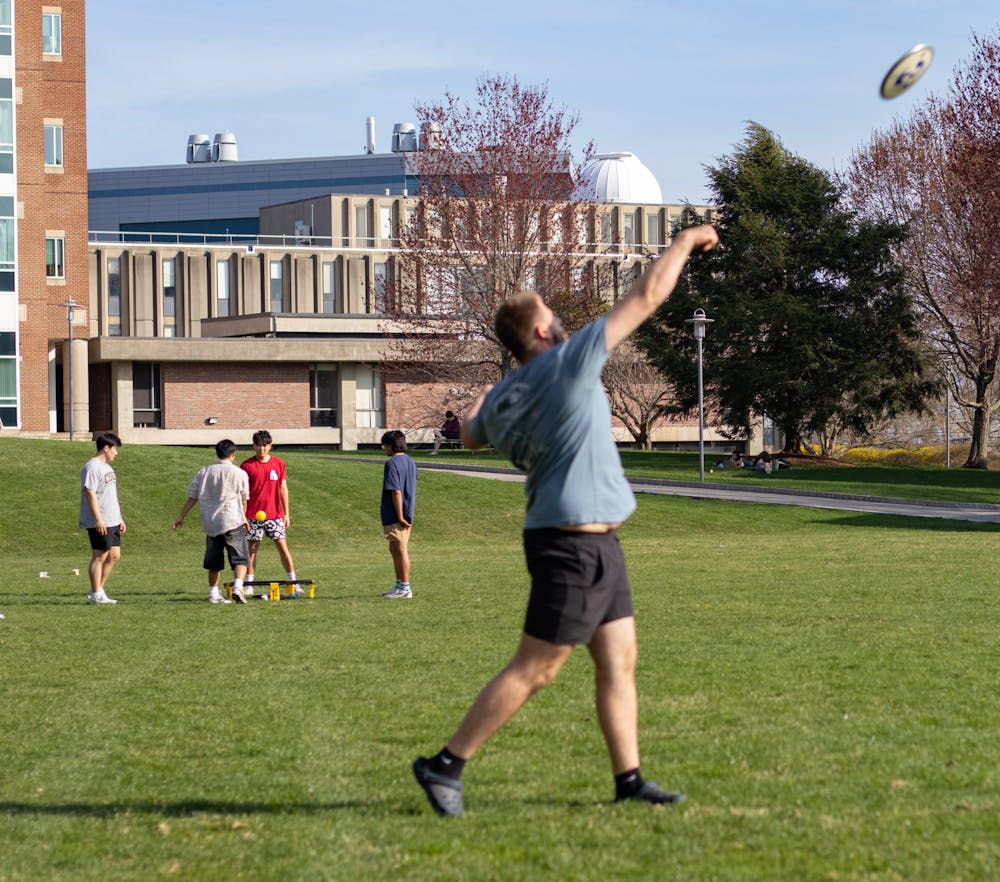
After months of cold weather, a short stretch of warm, sunny days brought Brandeis students outside in large numbers. People gathered on the grass, studied on benches and lingered in places that had sat empty during the winter. Campus immediately felt happier and more alive.
This contrast shows how much Boston’s weather influences the college experience at Brandeis. From social life and mental health to transportation and dining, the transition between winter and spring months can have a noticeable effect on students’ daily lives.
“I think I have a higher motivation when the weather is better since I get serotonin from the sunlight. I feel happier when it’s bright outside compared to when it’s gloomy with clouds,” Danwoo Song ’28 said in an April 19 interview with The Justice.
Students described a shift in productivity and energy depending on the weather. “On cold days, I just want to sleep, so the warm weather is a big change for me,” Jason Lam ’29 said in an April 17 interview with The Justice. He continued, “When it’s colder, I tend to be more sleepy so that means my productivity is very, very low. But when there’s sun, everything is just so nice, and I actually get motivated.”
That change is visible across campus. During warmer days, outdoor spaces that are often empty in the winter become active again. “A lot of [spaces are] usually empty when it’s snowing, because you cannot sit on the bench outside if there’s snow,” said Lam.
Daphne Lin ’29 pointed to an increase in student activity during better weather. “There’s fun sports and outdoor activities you can do,” Lin said in an April 17 interview with The Justice. She added that during a recent sunny day, more students participated in outdoor events. “A lot of people were able to join in, when it was raining, a lot of people chose to just head inside.”
Faculty members also notice the effects of weather on campus routines. “Attendance drops off, but only in really bad weather, storms just short of severity that calls for Brandeis closing,” Prof. Bernard Yack (POL) said in an April 20 interview with The Justice.
During cold weather, routines can become more difficult for many students. For off-campus students, transportation can be a challenge. “The shuttle can be unreliable, which is pretty annoying, especially if I have a test,” said Song. “I’m [usually] relying on the shuttle to appear at a certain time and if it doesn’t, I have to sprint to class.”
Commuting during storms can be difficult for faculty as well. “I commute to Brandeis on the train from Cambridge and in really bad storms trains get cancelled,” explained Yack. “Twice this term I’ve had to get an Uber to make it to Brandeis for class. But the worst is waiting two hours in the cold for a late train home. [The] commuter rail is normally very reliable, except in snowy weather, when delays and cancellations are common.”
Getting around campus on foot can also prove to be difficult. Lam said adjusting to winter conditions has been especially challenging in light of a new environment. “It’s my first year in a cold place. I’m originally from Hong Kong, so the weather there is very different,” explained Lam. “I slip all the time.”
Dining access is another area affected by the weather, with many on-campus dining options shutting down in the snow. “I live in North Quad, so having to walk all the way to Sherman [Dining Hall] when other dining [halls] are closed can be hard in the snow,” said Lin. “I have to walk through all of the snow, and I remember it was literally piled up to my knees. My roommate and I had to trek through snow for 10 minutes to get food.”
Beyond logistical challenges, students also described the emotional toll prolonged cloudy weather can have. Lin said the lack of sunlight has had a noticeable impact on her mood and productivity. “It really just makes me a little bit depressed. It affects my mood and my motivation to work,” said Lin.
Lin’s experience is supported by wider research. Seasonal affective disorder, often referred to as seasonal depression, is a form of depression linked to changes in seasons, typically beginning in late fall and continuing through the winter months when daylight is limited. Reduced sunlight can affect levels of serotonin, a chemical that influences mood and disrupts the body’s internal clock, both of which can contribute to depressive symptoms.
Studies have also found that increased exposure to natural light is associated with improved mood and lower rates of depression. These effects can be especially pronounced in regions like Massachusetts, where winter days are shorter and often overcast.
To support students through these challenges, Brandeis offers several mental health and wellness resources. Leah Berkenwald, director of Health Promotion and Wellness Initiatives, said seasonal changes can have a substantial impact on student well-being. “I’m sure you’ve heard of seasonal affective disorder, which is sometimes just called seasonal depression. Sometimes people abbreviate it to SAD,” Berkenwald said in an April 20 interview with The Justice. “That can definitely have an impact on people’s mood and mental health,” said Berkenwald in a post-interview statement.
Berkenwald explained that while cold temperatures and snow can disrupt daily routines, the underlying issue is often the reduction in sunlight and vitamin D exposure. “Weather like snow and ice can also just create a lot of stress in people’s day-to-day life, [making] it harder to get to school, get to work,” she said. “But it’s the lack of daylight that’s been studied in connection to depression,” said Berkenwald.
One resource available to students is light therapy boxes, which can be borrowed from the library. These devices imitate natural sunlight and are designed to help regulate mood and energy levels. “They are really bright lights that mimic the natural sun,” Berkenwald said. “There is some evidence that suggests if you spend some time with those, it can help kind of boost your vitamin D the same way having more sunlight time would.”
In addition to light therapy, Berkenwald emphasized the importance of maintaining daily routines. “Reach out to your loved ones, friends who care to connect, and have real conversations,” she said. “Make sure you’re getting rest. Make sure you’re eating food that nourishes you.” She also noted that mindfulness practices and counseling can be helpful for some students.
Berkenwald encouraged students to find ways to engage with the season, even when the weather is not ideal. “If you can find a way to embrace winter and the outdoors during the winter, that’s going to get you more sunlight,” she said. She also suggested creating a sense of comfort indoors, such as spending time with friends or enjoying a more relaxed environment during the cold months.
She explained that students experiencing these changes are not alone. “If you start to feel a little down in the darkest winter months, just know that you’re not alone and it’s situational,” Berkenwald said. “It is something temporary.”
Outside of campus resources, students can also build small habits to manage the effects of seasonal changes. Keeping a consistent sleep schedule, spending time near windows during daylight hours, staying physically active and maintaining social connections can all help support mental well-being during the winter months.
While many students experience challenges with the weather, some see it as an important part of college life. “When it’s snowing, it’s kind of nice, and you get to experience it with your roommates,” Song said.
Lam expressed a similar perspective. “It’s part of the experience, because I never [saw] snow in my life before I [came] here,” he said. “I wanted to experience something I’ve never experienced before. Overall, it’s been a good experience.”
The weather remains a defining part of campus life, especially for students coming from warmer climates. While the cold and gray months can be difficult, they can also bring new experiences and opportunities for Brandeis students.
Correction: An earlier version of this article incorrectly wrote "a April 17 interview," "a April 19 interview" and "a April 20 interview." It has been corrected to "an April 17 interview," "an April 19 interview" and "an April 20 interview."

Please note All comments are eligible for publication in The Justice.