
Brandeis community reflects on antisemitism and campus support
As incidents of antisemitism are on the rise globally, Brandeis community members reflected on campus climate, safety and community support.
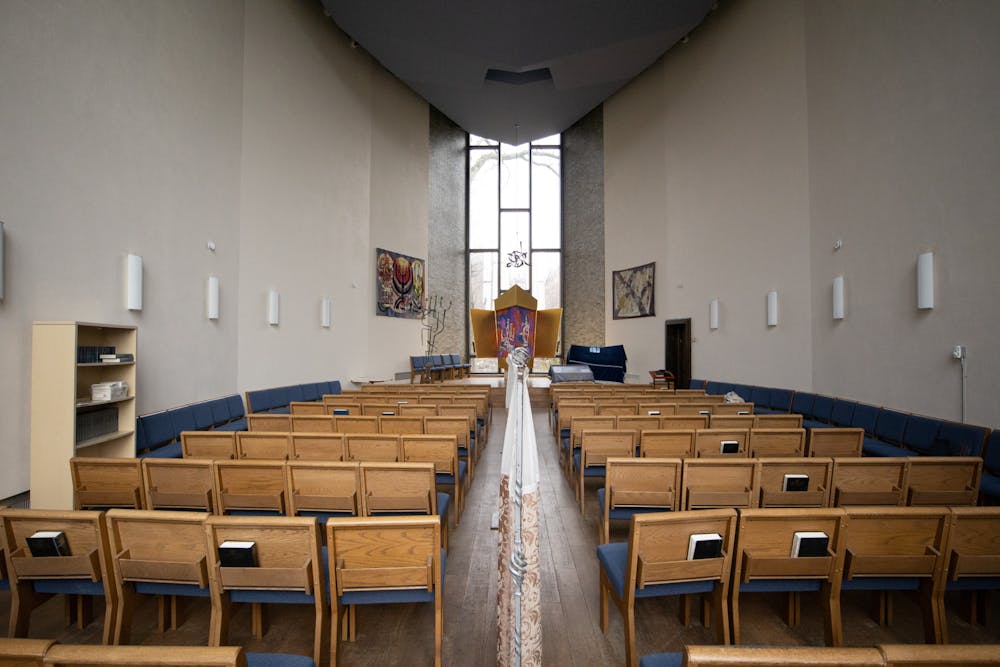
On March 12, an unidentified suspect drove a vehicle into Temple Israel in West Bloomfield, Michigan, causing the building to catch fire, and sparking fear within the Jewish community. Just over a week later, on March 23, ambulances of a Jewish volunteer rescue organization were set on fire in front of a synagogue in London. A recent report from the American Jewish Committee showed that in 2025, “two-thirds of American Jews surveyed report that Jews in the U.S. are less secure than a year ago.” As incidents of antisemitism are on the rise globally, students, staff and faculty members reflect on how antisemitism has been addressed in academic spaces along with how Brandeis supports the Jewish community.
According to the International Holocaust Remembrance Alliance, antisemitism can be defined as “a certain perception of Jews, which may be expressed as hatred toward Jews.” In 1948, Brandeis was founded as a nonsectarian university by the American Jewish community and has been committed to social justice as well as diversity in higher education. Brandeis Hillel, the University’s largest Jewish organization, is working to provide students with safe and inclusive spaces amidst a time of heightened tension. To inform this article, members of Hillel shared their perspective on the recent incidents of antisemitism around the world.
In a March 20 written statement to The Justice, Hillel Student Board President Ollie Small ’28 said that “recent incidents of antisemitism around the world have been disheartening for the Jewish community.” They added that Hillel is working hard to provide students with accessible resources. Despite students' fears, Small said that increasing antisemitism has brought the Jewish community closer together.
Hillel Student Board Vice President, Coco Trentalancia '27, also shared her perspective on the issue. In a March 19 written statement to The Justice, Trentalancia explained that recent incidents of antisemitism have been challenging for the Jewish community. “Based on the recent incidents of antisemitism, I have certainly felt more paranoid and scared for the safety of myself and my Hillel community (both students and staff),” Trentalancia shared.
Trentalancia also said she is grateful because she feels safe and supported by “the amazing Hillel community.” During Shabbat dinners, public safety personnel are present to ensure students' safety. Additionally, she believes the Hillel staff is always open to conversations and is dedicated to their work. When asked about what she wished more people understood about antisemitism, Trentalancia shared that she wished students understood that it can come in many shapes, such as “through stereotypes, jokes, etc. that subtly reinforce prejudice.”
To better understand how Hillel supports students, Rabbi Seth Winberg, Hillel’s executive director, explained how the group is working to provide resources to students. In a March 19 written statement to The Justice, Winberg said that Hillel works closely with Brandeis Public Safety alongside other local and national partners to ensure the safety of the University’s community. On March 16, Hillel hosted a security and safety training open to the public. The event was held in partnership with Public Safety and the Jewish Federation of Greater Boston. The meeting consisted mainly of situational awareness training.
Additionally, Winberg explained that Hillel offers “support through programming, through Shabbat and holidays, through one-on-one conversations, [and] space for students to make sense of what's happening in the world.” He also supported Trentalancia’s words that antisemitism can take different forms and that one of them is speech.
“Antisemitic violence follows antisemitic speech. This is real and serious, and it has been building. Rhetoric that delegitimizes or dehumanizes shifts what is considered acceptable speech, and Jews feel that shift,” Winberg reported.
In addition to Hillel’s efforts, Brandeis Public Safety has also taken steps to address safety concerns on campus. In a March 23 written statement to The Justice, the Interim Associate Vice President for Public Safety and Campus Operations, Matthew Rushton, said that the safety of the Brandeis community is taken seriously every day and is a “top priority.” He also explained that the University’s efforts are ongoing and not limited to specific events. The University has been partnering with federal, state and local law enforcement, as well as campus partners, to monitor threats and ensure safety.
“The Brandeis University Police Department works closely with federal, state, and local law enforcement partners, including the FBI and local fusion centers, to monitor threats and share information. We conduct regular assessments of our campus environment and adjust our operations based on current intelligence. We also work closely with campus partners through our CARE Team and Behavioral Threat Assessment and Management processes, which help us identify and address concerns before they escalate,” Rushton reported.
Additionally, Rushton said that Brandeis Public Safety is working closely with student life and campus leadership to meaningfully support students. He also directed the Brandeis community to the University’s website for more information about the available training programs.
To receive mental health support in light of incidents related to antisemitism, the Brandeis Counseling Center is another valuable resource available to students. Hillel works closely with the Counseling Center to ensure the well-being and safety of the Brandeis community. Julia Horvitz, BCC Community Therapist to Brandeis Hillel, provided insights into the impact that cases of antisemitism have had on college campuses.
In a March 20 written statement to The Justice, Horvitz said that “recent antisemitism is linked with reduced feelings of safety, more hiding of identity, strained relationships, academic discomfort and worse mental health, especially for Jewish identifying students.” Horvitz provided a list of resources available to Jewish and non-Jewish students who may have been affected by recent events, including the Center for Spiritual Life, BCC Community Therapists, BCC Urgent Care and Hillel’s events.
Another event held on campus in February 2025 was the discussion called “Safety through Solidarity: A Radical Guide to Antisemitism,” moderated by Prof. Sarah Mayorga (SOC). In a March 19 written statement to The Justice, she explained how the framework of “safety through solidarity” applies to recent incidents of antisemitism.
“Safety through solidarity invites us — Jewish and non-Jewish alike — to focus on the interconnected aspects of global fights for justice. It invites us to understand the distinctiveness of Jewish marginalization, exploitation, and devaluation while simultaneously identifying its ties to other forms of oppression. For example, Ben Lorber and Shane Burley, who we invited to speak on campus last year, point to the importance of understanding white Christian nationalism to map the ties between antisemitism, antiblackness, homophobia, Islamophobia, and anti-immigrant sentiments,” she said.
Prof. Mayorga reported that Brandeis events focused on “safety through solidarity” are crucial today, as they demonstrate the University’s commitment to social justice. In an effort to host similar events, Mayorga said that she and Prof. Ulka Anjaria (ENG) are hosting a seminar series next year titled “Rethinking Safety/Remaking the University,” open to all Brandeis faculty, students and staff.
Another resource available for students to educate themselves on the topic of antisemitism is the Hadassah Brandeis Institute. This on-campus institution researches antisemitism, specifically at the intersection of antisemitism and gender. Dr. Lisa Joffe, the Shulamit Reinharz Director of the Hadassah-Brandeis Institute, elaborated on the institute's work in a March 19 interview with The Justice. Dr. Joffe spoke about two recent events hosted and currently being hosted at the Hadassah-Brandeis Institute — the Diane Markowicz Memorial Lecture on Gender and Human Rights and the exhibition called “Who Will Draw Our History? Women’s Graphic Narratives of the Holocaust, 1944-1949.”
The annual lecture on gender and human rights, delivered on March 8 by Pamela S. Nadell, the Patrick Clendenen Chair in Women’s and Gender History at American University, focused on women’s experiences of antisemitism. “So what she did, both in her book, which is called ‘Antisemitism: an American Tradition’ and in the lecture, was to trace the particular experiences that women have had grappling with antisemitism — how they were subjected to discrimination in the 20th century,” Dr. Joffe said.
Another event focusing on combating antisemitism is a current exhibition about women’s graphic memoirs created between 1944 and 1949, illustrating their experiences during the Holocaust. Dr. Joffe reported that the diverse experiences show certain patterns about how women’s experiences differed from those of men during the Holocaust.
“The curator, Dr. Rachel Perry, has identified that many of these narratives focus on the experience, the trauma of women being separated from their children. Another theme that emerges is sexual violence that occurred against women in the camps and in other contexts that might not be talked about in narratives written by people who are not women,” she said.
To better understand contemporary antisemitism and Jewish stereotypes, Dr. Samantha Pickette, an assistant director of Hillel, provided written quotes to The Justice in a March 19 email. Dr. Pickette explained that Jewish stereotypes tend to contribute to the spread of antisemitism by portraying Jewish people as fundamentally different from others.
“All of these ideas are steeped in centuries-old antisemitic tropes used to dehumanize Jews and separate them from the rest of society by pointing out their differences — differences that were and are imagined, rooted in a desire to single Jews out rather than motivated by any kind of historical or social truth,” she wrote.
Dr. Pickette also explained that contemporary antisemitism is not new, but rather draws from century-old ideas that are now easily spread on social media. She implored people to be cautious about what they read on social media, as online platforms can accelerate the spread of misinformation. “And the ‘soft antisemitism’ often found in media portrayals of Jewish life can diminish the nuance and humanity of Jewish identity in a way that further exacerbates the tropes perpetuated by hardened antisemites online,” Dr. Pickette reported.
As concerns about antisemitism continue, students, faculty and staff at Brandeis highlight the importance of safety measures, community building and shared support on campus while learning to navigate these challenges together.

Please note All comments are eligible for publication in The Justice.