
JOE FARBEANN: Right-wing attacks on the liberal arts: Standardized testing will hurt colleges
Taking standardized tests was an inconvenience in 4th grade, a hassle in 6th and an utter waste of time by 9th. The only good thing about the government-mandated tests taken by most of our generation was that they were over with sometime during high school, at which point we were able to escape boring classes geared toward passing those exams, and pursue more interesting and diverse subjects. By college, standardized tests were nothing but a distant memory. Surely, we'd never again have to prove we'd learned the correct things in the eyes of the state.Sadly, that assumption turned out to be as true as "Never again will we allow genocide to happen on our watch" and "Never again will we get stuck in a quagmire against a popular insurgency."
Last week, Secretary of Education Margaret Spellings promised to "reform" higher education. Part of the Bush administration's plan is to introduce
standardized testing in public universities, and then create a database ranking and evaluating schools based on the results. Spellings says this plan will achieve more accountability, extending the federal government's reach into higher education in the same way that No Child Left Behind did with K-12 education. She argues that a testing regimen is necessary to keep American colleges on par with European and Asian schools in the wake of studies showing a decline in U.S. global competitiveness in higher education.
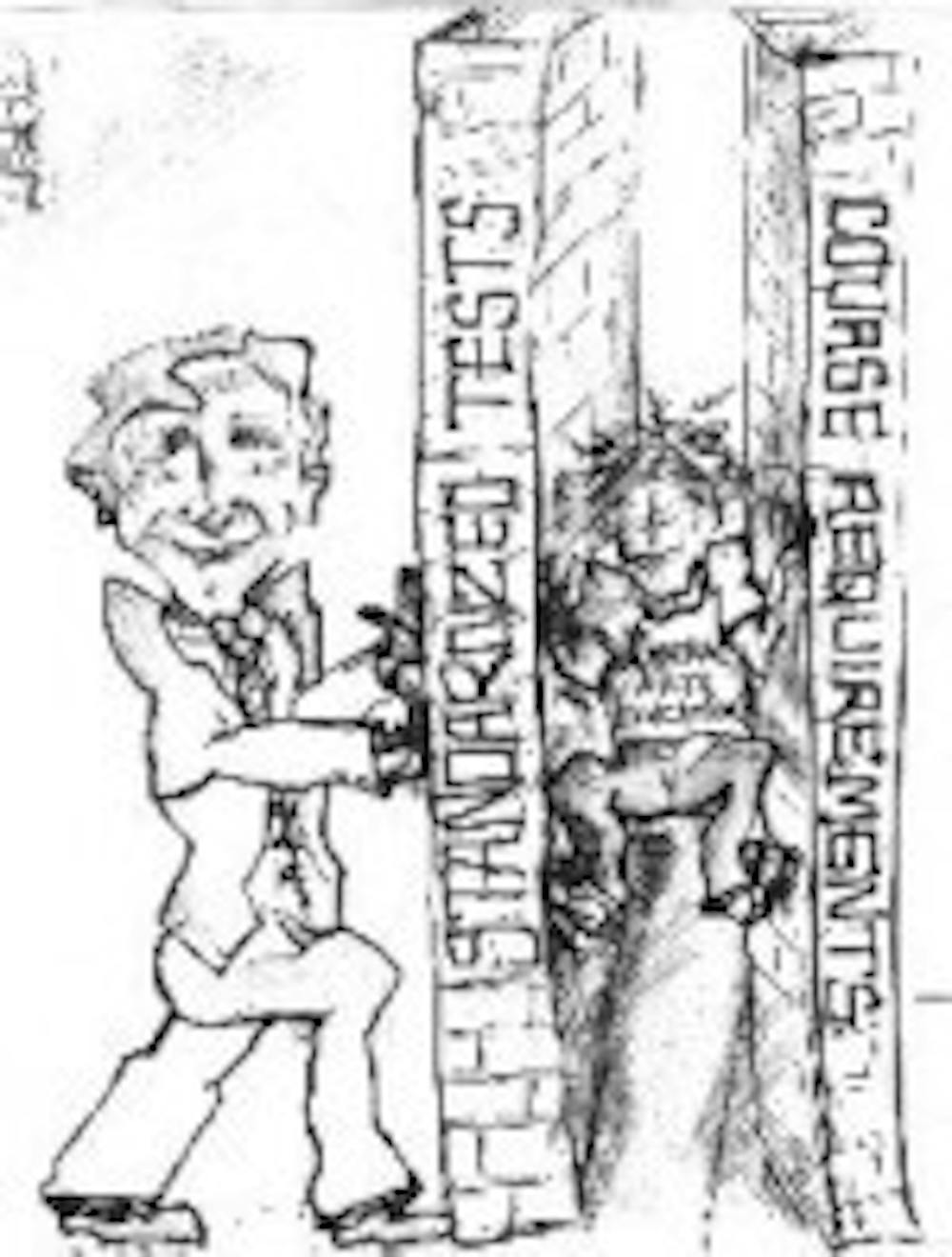
The absurdity of the plan is quite striking. Grade school tests measure basic progress in reading and mathematics, but how can a test go about evaluating college students? After all, it would be difficult and misleading to attempt to judge a chemistry major and a theater major by the same test. Such a program would likely cause colleges to narrow their curricula, cutting interesting, specialized programs in favor of general education courses that would prepare students for the test. Instead of taking a wide array of classes,
college students could find themselves stuck in survey courses designed to equip them to pass a test. But why let college students choose what they want to study when Big Brother can do it just as well?
In seeking to apply the principles of No Child Left Behind to colleges, the Bush administration is trying to expand a failed program. The increased standardized testing and increased federal intrusion into K-12 education represented by that law has caused such an outcry that 47 states have either challenged it or are considering doing so. Across geographical and ideological spectrums, there is an agreement that the federally mandated tests are a failure. The conservative state legislature in Utah passed an act instructing school districts to ignore certain portions of No Child Left Behind, and the liberal legislature of Connecticut has challenged it in court. Why take a policy that has caused uproar in grade schools and use it in the even less appropriate environment of universities?
If the Bush administration is serious about improving higher education, it should seek to make it more affordable and accessible to all citizens. But while the cost of education continues to skyrocket, the Bush administration has taken crucial Pell Grants away from 81,000 students and reduced the size of the awards for another 500,000.
As working Americans find it increasingly difficult to send their kids to college, the Bush administration is ignoring their plight in favor of spending $2 billion a week in Iraq and cutting taxes. When pressed to improve higher education in response to competition from Asian and European universities, the administration offers only the failed idea of standardized tests. International schools do not thrive due to standardized tests, however, but instead succeed by charging students significantly less tuition than American schools, attracting bright and promising students from all economic classes. The administration's plan for "reform" is a bad idea for currently enrolled students and it does nothing to help those who are trying to find the money to attend college.

Please note All comments are eligible for publication in The Justice.