
Fall 2026 course registration: trends, concerns and advice for students
As fall 2026 course registration is ongoing, Brandeis faculty, staff and students share their thoughts on course offerings, trends and concerns.
On April 22, early course registration for fall 2026 officially opened, which allowed undergraduate students to build next semester’s schedule. Early registration remains open until May 10, allowing students to continue choosing which classes to take. However, many have already reported being waitlisted for their preferred classes.
To inform this article, a small-scale survey was conducted by The Justice to provide insight into how Brandeis undergraduates felt about fall 2026 course registration and offerings. As of press time, the survey received 35 responses from Brandeis students, of which 49% were third-years, 37% were sophomores and 14% were first-years. Among the respondents, the most popular majors were Business, Politics, Biology and Psychology, with Legal Studies and Studio Arts being the most common minors, suggesting a variety of perspectives.
74% of respondents also reported taking language courses at Brandeis, including Spanish, Hebrew, French, Chinese and Italian, with Spanish being the most popular. The answers suggest student interest in taking a variety of languages, regardless of their majors and minors.
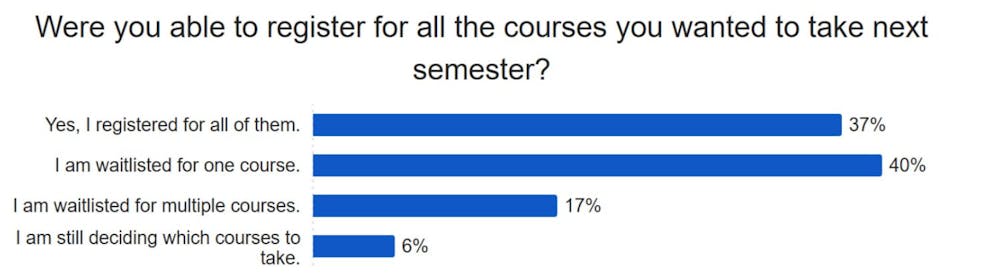
Since the opening of early registration for fall 2026, 37% of respondents were able to register for all their desired courses, while 57% of students were waitlisted for one or more courses and 6% are still deciding which courses to take. Most of the students who reported being waitlisted for multiple courses are majoring in Biology, Business and Neuroscience, while most of the students who are waitlisted for only one course are majoring in Psychology. The results indicate that these departments have high demand and some classes might be small in size, unable to accommodate all students.
To better understand which classes are most popular in different departments and the struggles students face during registration, The Justice reached out to Brandeis faculty and advisors. In an April 24 written statement to The Justice, academic advisor Tim Brown shared that there has been an increased popularity for Engineering, Health: Science, Society and Policy and machine learning-related courses. There has also been a growing interest in courses related to the new majors that will launch in fall 2026 at Brandeis — Quantitative Economics, Communication and Media Studies as well as Philosophy, Politics and Economics.
As the course registration period can be stressful, Brown offered some advice to students. “When registering for your courses, it's important to prioritize a balance for yourself, and that can look different from person to person. Maybe it's keeping in touch with courses that feel important to your current or emerging interests outside of your major/minor. Maybe it's planning a schedule that provides gaps in the day if you work best that way. Maybe it's taking a class or two with some friends so that you can support each other in the shared classroom experience,” he stated.
Roosevelt Fellows, a trained group of junior and senior peer academic advisors, are another helpful resource for students. Greg Roitbourd ’26, a Roosevelt Fellow, shared some of their observations for the fall 2026 registration period. In an April 24 interview with The Justice, they said that some departments tend to fill up more quickly than others, including Psychology, Biology and Neuroscience. Roitbourd also reported that some students have been “unable to fulfill requirements that they need,” especially when there aren’t enough course offerings.
“For example, in the Environmental Studies department, there were a lot of classes that were cut … or in the Film department, both of those are key examples of this. But sometimes there are not enough classes for students to be able to complete a major, and so they are not able to take the class they want to take,” they said.
Roitbourd shared that taking summer classes or classes at universities that partner with Brandeis has been helpful for students facing these challenges. They also gave some advice to students who are currently in the registration process.
“Of course, you don’t know what classes are gonna be offered in the next three years, even if they say they are gonna be offered for three years, but you can try to make educated guesses based off of trends in past course years, talking with your advisors, since we do know all these things and we need to talk about them often and we have a bunch of resources available for you to take use of,” Roitbourd explained.
They also recommended talking to the undergraduate departmental representatives and the undergraduate advising head, all of whom can help with course selection.
Professors from different departments also provided their observations on fall 2026 course registration and advice for students. In an April 24 interview with The Justice, Prof. Dylan Cashman (COSI), Assistant Professor of Computer Science, said that machine learning classes have become increasingly popular over the last decade. In the fall, he will teach COSI 165B: Deep Learning.
Prof. Cashman reported that the Computer Science department has been trying to incorporate Artificial Intelligence into existing courses, rather than creating an entire set of new classes designed around it. There have also been discussions about offering more AI-related courses. On a broader level, the University currently offers an online microcredential, “AI Fundamentals for STEM Professionals,” that enables STEM professionals to learn more about AI and its real-world applications.
“Machine learning changes over time. AI changes over time. And so we are looking to offer courses in the design of the types of models that are driving text-based, agentic AI. We already touched on those in some of the courses, but maybe the course itself didn’t completely focus on it. And so we are exploring having courses like that, and we are also hoping to grow that within our faculty expertise,” Prof. Cashman explained.
However, he also emphasized the importance of students learning the fundamentals and theory, and noted that technology trends change over time. “We want to make sure that we go through the process of learning, computational thinking, learning how to program, even though the tool can give you the answers,” Prof. Cashman said.
Business is another popular program among Brandeis undergraduate students. In an April 24 written statement to The Justice, Prof. Daniel Bergstresser (BUS), Chair of the Undergraduate Business Program and Associate Professor of Finance, shared that there has been strong interest in business and finance courses. He noted that BUS 47A: Business Communication has extremely high demand. Core courses, such as BUS 6A: Financial Accounting and BUS 10A: Business Fundamentals, are also very popular among students.
As courses have started to fill up, Prof. Bergstresser reassured students that the department is working hard to help everyone complete their requirements on time. “Be patient. We use waiting lists to manage the course enrollment process, and we do this to make sure that graduating seniors get the courses they need in order to graduate on time. So the system works, but it always requires some patience as we go through and open up the course waitlist and make sure students can get the courses they need to graduate and graduate on time,” he said.
The Politics department also shared insights into which classes have been in the highest demand and which topics students are interested in learning more about. In an April 24 interview with The Justice, Prof. Jill Greenlee (POL), the Chair of the Politics Department, noted that it’s hard to identify any trends right now, as many factors contribute to which classes have the highest demand, including the teaching faculty and student interests. She mentioned that students’ interest in politics classes can shift in response to current political events.
“Sometimes what shapes students [is] … when courses connect with things that are happening in the real world, that could be really motivating, unless what’s happening in the real world is worrying or discouraging or depressing, and then, they maybe don’t want to spend all of their intellectual energy focused on those things. That’s just my own observation,” Prof. Greenlee explained.
She also noted that some students might be discouraged from signing up for classes because they think they need a certain level of background knowledge or expertise. However, Prof. Greenlee explained that students “do not have to know a lot or know anything to be a part of the class,” they only need to be open minded and do the work. She also shared that Brandeis students tend to be politically active, and there are a lot of “engaged students now.”
When it comes to classes, Prof. Greenlee mentioned that American politics courses during an election year are extremely relevant as well as helpful. However, as the world is dynamic, she also emphasized that “all political classes are relevant all the time” for students to take.
In the small-scale survey, students were also able to report their favorite classes at Brandeis and classes they wished were offered in the fall. Some courses that respondents recommend taking and are offered in fall 2026 were BIOL 16A: Evolution and Biodiversity, PHIL 1A: Introduction to Philosophy, AMST/JOUR 137B: Journalism in Modern America, POL 164A: Seminar: Arabs and Israelis: Conflict and Peacemaking and AAAS/WGS 122A: Carceral Studies.
Respondents also shared about classes they wished they saw in the fall 2026 offerings. Some students expressed their desire to see more Environmental Studies and HSSP class offerings. There were also responses requesting specific classes, such as Anatomy, Sociology: Family, Kinship and Sexuality, Business Law and a legal studies class on the creation of the Massachusetts Constitution. Some students expressed concerns about the lack of class sections.
“[I wanted] a second section of Hebrew 30. Our class has 30 students when it should only have 15,” a student reported.
As registration is still ongoing, student leaders, faculty and staff work together to ensure that students register for classes they want and need. Early registration remains open until May 10, and general registration will reopen on July 17, when students will be able to add, change or drop classes from their fall 2026 course schedules.
Correction: An earlier version of this article incorrectly spelled "Prof. Greenless." It was corrected to "Prof. Greenlee."


Please note All comments are eligible for publication in The Justice.