
Following February fire, Sherman's closure reshapes dining experience on campus
In light of the uncertainty surrounding the Sherman Dining Hall’s re-opening, students report how their daily routines have been significantly disrupted.
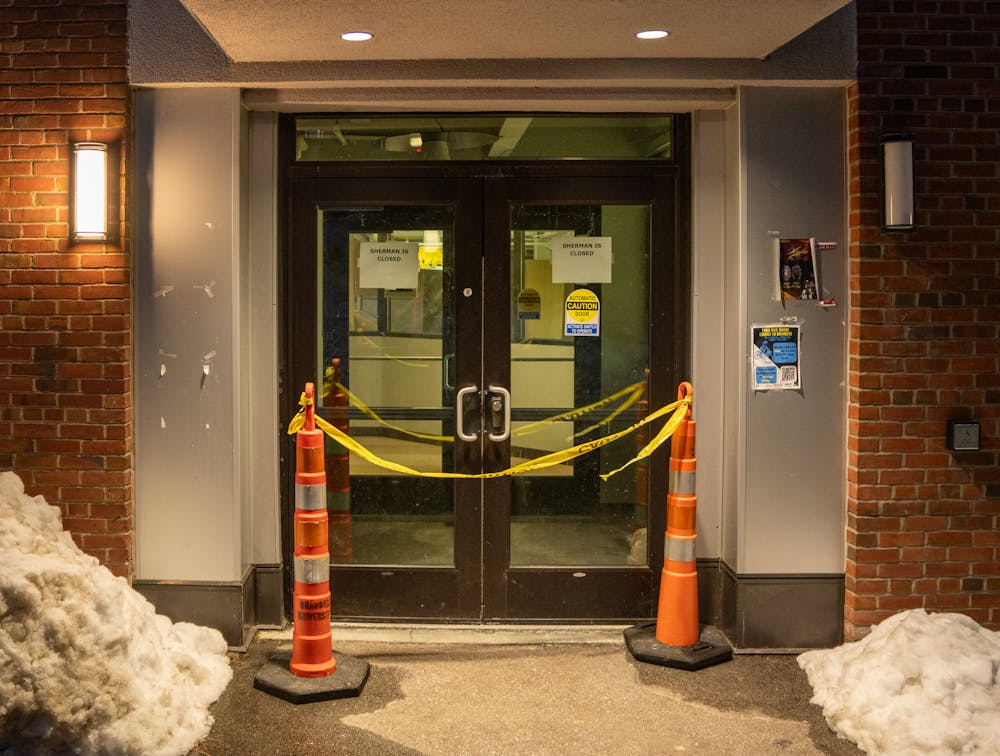
More than a month after Sherman Dining Hall’s Feb. 2 closure, students reported overcrowding, limited food options and accessibility challenges, as Usdan Kitchen serves as the main dining hall on campus. To better understand the impact of this situation, The Justice conducted a survey between Feb. 18 and Feb. 27 to reflect students’ experiences during this time.
The Sherman-Hassenfeld building closed its doors after students received a Brandeis Alert about “ongoing fire activity.” However, students have faced various challenges during the past month, including but not limited to their ability to reach Usdan, finding available food options and finding seating. As of press time, the University has not announced Sherman’s reopening date nor provided details regarding the extent of the damages caused. The Vice President of Student Affairs, Andrea Dine, in a Feb. 24 written statement to The Justice, reassured students that “the current two-location model is both sustainable and flexible as Sherman Dining Hall and Hassenfeld Conference Center repairs continue.” After attempting to contact the Hospitality Manager Alan Meyer, the Hospitality Director of Sherman Omar Zouak, the Guest Experience Manager Craig Foster and the Hospitality Director of Usdan Ashley Weaver for a quote, The Justice has not received a response. Additionally, a request for comment to the University’s media relations team has not been answered.
On Feb. 22, the Faculty Club opened to provide full-time kosher dining options in lieu of Sherman’s closure. Before the Faculty Club opened, Louis’ Deli served as the primary kosher dining option, as well as limited offerings from a designated kosher table in Usdan.
The Justice’s survey received 117 anonymous responses from Brandeis undergraduate and graduate students. 31% of the respondents were sophomores, 23% juniors, 21% seniors, 21% first-year students and 4% graduate students. This variety provided a balanced mix of perspectives from the student body.
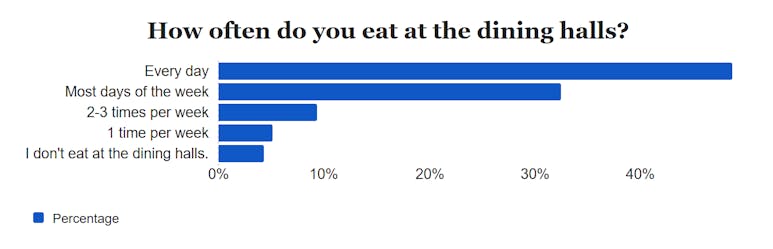
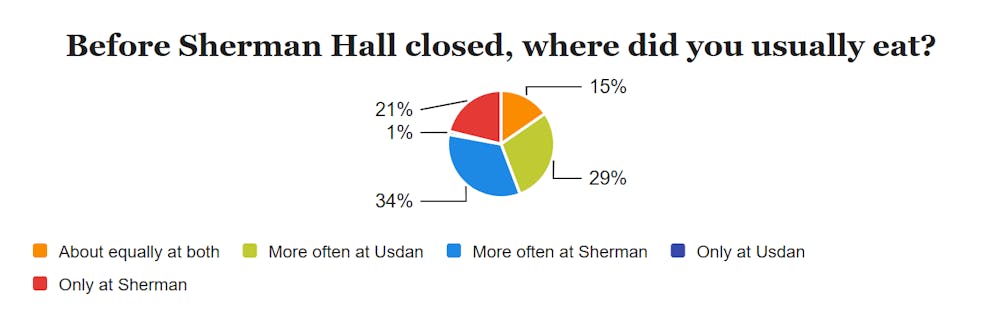
To better understand the level to which respondents were affected by the issue, the survey asked students to share how often they usually eat at the dining halls and which of the two they frequented before Sherman’s closure (Figure 1). 49% of the respondents eat at the dining halls every day and 32% eat there most days of the week. When it came to respondents’ dining hall preferences, 34% of students reported going more often to Sherman, while 29% ate more often at Usdan. 21% of respondents said that they only ate at Sherman. Consequently, the data suggest that these students were significantly affected by Sherman’s closure.
Respondents also reported a range of dietary restrictions. Some of the most common ones include kosher and halal diets, allergies, lactose intolerance, celiac disease and vegetarianism. The diverse answers reflect students’ various needs on campus, which the dining halls are expected to meet. As there is one main functional dining hall at the moment, it is critical that the University accommodates all students' dietary needs. “It has made it almost impossible to eat at the dining halls with my dietary restrictions and Sherman being closed,” a student reported.
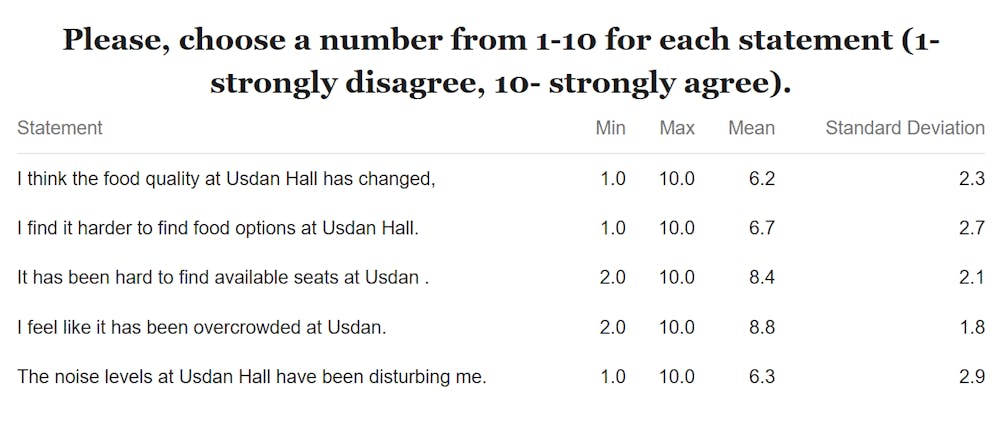
Responses revealed mixed opinions about students’ experiences in Usdan since the beginning of the month, with scores ranging from one to 10 (one being “strongly disagree” and 10 being “strongly agree”). 72% of respondents completed this part of the survey, which presented statements for students to rate (Figure 2). The statement “I think the food quality at Usdan Hall has changed” had an average score of over six points, indicating that many students have perceived change in food quality since Sherman’s closure. The answers to the open-ended questions presented in the next section suggest that many students view these changes negatively. Additionally, the statements “It has been hard to find available seats at Usdan” and “I feel like it has been overcrowded at Usdan” had the highest scores, exceeding eight points. The results suggest that respondents’ experiences have been mostly negative — a challenge that the University has to overcome.
The survey’s open-ended question asked respondents how they have been personally affected by Sherman’s closure. Almost all respondents reported that their recent weeks on campus have been challenging. According to their responses, more than 10 students reported being forced to eat smaller meals due to limited food options or food running out, while some have skipped meals and gone hungry. “I have sensory issues with food, and so having variety and options on campus between the two dining halls helps me a lot. Sherman being closed limits my options, and if Usdan doesn’t have any safe foods for me, I usually just skip a meal now,” a student shared.
Another student also noted that “since the closure of Sherman, our dining options have been (understandably) limited, which often means having the same three chicken/pasta/pizza options for meals.” These responses raise serious concerns about food accessibility during the closure.
Students also reported being disappointed by the reduced food options available, as they expected more given the cost of their meal plans. “We pay so much money for dining plans, and it’s been upsetting to have only one dining hall—far away from where I live—open,” a student said. Respondents have also had trouble reaching Usdan, especially given the severe winter weather. This raises concerns over the accessibility of the dining hall among students with limited mobility.
“I’m a disabled student who lives on lower campus (Ziv/Ridge/Village area). I cannot get up to Usdan unless there’s a shuttle running when I need it, which isn’t often. Getting to Sherm is annoying but doable. I have access to a kitchen, which is the only way I’ve been getting any food over break,” a student shared. Many respondents also stated that they had to order takeout and buy groceries, which required them to spend extra money in the last few weeks. In the survey, students used words such as “miserable,” “extremely frustrating” and “inconvenient” to describe their dining experience.
As the survey results suggest, there is significant strain on campus dining services, and students expect to see changes to their dining experience. In a Feb. 24 email sent to students by Associate Vice President, Campus Services, Susan Scannell, the University shared that students should expect to “experience shorter wait times with better queuing for dining stations.” Additionally, the Brandeis community should expect changes to Usdan Kitchen’s menu that will include expanded food options and more available seating. The Faculty Club is also available to all students, faculty and staff who wish to have kosher dining. Students with specific dietary requirements that Usdan is not currently meeting are encouraged to contact the Health and Wellbeing Manager, Nicole Zapherson, and share their feedback. Many have reported on the survey that they are “grateful for the work that the dining hall staff put in.”
Both students and staff are adjusting to the new operational model for dining hall services and have been making communication a priority. As the Feb. 24 email stated, changes are currently being implemented to Usdan, which students should be able to see soon. However, the survey’s findings highlight a significant gap between students’ expectations and their current dining experience. While Sherman remains closed and Usdan serves as the main dining hall, all members of the Brandeis community have had to learn to navigate these challenges together.

Please note All comments are eligible for publication in The Justice.