
Faculty discusses University rankings in the U.S. News and World Report, retention rates and confirmed microcredentials
The last faculty meeting of fall semester schedule discussed plans to boost student success and employment for post graduation.
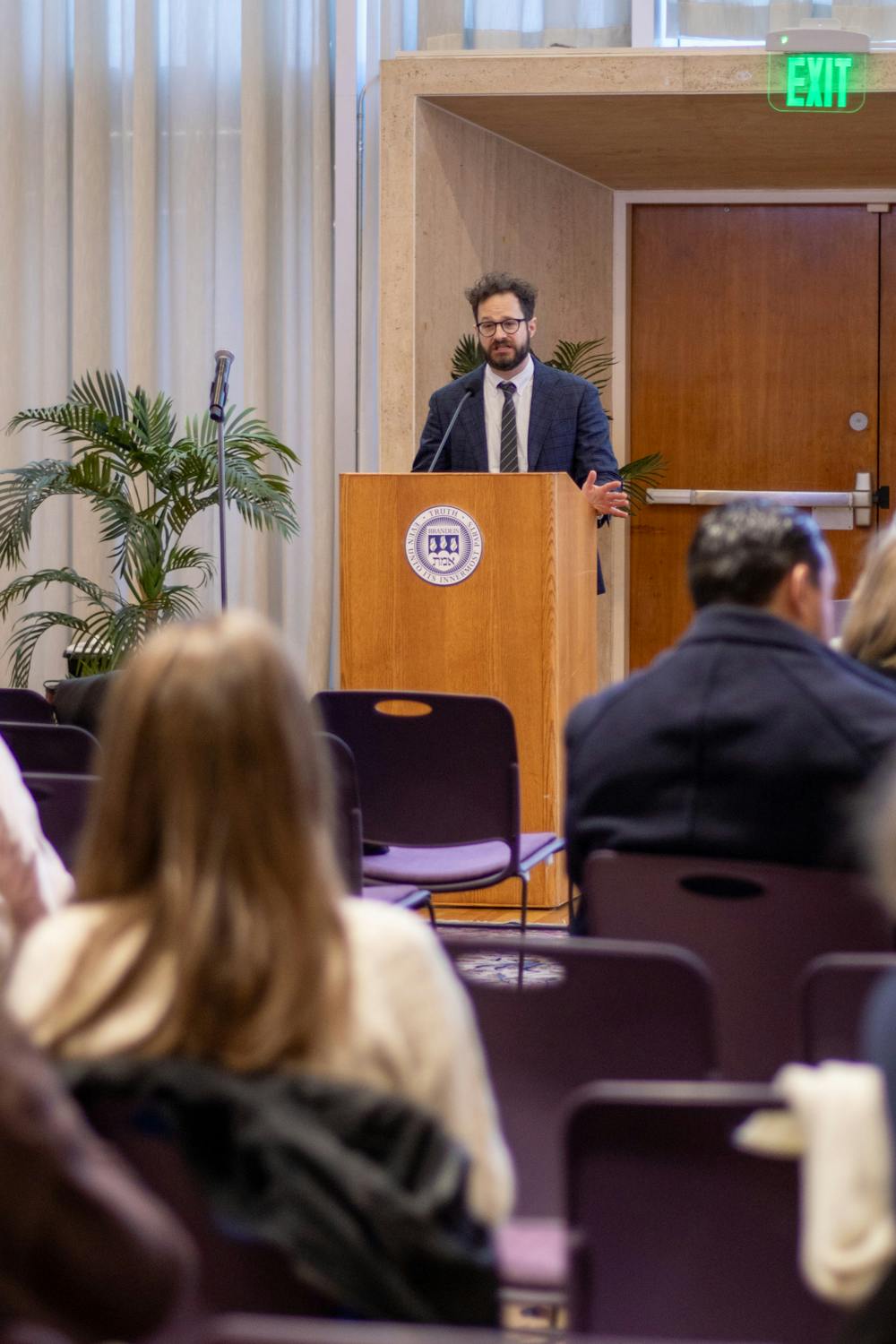
Faculty convened in the Rapaporte Treasure Hall on Friday, Dec. 5, hearing a series of presentations from the Director of Institutional Research, Haley Rosenfeld; the Dean of Undergraduate Studies, Prof. Jeffrey Shoulson (ENG) and the founding Dean of the Center for Careers and Applied Liberal Arts, Lewis Brooks ’80. These presentations covered Brandeis’ U.S. News and World Report ranking, elaborated on the University’s coming microcredential program and expanded on Brandeis’ plan to reimagine its core curriculum.
Before the presentations began, the meeting had a moment of silence for Prof. Emeritus Robert Zeitlin (ANTH), followed by remarks delivered by Prof. Javier Ucrid (ANTH). In addition, the faculty voted to close debate on all three proposed handbook amendments from the previous faculty meeting.
Rosenfeld addressed the University’s consistently dropping ranking in the U.S. News and World Report. She shared that since 2018, Brandeis has fallen by a “startling” 35 points, the highest drop taking place in 2024 when the institution lost its spot among the ranking’s top 50 universities. In U.S. News’ 2024 report, Brandeis fell from number 44 to 60, and in the 2025 rankings, fell another three spots. Rosenfeld said that for institutions that experienced a drop in rankings, the average spot decline was 22 points, whereas the average spot increase was 18.
“It’s really important to understand that our current ranking has far more to do with a changing methodology than a change in our business practice or academic quality,” Rosenfeld said. To support the claim that the rankings were the product of the most significant methodological change in their history, she cited a U.S. News press release. In addition, the release clarifies that the rankings now prioritize social mobility and outcomes for graduating students.
Rosenfeld claimed that the U.S. News “[changed] the recipe, but not the packaging.” She explained that the first rankings report from 1983 were dependent on a fewer number of data points: admission rates and reputation, the latter determined by surveys conducted among professionals in higher education. On the other hand, such surveys still make up 20% of the rankings, among numerous other changes made to the methodology’s original iteration.
However, per Rosenfeld’s metaphor, “the ranking continues to be packaged as if there is no change.” The methodology has added more weight to the factors that contribute to student outcomes and removed factors concerning “university metrics,” such as class size and admission selectivity, from the calculation. According to Rosenfeld, metrics for social mobility entered the methodology in 2019 and quickly became 50% of the total calculation by 2024. Regarding the new methodology’s stress on outcomes for graduating students, Rosenfeld shared that the calculations between an institution’s projected graduation rate and its actual graduation rate differ by the graduates’ performance. Rosenfeld clarified that graduation rates are calculated by the proportion of students entering among a fall cohort who graduate Brandeis in six years — transfers in and midyear students do not contribute to this calculation.
In studying the University’s graduation rates, Institutional Advancement found that “very few” students are still enrolled after six years. The issue is not that students are taking longer to graduate than expected, it is that they do not stay at Brandeis, pointing to a retention issue. “We can’t graduate students who aren’t here,” Rosenfeld said. That being said, despite looking for “patterns of overrepresentation across a wide range of variables” among students who leave the University, there is not a clear pattern or common data. To Rosenfeld, this suggests that students leave for qualitative reasons, such as a lack of sense of belonging, concerns over the University’s ranking or the United States’ political climate, she suggested.
When students transfer out of Brandeis due to a perceived lack of the institution’s prestige it hurts its retention rate and, by extension, the University’s ranking, Rosenfeld explained. She said a “vicious cycle” ensues where students question Brandeis’ market value and transfer out, negatively influencing its retention rate and leading to a further fall in the rankings.
To mitigate concerns about Brandeis’ retention rate, Rosenfeld shared a list of strategies that “scratches the surface” of the work that Institutional Advancement is doing. These efforts include surveying students, working to identify students who may transfer out and employing a full time Director of Student Success. Rosenfeld also expressed a sense of optimism about the University’s ability to improve retention, stressing the commitment of Brandeis’ faculty and staff as well as President Levine’s leadership. “This is an all hands on deck moment, and people are showing up,” she said.
Prof. Lenowitz introduced the presentations by Lewis Brooks and Jeffrey Scholson, stating that while the feedback regarding The Brandeis Plan’s microcredential program was positive, there was a lot of confusion in the community regarding how it will be integrated. “All of the [microcredentials] are meant to certify that students have achieved some sort of career-relevant skill, but they can be divided based on the type of skill in question,” Lenowitz clarified. These categories are “hard skills” that correspond to particular jobs, such as survey research methods for technology development companies, and “durable skills” which are needed across all fields. For example, communication can be considered a durable skill.
Brooks shared the five microcredentials the administration is introducing next spring: Applied Data Science, Foundations of Data Analytics, Person-Centered Research and Analysis, Policy Analysis and Implementation and Sound and Video Media. Each of these skills were proposed by the new schools of learning. To achieve the microcredential credit, students must register to complete it through the registrar, and the Workday interface will keep track of the student’s completed requirements. Additionally, they need to request the assessment once they complete the badge’s course load.
“The [assessment] is unique to that hard skill microcredential,” Brooks explained. “We’re going back to the authors of those microcredentials to determine how best to assess and then we will be determining how the assessment will be completed for those.” He clarified that students must send the registrar a request to access the assessment. Once a student passes the assessment, the microcredential will be delivered as a digital badge to the student’s wallet and can be affixed to their LinkedIn profiles.
Additionally, the University plans to pilot microcredentials for extracurricular activities, the first of these being Leadership and Emergency Medicine for students who serve in the Brandeis Emergency Medical Corps. Brooks highlighted that many students are involved in such activities for at least three to four years, and, in doing so, develop skills that they will carry with them into their careers.
“Brandeis should be able to acknowledge that and stand behind it and recognize it,” Brooks asserted. The assessments are still being determined and the University is working with student leadership to determine the best way to move forward — they could be as “simple” as a review of the student’s years of participation and positions accrued or there may be a more in-depth form of testing.
During the question and answer session following his presentation, Brooks clarified that the faculty will be able to propose more microcredentials this upcoming January and expressed that the University wishes to provide time to solicit industry and employer feedback in order to best direct the program.
Lastly, the meeting transitioned to Jeffrey Shoulson’s presentation about developments to the Brandeis core curriculum as administration works to better align it with career readiness. Shoulson said that Brandeis consulted the National Association for Colleges and Employers to identify the types of hard and durable skills that employers — from “mega corporations to small mom and pop businesses” — are searching for among college graduates. In addition, Shoulson stressed that these competencies will be “portable” as graduates move between careers.
The new Brandeis core will also serve to decrease the number of courses necessary to finish it. “We’re looking for ways to make it as possible as we can for students to complete all the requirements they need for a degree in three and a half years, in seven semesters as opposed to the eight semesters,” Shoulson described. By decreasing the number of classes necessary to complete the Brandeis Core, the University hopes to encourage students to use the leftover semester to take on a “much more intensive, external learning experience, or co-curricular experience,” such as an internship. While they progress in their internship, students could choose to take a lighter course load.
“We’re trying to do this at a break neck pace,” Shoulson described. The University plans to establish the new core curriculum by the next fall semester, which makes for an eight to nine month timeline. He compared this expedited plan to that of the 2017-18 Brandeis core revision, which took around two to three years to implement.
Prof. Shoulson stressed that, at this point, the plan in its current form is far from its last iteration. The next steps are to hold more town hall meetings during the spring semester and solicit further faculty feedback before finalizing the new core proposal. The final version of the core will have to be reviewed and approved by the Undergraduate Curriculum Committee and then voted on by faculty. Shoulson hopes to finalize the plan for voting by early February.
Shoulson also introduced the idea of including library modules in the core as well — both asynchronous and in person — that will provide students with basic skills for managing technology such as Excel. These courses would be an alternative means to fulfill the digital literacy requirement. Another proposed addition to the core will be a career direction course, a six-week module that will encourage students to “think incrementally across the four years of their experience about how to think about what their next step is when they graduate.” This course is an aspect of other revisions to the Health and Wellness requirement. According to Shoulson, it could make the requirement a year-long course that features three different six-week modules. He reiterated that this aspect of core curriculum revisions is still under consideration.
Lastly, Prof. Shoulson discussed the intended relationship between the core competencies and the microcredentials. He shared that every class a student takes to fulfill a competency is aimed to be the first step towards completing a microcredential. From there, the student would have to take another course that fulfills the microcredential, though he noted that the course must fall under a different department listing than the student’s first class for that badge. On the other hand, Shoulson said that the student may have the option to fulfill the second course requirement through their extracurricular experience.
Prof. Lenowitz closed the meeting, reminding attendees that he and Prof. Shoulson are holding town hall meetings in the spring.

Please note All comments are eligible for publication in The Justice.