
Trouble in Paradise: Sense and Sensibility’s Virtues and Theater Sins
— Correction: An earlier version of this article falsely claimed that two incidents during the performance were caused by “not nearly enough full-tech run throughs.” A source close to the matter has clarified that this report is factually inaccurate. The mentioned incidents had no correlation to the number of the production’s run-throughs. All related sentences have since been removed from the article.
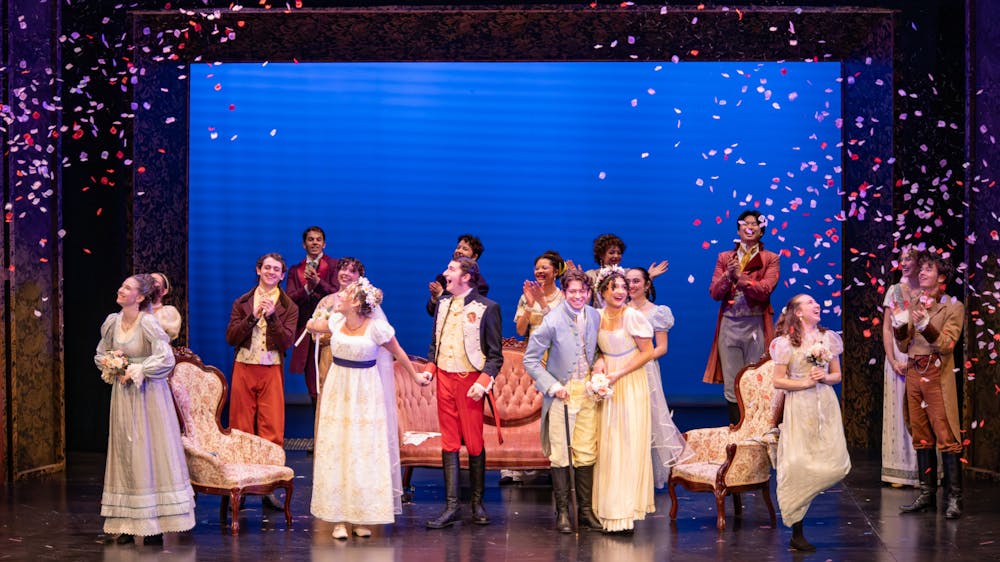
After hosting a peculiar set of particularly hit-and-miss productions, the Brandeis Theater Department held its opening night for “Sense and Sensibility” this past Friday, March 6. This Kate Hamill adaptation of Jane Austen’s novel was, to our great relief, nothing short of spectacular. Its storytelling followed the lives of an extensive cast of characters in great detail, but had for its protagonists the older Dashwood sisters and their paths to “true” love. As great as Austen’s plot may have been and as excellent as most of the actors were in portraying such a story, the Brandeis production had an unfortunate abundance of “technical” errors — that is to say problems related to the backstage crew — and a notable presence of glaring “theater sins,” a term often used in theater education to describe major issues that one must avoid when producing a show. That is not to say that this production was unsatisfactory because, as a matter of fact, most audience members were delighted by the spectacle. Nonetheless, the issues that were too noticeable to be ignored in a proper review.
One point of excellence was the fervent and passionate acting from its performers. In her portrayal of Marianne Dashwood, Dani Salsberg ’27 had undoubtedly the most precise British accent. Salsberg lacked the underlying American cadence found in her castmates; she successfully masked the forced quality that often plagues American actors attempting British accents. Although all the cast had achieved the modality of English phonemes, it was only Salsberg who could truly pass for a British woman. Her acting was phenomenal, with a speech truly marked by sentimentality, where every word was not only uttered for its morphological value but where its emotional charge ricocheted from Salsberg’s heart through the audience’s soul. Jasper Woliver ’28, who played Mrs. Dashwood, exceeded expectations in a soft delivery of Stanislavskian realism. Every flickering muscle had an intention to it that allowed the audience to be transported into this realistic fictional world where a true grieving woman was trying to be happy and make the most out of everything for her daughters’ sake. Meanwhile, JD Dowd was tasked not to be a funny character but a character who is, himself, the joke. With John Dashwood, Dowd was tasked with being a fool, and in being a fool, he succeeded — a feat not to be diminished. John’s wife, Fanny Dashwood, was played by Caroline Burke ’28, whose acting did not fall under realism, but under a mixture of farce and Victorian melodrama. Burke threaded that line carefully and to great triumph, perfectly fulfilling her comedic archetype as a conniving and utterly… unpleasant individual.
Final notable mentions in the cast include Liam Delaney ’26, whose portrayal of Colonel Brandon was so masterful that it was able to showcase a progression in characterization through a multifaceted approach in which the audience is slowly introduced to his depths of the Colonel, Emma Sadewasser ’27, Phoenix Yuan ’26, Nico Sloan ’28 and Laura Araujo ’29. Sadewasser and Yuan served as absurd and farcical archetypes that far exceeded superficial comic relief and served as active characters for plot progression. One could not leave the theater without thinking back and chuckling at their performance, with one notable instance being their introduction. They burst onto the stage while walking leashed dogs, yet no dogs were present. They shook the leashes and ordered their nothingness to be well-behaved, a situation so ridiculous that it made for perfect comedy. Sadewasser should be extremely proud of her performance because she was, to the eyes of many audience members — mine included — the funniest actor in the cast. Sloan was also a talking point of many audience members as they left. As short as his cottage monologue was Sloan’s hilarity was prominent enough to make him one of the best features of the show. Araujo made her department debut with her role of Margaret Dashwood, the youngest sister, and the actress fulfilled her archetype to a great effect. Her acting was respectful of the author’s intent and, indeed, she was funny and extravagant when the scene demanded it.
That said, two performers that I must bring up with a certain carefulness are Madelyn Zimbalist ’28 and Simon Link ’28. As Elinor Dashwood, Zimbalist was able to portray Elinor’s love towards her sister, the hidden sorrows of her broken heart and the joy upon her proposal. Nonetheless, a role as central as hers required a certain level of intensity, a drastic shift in energy across scenes, which was not met. Whether this is due to a flaw in Hamill’s adaptation in which Elinor’s dynamic is not so dramatically conveyed or due to a flaw in directing or even, possibly, an actual shortcoming of Zimbalist, no audience members shall ever know. However, from what I was presented with, I believe that Zimbalist’s potential exceeded what was given to her in this setting, and I will remain hopeful that her next role will be able to show the true extent of her skill. Link, however, is a prominent member of the Theater Department. He holds the highest celebrity status and for good reason, too! Amongst the Brandeis theater community, although both “Eurydice” and “Dance Nation” were perceived by most of the Brandeis community as overall subpar productions, all conversations had the same comment: “But ‘Slink’ was fantastic.” Link’s comedic talents are truly stupendous. Even when I compare Brandeis to Broadway performances I’ve had the privilege to watch, Simon Link’s comedic persona remains top-tier. Though I do not know of Link’s plans for the future, he is the actor that we must certainly watch out for. I am one of many who believe he is Brandeis’s best bet for a Broadway (or Hollywood) actor. Through most of the show, Link delivered a proper performance as John Willoughby, which, though not as extravagant and present as his other roles, was nonetheless a marker of a great actor. One scene fell far below his standards, however, and that is the scene in which John attempts to visit bedridden Marianne. He tells Elinor that he is there because he is drunk, but unfortunately, Link’s performance did not show that. The most likely scenario for this occurrence was that the director’s interpretation of this scene was that John was lying, and thus Link should not play him as a drunk. However, the ultimate result was that the performance did not make either interpretation clear: He was neither behaving as a drunk man nor as a liar. This was undoubtedly one of the strangest moments of the play.
Now, we must address the elephant in the room: this production’s theater sins. The most blatant one was during the dialogue between Elinor and the Colonel, after Marianne had discovered that John was already engaged. During this pivotal scene, all of a sudden, someone turns on the house lights — the ones that theaters turn off so we can focus on a play as it begins. As amazing as Liam’s monologue could have been, we were far too distracted looking up, down and around to understand what was going on. This mistake is too grand, too simple, too much of an utter amateur move for a university production. It was pathetic, a grand shame to be brought during opening night. Another opening night mistake was the continuous defective microphones, with most errors being a distorted, over-amplified, clipped audio. One particularly sad instance was when Sadewasser’s microphone utterly gave out; thankfully, her powerful and skilled voice-projection skills were able to superceded this issue. There was also an unfortunate abundance of scenes where the blocking had actors turning their backs to the audience and most instances did not have a beneficial effect that would validate subverting this theater norm. The one case in which this subversion was clearly justified was when Salsberg played her fictional piano in the background of the scene while singing a classical tune — with an angelic voice, too, I must add.
Thus, I defend the claim of this review’s title: this production indeed reached paradise status for the greatness of its cast, as I have detailed, but it was afflicted by an enormous quantity of troubles too big to be overlooked. The department aimed for greatness with a stupendous cast and extremely well-designed features such as a functional rain curtain, but it nonetheless faced some amateur mistakes. Nonetheless, the positive features were so great that the audience found the show to be completely astonishing, many returning for a second watch, singing the praises of the actors and the works of the creatives. I thus affirm that this production was far greater than previous shows in this season, and places itself in the position of “hits” alongside “The Thanksgiving Play.” Congratulations to all involved.
—Correction: An earlier version of this article misstated Lance Rothchild and Phoenix Yuan’s class years as “’27,” they have since been updated to “’26.”
—Correction: An earlier version of this article misspelled Phoenix Yuan’s surname as “Yung.” Both instances have been fixed.
—Correction: An earlier version of this article included the sentence, “Nonetheless, the issues that were to noticeable be ignored in a proper review.” It has since been updated to, “Nonetheless, the issues were too noticeable to be ignored in a proper review.”
—Correction: An earlier version of this article included the sentence, “As short as his cottage monologue was Sloan’s hilarity has prominent enough to make him one of the best features of the show.” It has since been updated to, “As short as his cottage monologue was, Sloan’s hilarity was prominent enough to make him one of the best features of the show.”
—Correction: An earlier version of this article included the sentence, “During this pivotal scene, all of a sudden, someone turn on the house lights — the ones that theaters turn off so we can focus on a play as it begins.” The sentence has been updated to read, “During this pivotal scene, all of a sudden, someone turned on the house lights — the ones that theaters turn off so we can focus on a play as it begins.”
—Correction: In an earlier version of this article, “Department,” “Farce” and “Melodrama” were incorrectly capitalized. They have since been lowercased.

Please note All comments are eligible for publication in The Justice.