
Third faculty meeting sheds light on Brandeis University’s financial future
The meeting mentioned in depth figures about Brandeis’ “growth mode” and efforts to inspire new financial contributions by donors
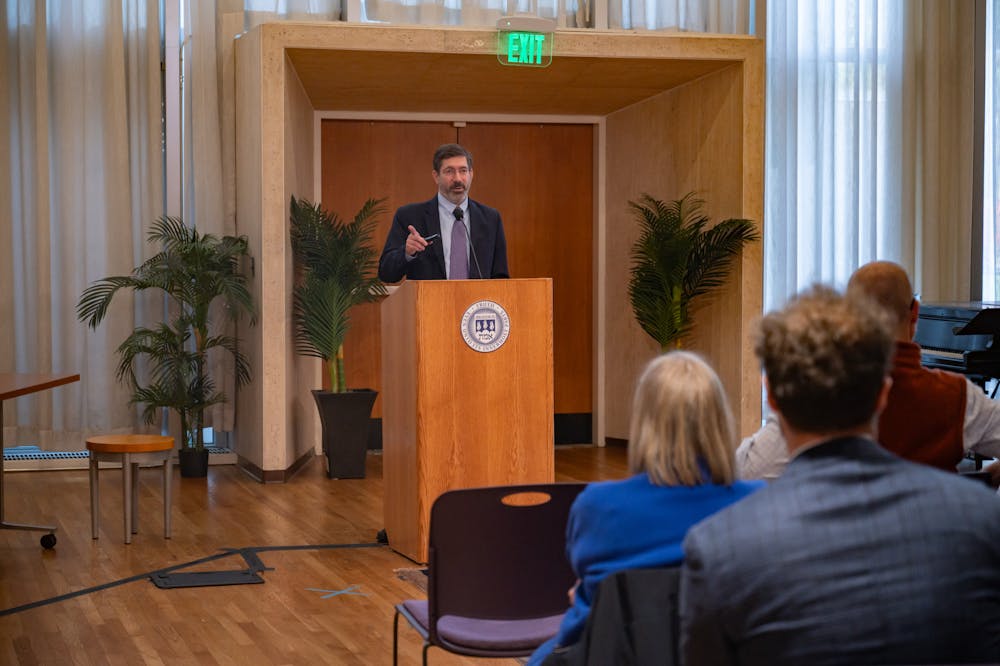
The third faculty meeting of the year convened in Rapaporte Treasure Hall on Nov. 7 with presentations from the Executive Vice President of Finance and Administration, Stewart Uretsky, and the Vice President of Development, Stephen Rodriguez on the University’s budget and Institutional Advancement, respectively. The faculty also heard four handbook amendments. Senate Chair, Prof. Jeffrey Lenowitz (POL) outlined these objectives at the start of the meeting.
Provost Carol Fierke thanked faculty for their willingness to implement and participate in The Brandeis Plan to Reinvent the Liberal Arts. “We continue to move our new vision at an unprecedented pace for academia. We are in fast forward mode, so thank you for that,” Fierke said. Five microcredentials have been chosen out of faculty proposals from October, and they will be announced before Nov. 11.
Fierke mentioned ongoing staffing changes associated with the University’s reorganization plan and highlighted “exciting change[s]” — specifically the appointment of Lewis Brooks ’80 P.’16 the director of the Center for Careers and Applied Liberal Arts.
She also reminded faculty who plan to retire in the next five years to read the details of the University’s voluntary retirement program. She touched on how the programs may vary based on years of service.
The meeting transitioned to a budget presentation delivered by Vice President Uretsky, opening with his thanks to the faculty. He said that it has likely felt like a “nonstop drumbeat of sacrifices that have been asked of our entire community” and wished to acknowledge the sacrifices that have been made in order for the University to embrace “a financial strategy that focuses on sustainable growth and building a brighter future for Brandeis.”
Vice President Uretsky explained that the University is in “growth mode,” which means that Brandeis lacks financial capital, causing a need to focus on resource utilization by having precise initiatives and targeted investments. According to Uretsky, Brandeis’ budget — $415 million — tells a “healthy diversified funding story,” although it is “relatively dependent” on net tuition revenue.
Similarly, the University’s expenses also sit at roughly $415 million. Uretsky said that many expenses are “sticky,” meaning that they are “less variable over time than others.” Although the budget for Brandeis’ physical infrastructure is less of a sticky variable, its “strategic space consolidation plan,” — where the University is remodeling or closing down half-used or vacant buildings like Pearlman Hall and Kutz Hall — has made some infrastructure expenses less predictable. For instance, the University is reimagining the vacant Kutz Hall into a Center for Jewish Life on Campus. Associated costs with such projects makes physical infrastructure costs less predictable. Brandeis’ non payroll operating expenses, such as insurance, utilities and dining are also “very sticky.”
Uretsky shared that the University has raised $211 million through sponsored research revenue and $39 million through non-sponsored revenue. Since benefits are becoming an increasing expense, he clarified that health plans at Brandeis have increased by 20%. This is a national trend and the University is absorbing half of this cost on behalf of community members.
The third major component regarding the University’s budget is its endowment. He confirmed that while the endowment’s performance has been strong it is “nowhere near the size that it should be” and “ought to be about 50% larger than it is.” The endowment supports 20% of the University’s total budget and its market value at the end of the past fiscal year was $1.4 billion. The complication with using the endowment is that 90% of it is “restricted by donors for certain purposes,” and even the 10% leftover is still complicated by a “continuum of levels of restrictedness” as its use is designated by the Board of Trustees.
Currently, Brandeis’ endowment performance is 8.3% with a five and 10 year performance return of 8.6% and 8% respectively, whereas the industry standard is about 7%. Uretsky explained that prior to the 1990s, Brandeis had a higher draw rate from the endowment before starting a “10 year draw diet” to decrease the rate to 5%. Over the past several years, Brandeis has broken this draw diet to accommodate impacts from COVID-19 and the University’s new growth state.
Furthermore, Uretsky said that the surplus was $69,000 on a $415 million spending budget — 0.2% in comparison to the industry standard being three to four percent — which would be $12 million to $16 million. “We don’t have either operating contingency or strategic contingency funds to invest in unanticipated opportunities that present themselves outside of our normal budget or the funds to handle those things that oftentimes come up that we don’t anticipate,” he explained.
Regarding cash flow, Uretsky said that it’s ideal to remain “flat.” Two notable dips between fiscal years 2022-24 were primarily caused by the pre-spending for the Science 2A building before the project was put on hiatus for fundraising purposes, and an “unanticipated water infiltration event” in the Usdan Student Center. Water was leaking through Usdan’s courtyard, through the ceiling and into the dining hall, which forced the University to remodel the courtyard. “$7 million later, we now have a dry and flat courtyard, but that was an example of a significant capital expense that we weren’t anticipating for which we needed to address,” recalled Uretsky.
Such unanticipated costs take place each year — including more water leaks — but Uretsky expressed optimism regarding the upcoming fiscal year as the University manages its budget. He stressed the importance of acting quickly and elaborated on ways individual faculty can support “revenue-generating areas within the academy,” such as creating more interdisciplinary programs to integrate undergraduate and graduate experiences, becoming actively involved in admissions and communicating with stakeholders and prospective donors.
Stephen Rodriguez, the Vice President of Development, outlined new developments in Institutional Advancements and how faculty can get involved. The Senior Vice President of Institutional Advancement, Jordan Tannenbaum ’72, joined the presentation via Zoom. Tannenbaum said that IA’s mission has been to introduce worldwide connections between alumni, families, friends and donors, which will support Brandeis’ mission, and that it is in the “midpoint” of its campaign.
So far, the campaign has raised $365 million out of Brandeis’ $750 million goal, Tannenbaum said. He highlighted the contributions of the University’s campaign executive committee members and shared that its major gift officers are making a lot of progress in raising revenue by identifying and contacting “top prospects.”
Vice President Rodriguez expressed that Institutional Advancement has worked alongside President Arthur Levine ’70 to ensure that the campaign’s goal remains $750 million at a minimum. “We want to far exceed the goal, but we want to do that in a way that builds momentum, excitement and confidence that we’re going to exceed that goal, so we’re staying firm to that number,” he said. Additionally, since Brandeis’ last campaign was in 1997, Rodriguez stressed that the University is moving at a fast pace in order to “get the campaign up to speed,” since having long periods between campaigns is “abnormal for higher education.” Currently, Institutional Advancement plans to publicly launch the campaign on campus in about a year. Rodriguez suggested that the campaign’s public launch could resemble the University’s 75th anniversary celebration.
Rodriguez explained that the campaign will focus on supporting the endowment “whether that’s professorship, financial aid, programmatic funds and the ever-elusive, unrestricted endowment gifts that we hope to get many more of in the future.” This campaign will also support the Center for Jewish Life, constructing the new residence hall and the Center for Careers and Applied Liberal Arts. Institutional Advancement has an “aspirational goal” of finding a donor willing to provide the funds for the liberal arts center and name it.
Rodriguez reiterated the work of the campaign’s executive committee, which has been “externally-focused” and contacting individuals outside of the community on behalf of Brandeis. He said that President Levine’s vision has “transformed” the Board of Trustees, and the market increase in growth over the past four fiscal years are testaments to the committee, faculty’s work in the classroom and donor’s gifts.
“[Faculty] are the engine of what we do,” Rodriguez said. Although he, Tannenbaum and the campaign team work hard to network with donors for the University, he shared, “the real magic of an institution is its students and faculty, and we need to deploy and partner with you more.”
With this in mind, Rodriguez emphasized that Institutional Advancement plans to solicit more fundraising ideas from faculty and encourage them to connect with students and donors in person. The library created a database for IA team members to access research projects across all disciplines, which will deepen IA’s understanding of Brandeis’ research. Having a better understanding of these projects will allow campaign committee members to be more equipped to locate donors with similar interests. On the other hand, Rodriguez said that Institutional Advancement will also provide faculty with more transparency about its work and organization, since it will give faculty a clearer understanding of how the team promotes Brandeis and presents its data. Faculty will have access to a portal: a “one-stop shop” where faculty can find all the information needed about IA in one place. This portal will allow faculty to coordinate using their spare professional travel time to meet with a donor or host a fundraising event in the area, if they choose.
Prof. Lenowitz transitioned the meeting into voting for faculty handbook amendments. The first motion was put forward by the University’s Committee on Diversity, Equity, Inclusion and Social Justice and was already approved 118 votes for and 25 opposed. This amendment changes the handbook’s description of DEI “to align with recent changes made to the Office of Access and Excellence, remove unnecessary functions and better reflect existing federal and state law,” Lenowitz said. With no objections, the debate concerning the amendment closed.
The second amendment is a motion proposed by the Handbook Provision committee, which clarifies text in the faculty handbook concerning voting procedures. With this motion, “double voting is eliminated for all matters other than handbook amendments, … the term ‘legislation’ is replaced with ‘resolution’ throughout … , substantive amendments to propose handbook amendments are prohibited at the second reading stage and four, references to members present in voting are eliminated from section seven to align with electric voting procedures.”
Prof. Dan Breen (LGLS), a member of the Handbook Revision Committee, explained that the committee raised this motion to remove ambiguity from the voting process. This motion will streamline voting in a way that allows faculty to propose one amendment at a meeting, give attendees the opportunity to adjust it and vote on the changes. After this process, faculty will vote electronically, and there will be a second reading. The most significant change in this motion will be that no amendments will be accepted after the motion’s second reading.
After deliberation regarding the motion’s wording and clarification about the changes it would make to the voting process, the second motion was approved to send to a full faculty vote next week.
The third amendment reads, “The Brandeis faculty handbook section on tenure postponements, the amendment to direct the committee on faculty rights and responsibilities, to work with Human Resources when evaluating postponement requests, and to mention that the law might require leaves greater than four semesters.” This motion will guarantee that the University will abide by the Americans with Disabilities Act, ensuring that administrators will not be required to look at personal medical records. The motion passed for voting next week.
The last motion up for deliberation was introduced by the Faculty Senate and the handbook revision committee that the Board of Trustees must elect a faculty member from each of the four academic schools to represent their schools. All voting-eligible faculty members will be able to participate in these faculty representative elections — should there be no nominees from a school, the position will become an “at-large seat” for that election cycle. The position will revert to a seat designated for a single faculty member during the next election cycle. After clarifying conversations about the election cycles and particulars about the representative position, the motion was passed.

Please note All comments are eligible for publication in The Justice.