
Wherever BAASA takes us
Brandeis Asian American Students Association’s APAHM Opening Showcase highlighted culture, diaspora and belonging.
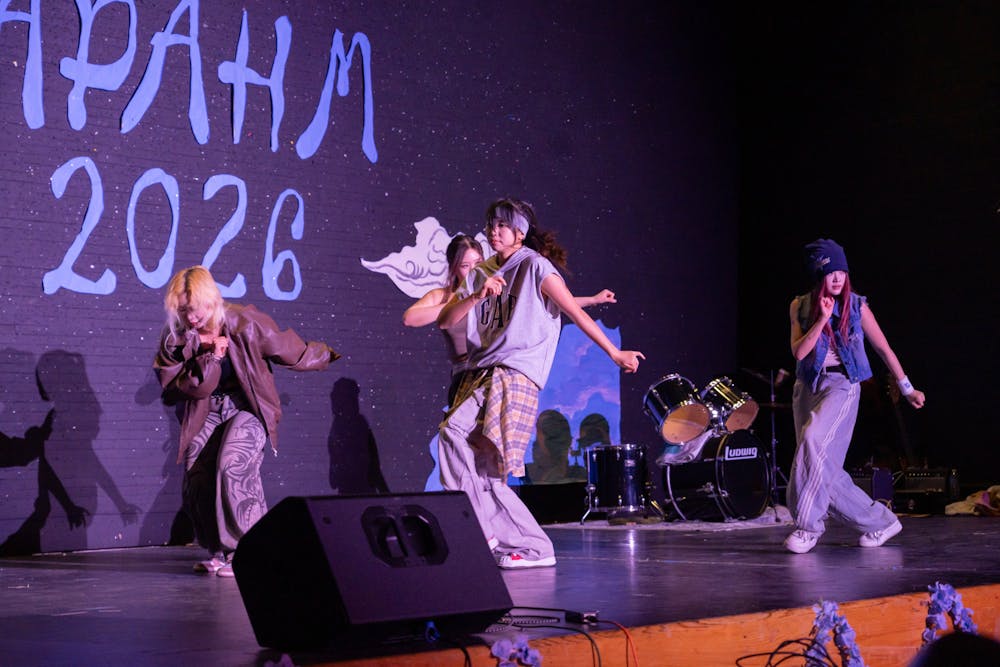
Last Saturday, the Levin Ballroom transformed into a space for performance, celebration and reflection as the Brandeis Asian American Student Association hosted its annual celebration: Asian Pacific Islander Heritage Month Opening Showcase, or APAHM. This year’s event, themed “Wherever the Wind Takes Us,” brought together food, dance, music and community for a night that centered not only on cultural representation, but on the question of what it means to build a home across distance and change.
Held on March 7, the showcase featured a wide range of acts including a fashion show, musical performances, dance numbers and a raffle fundraiser. Over 300 people attended, making it BAASA’s strongest post-pandemic turnout.
Casey Tan ’26, BAASA’s APAHM Opening Coordinator and the main planner of the event, said the theme grew out of her desire to think about diaspora in a way that felt both historical and hopeful. “This year's theme was ‘Wherever the Wind Takes Us.’ I came up with this theme because I thought of the wind carrying seeds from plants to new places for them to grow as a metaphor for the diaspora of immigration,” Tan commented in a March 9 interview with The Justice. “On top of that, I thought about how BAASA has changed so much since it was created. BAASA was founded in 1971 during the Vietnam War, and the world has changed so much since then, but we continue to exist and to celebrate our cultures together and to create a sense of home.”
This idea of home shaped the event from beginning to end. Rather than treating culture as something fixed, the showcase emphasized the way traditions travel and take root in new places. “To me, home is not just a place, but [a space] where a sense of belonging is found,” said Tan. “I think culture clubs at Brandeis create this sense of belonging for a lot of students, and I encourage students to engage in the many programs that culture clubs have to offer.”
Daphne Lin ’29, a BAASA first-year representative, said that broadening representation was one of the most important goals of this year’s showcase. “This year is really special because we decided to focus on the underrepresented communities in the Asian American identity, which are Southeast Asia and South Asia,” Lin said in a March 9 interview with The Justice.
This emphasis on immigration and diaspora gave the event particular resonance in the current political environment. Tan said that was part of what she wanted audience members to recognize. “I want audience members, regardless of race or ethnicity, to recognize the importance of sharing your culture and beliefs unapologetically, and to recognize that despite the inherent uncertainty that this political climate brings us, there is hope for the future,” said Tan.
Aaron Tian ’28, a member of Club Cantonese at Brandeis who attended the showcase in support of BAASA, said he sees cultural events like this as an important part of campus life. “I make it a more personal goal of mine to go to as many of these culture shows as possible, and to experience a wider breadth of cultures that we have here at Brandeis,” Tian said in a March 9 interview with The Justice.
Michelle Ou ’28, BAASA’s Social Media Chair, said that openness to different perspectives is especially important on Brandeis’ campus. “I feel like every culture has its own voice, has its own uniqueness and has its own art,” Ou commented in a March 9 interview with The Justice.
Beyond performances, the food at APAHM was another important aspect. Tan said she put particular effort into bringing Filipino food to the event. “I was passionate about acquiring Filipino food for the event,” Tan explained. “Only 1% of AAPI restaurants are owned by Filipino Americans in the United States, and so I was excited to share my culture with the Brandeis community.”
The showcase extended its impact beyond campus through its fundraiser for Asian American Resource Workshop, a local non-profit organization supporting the Pan-Asian community in the greater Boston area. “We chose the organization AARW, because it helped support [the] Pan Asian community and they're really focused on immigration support and deportation relief right now at the moment,” Tiger Wang ’28, BAASA’s Community Chair said in a March 9 interview with The Justice.
For Wang, that part of the evening was especially meaningful because of the reciprocal support the two organizations provide. “Many of these non-profit organizations don't have the means to publicize their organizations,” said Wang. “So it's really important for us to support and bring about showing [students] that we have these events.”
The event’s performances and messages offered something more lasting: a model of what campus can look like when students are invited to bring different identities into the same room. Samuel Bae ’28, BAASA’s APAHM Closing Coordinator, said that being behind the scenes changed the way he understood the event. “I remember not being part of e-board last year and attending APAHM, and being blown away by the performances. This year, seeing from the inside-out what goes into the process, the camaraderie that it builds within e-board by collaborating and the appreciation that the general Brandeis students get to have has been rewarding,” Bae said in a March 9 interview with The Justice. “It's great that we can improve every year and have new performers every year.”
Bae hopes audience members take away new understandings of different cultures. “First and foremost, we hope they had a good time enjoying the tasty food and the fun performances, but we also hope that they got to take something back home about the cultures that they were able to experience, from a Vietnamese rock band to interpretive Indian dance,” Bae said in a March 9 interview with The Justice. “Our turnout was over 300 this year, which I think is our best post-pandemic.”
Events like APAHM Opening Showcase show how creating spaces where students can share traditions and their unique experiences, can help shift the conversation into a place where identity is not only acknowledged but actively celebrated.

Please note All comments are eligible for publication in The Justice.