
Students for Environmental Action unveils new Brandeis Food Forest in grand opening
The Oct. 2 grand opening was held in collaboration with the Waltham Land Trust and COMPACT, and featured food and live music.
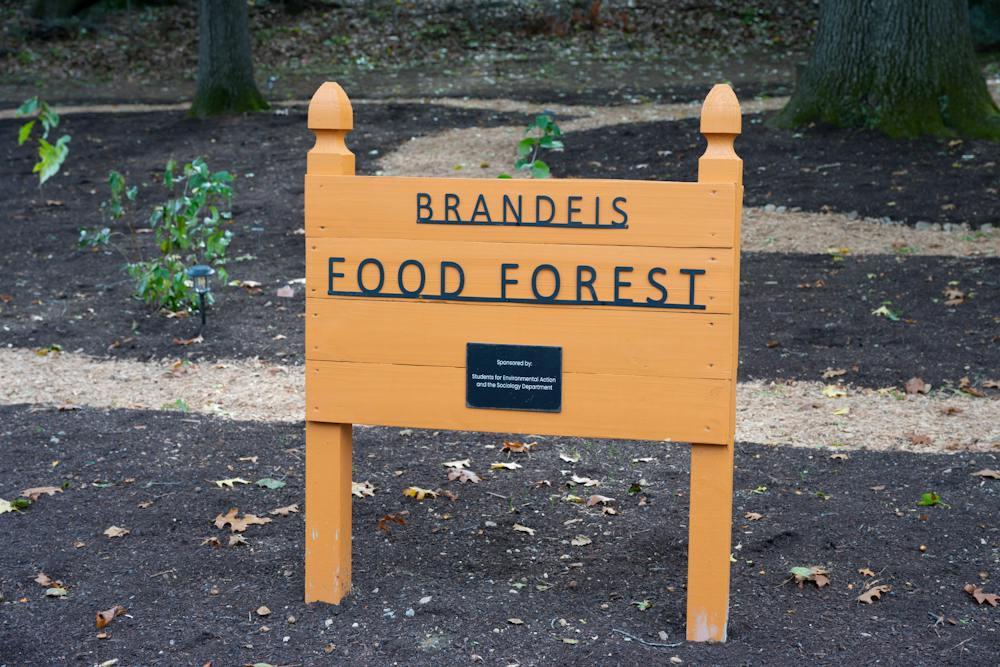
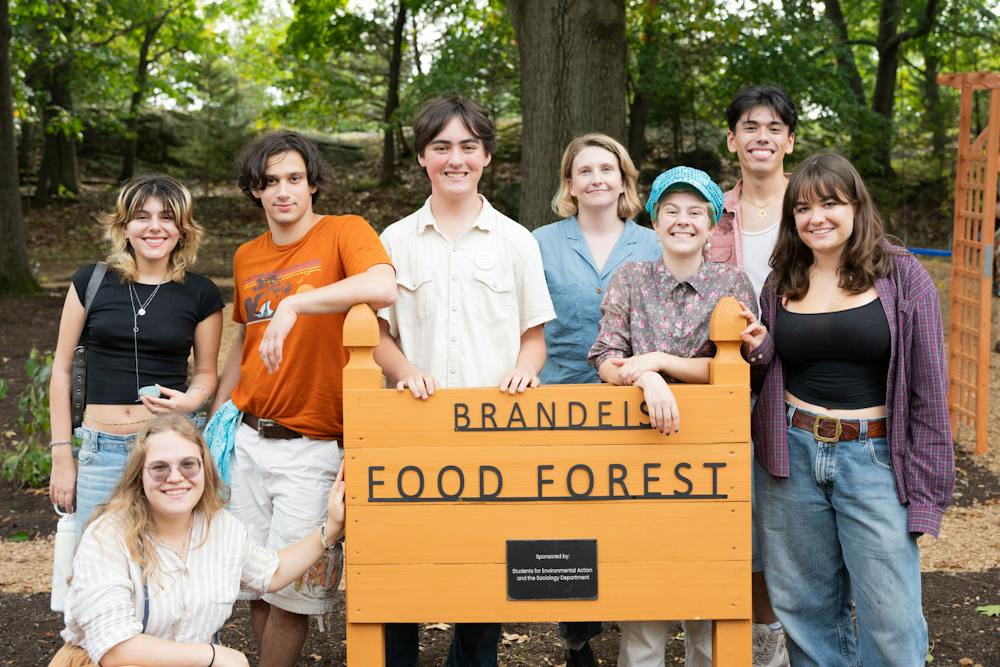
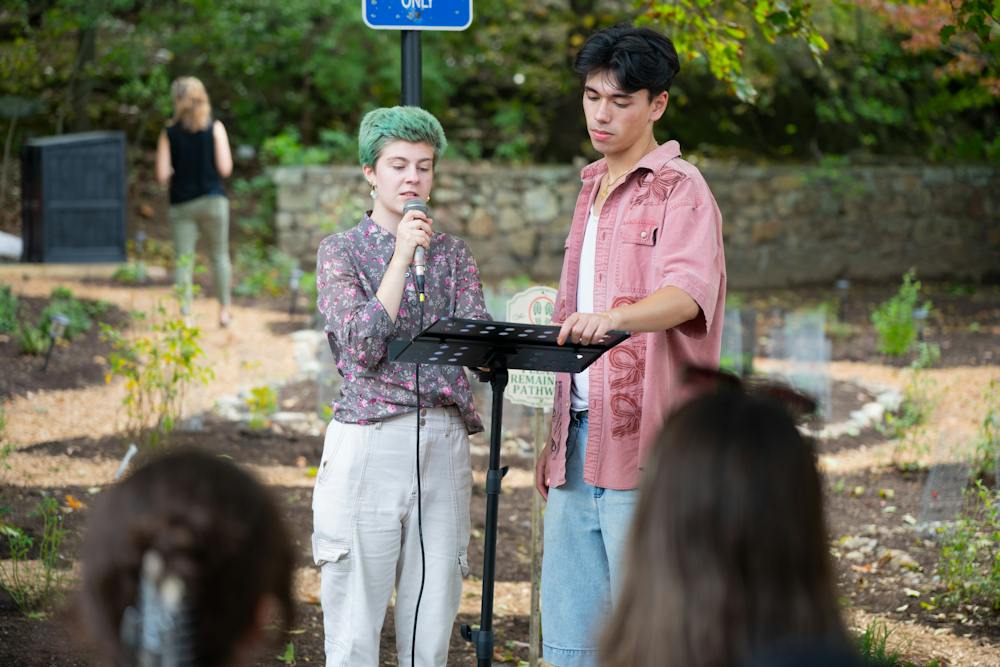
A nearly full tent of Brandeis students, faculty, staff and members sat between Pearlman Hall and the Brown Social Science Center on Friday, Oct. 1, to await the grand opening of the Brandeis Food Forest. The project, led by Students for Environmental Action in collaboration with COMPACT and the Waltham Land Trust, also offered catered food, art projects, additional opportunities to become involved in student advocacy work and a live music performance from the Brandeis’ Music and Dance Band.
The ceremony began with a land acknowledgment led by Spike King ’27, one of the student leaders of the project. King recognized the historical significance of the land to the Wampanoag people and spoke about the intersectionality of various issues such as food scarcity, the history of forced labor and slavery in America and immigrant rights. King transitioned to introduce the first speaker, Justin Koizumi ’27.
Koizumi, who has been the primary student leader behind the project, spoke about its early inception and how he was approached by Prof. Rachel McKane (SOC) about the idea of beginning a food forest. One of the primary goals of the project, he said, is to “build environmental and social resilience in our communities” and strengthen the relationship between Brandeis students and the Waltham area. Koizumi also spoke briefly about the actual garden, sharing that it was built intentionally and uses climate-resilient plants.
Following Koizumi’s address, Prof. Sally Warner (ENVS), the director of COMPACT, spoke about the history of the project. Warner shared that in her time at COMPACT, she had seen many student attempts to start the project, but they never fully got off the ground. However, it was evident to her that because of this past interest, there was an obvious desire to create a food forest, and McKane and Koizumi, along with support from SEA and COMPACT, “finally cracked the code” on helping the initiative come to fruition. Warner similarly spoke about the use of low-maintenance crops and how the forest would become a “symbol of sustainability on campus” that has already been embraced by the University at large. She also shared that she believes the project embodies the school’s new philosophy of “one foot in the classroom, one foot in the street.” She views the Brandeis Food Forest as a practical application of a Brandeis education, and emphasized the University’s commitment to community engagement.
Following the conclusion of Warner’s remarks, Dr. Nadene Stein, president of the Board of Directors of the Waltham Land Trust, spoke to the crowd about her work. In an Oct. 1 interview with The Justice, she shared that her background as an elementary school principal has informed her commitment to hearing student voices. “We believe that the students who live here and go to school here and are a part of the community,” she said. In her remarks, Stein spoke briefly about the group’s past work with SEA, in an effort to collaborate on advocating for an end to the use of anticoagulant rodenticides, and the Land Trust’s commitment to getting community members outside and involved with environmental advocacy efforts. She also named her colleague Sonja Wadman as the primary liaison between the groups.
Wadman serves as the executive director of the Waltham Land Trust and is responsible for the group’s programming, as well as coordinating fundraising efforts and volunteer opportunities. In an Oct. 2 written statement to The Justice, Wadman stressed the importance of local projects such as the food forest. “Very local programs like the Brandeis Food Forest are important because they give folks an opportunity to make positive changes right where they live,” she wrote. She also encouraged students interested in environmental activism to look to their immediate, local communities to make a difference, and to remain positive despite challenges.
Following Stein’s comments, Prof. McKane spoke about their involvement in the food forest and thanked individuals who supported the project. McKane expressed their gratitude to the sociology department for “listening to me ramble on” about the project for years, as well as the students who did the physical labor of creating the forest. Speaking about their own background, McKane shared that they grew up in a rural part of eastern Tennessee and subsequently grew comfortable outdoors and in nature. They shared that their father was a formative part of their childhood and taught them “that nature isn’t something separate from us.” McKane similarly expressed that the opening of the forest will teach the Brandeis community about resilience and self-sufficiency, and will also teach them about the environment in an experiential manner.
Finally, attendees heard from King, who expressed their thanks to the sociology department, and highlighted that the program has been instrumental in several other efforts on campus, including the creation of the Enterprise anti-ICE petition, which discouraged the University from engaging with Enterprise Rent-A-Car, an organization that supplies vehicles to ICE. They also thanked COMPACT and the Brandeis Student Union for their support, as well as the “many friends we dragged into this project.” King concluded, highlighting that the forest is “groundbreaking for this campus,” before thanking and introducing MAD Band to begin their set.
In an Oct. 1 interview with The Justice, Kaitie Chakoian, assistant director of COMPACT, spoke about her role in the project. Much of her work for the opening came in the form of fiscal support, through the use of the Rich Collins mini grants. The grants were used to purchase supplies for the opening day ceremony, such as paint, rocks, snacks and woodchips for the forest.
In the past, Chakoian shared, COMPACT has worked to support other student initiatives such as research, school supply drives and other community-oriented projects. She also shared that COMPACT has a strong relationship with the Waltham Fields Community Farms.
In her work supporting the BFF, Chakoian has primarily worked with Koizumi, and the pair meets monthly to discuss the project’s progression. Though she spoke about her role as somewhat removed from the project, she shared excitement about seeing what is next for the food forest, continuing her work supporting students and fostering greater engagement with the community, as that is central to COMPACT’s mission.
Following the conclusion of the formal event, King and Koizumi spoke to The Justice about the project and their hopes for the food forest in the near future. Koizumi spoke about the timeline of the project and shared that McKane approached him during his sophomore year in 2025. Koizumi said he was initially hesitant to begin the project, as he was unsure if SEA had enough students to assist with the work. In December of 2025, he said the group was awarded the grant to fund the forest and began working closely with McKane during the spring of 2026.
Once the group began planning the logistics of the project, they first had to seek approval from the grounds crew and also had to speak to maintenance about the practicality of watering and maintaining the forest. Once the land was approved, the group was given the go-ahead to begin work on June 1, 2026. Koizumi also highlighted that McKane was instrumental in assisting with this part of the project, and spoke about his personal relationship with them. “They're so invested in the success of this project of the students themselves. Like they're invested in me individually, Spike individually, as students to see that we are growing as part of the project,” he said.
King shared practical details about the project, including the fact that all of the plants are perennials and require little water. Additionally, King said, the food will not need to be transported to those who consume it, and in turn will help make it accessible. Koizumi stated that an additional goal of the program is to foster greater engagement with the Waltham community. Noting problems of food insecurity in the Waltham area, Koizumi shared that “the idea is to educate people, to let them know how to grow plants, to educate them about native plants that they have access to and to also find a way for Brandeis students to really engage with the Waltham community as a whole.”
Going forward, the group also sees potential for collaboration with other activist organizations and academic departments on campus. Koizumi was particularly enthusiastic about the idea of building a “living laboratory,” in collaboration with the Environmental Studies department. He also spoke about gaps and inequities between students with access to green spaces and other environmentally-conscious resources.
In the past, SEA has confronted the Brandeis administration’s decisions surrounding environmental policy and approaches. Most significantly, the group has held protests and drawn up a petition that has now garnered over 1,000 signatures urging the school to reopen its Office of Sustainability. When asked about the impression the Food Forest sends to the University, King stated that they believe the project has shown a true commitment on behalf of the student body to actionability and environmental causes. “We have … a space that really shows that Brandeis students do care about sustainability, that our student union has supported us in this work, that we're just both incredibly grateful,” King said.
As both student leaders are seniors and prepare to graduate at the end of the year, both spoke to their hopes for the future of the food forest and the way they envision its success in coming years. Koizumi shared that he hopes this food forest is the first of many on campus, and that Prof. McKane shares a similar sentiment. King similarly hopes to see the current food forest prosper on campus, but also want to spread a broader message about advocacy and change. “I think the other thing is really empowering people to know that they can make a change,” King said.
Koizumi added that his final hope for the project is to foster a sense of community and bridge the divide between Brandeis students and Waltham residents. “There’s a real community here,” he said, stressing the collaboration with the Waltham Land Trust. “If you think that you are passionate about something at Brandeis, I can guarantee you that someone at Waltham will also be passionate about that. And there'll be an organization coming there waiting for you,” he concluded.

Please note All comments are eligible for publication in The Justice.