
Nothing’s Gonna Save Us: music, fashion or film
Nothing’s Gonna Save Us: music, fashion or film
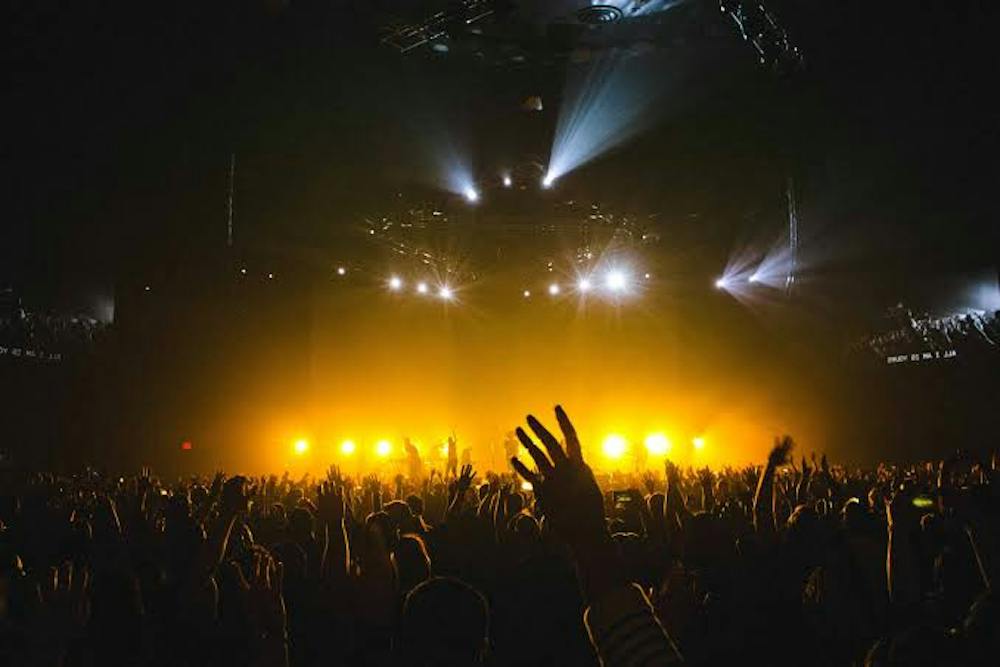
The stage at TD Garden looked less like a concert stage and more like a film set. On Sept. 24, Charli XCX brought her Music, Fashion, Film tour to Boston, turning an arena packed with thousands of fans into a space where a concert, runway and movie could exist at the same time. The performance was built around the idea behind “Music, Fashion, Film,” — Charli’s newest album, that pop music no longer has to exist within the bounds of music alone. Throughout the night, sound, clothing, choreography and cinematography constantly overlapped. Rather than simply performing songs from the album, Charli created an environment that asked the audience to experience the album visually as much as sonically.
This approach marks a noticeable shift from the world of “Brat,” Charli’s 2024 album that became one of the defining pop aesthetics of the past several years. “Brat” was intentionally chaotic — lime green, lowercase lettering and a polished visual identity. “Music, Fashion, Film” moves in another direction. Its black-and-white imagery and sleek styling feel more deliberate, cinematic and controlled. At TD Garden, that change was reflected not only in the music but in nearly every aspect of the performance. The concert opened with “Rock Music,” using flames, smoke and an amplifier surrounding Charli as she entered the stage. From the beginning, the production made clear that this was not intended to be a straightforward album tour. The lighting made it a major pop production, while the live cameras added another layer. Charli was not only performing for the audience — she was also being filmed as she performed.
A cameraman followed her across the stage throughout the show, with live footage projected onto massive screens above the audience. The result was strangely intimate despite the size of TD Garden. Thousands of people could watch Charli through the screens, but the close-up camera shots also made the audience aware that they were watching something being constructed in real time.
That tension between performance and filmmaking became one of the most interesting parts of the show. Concert screens typically exist to make a performer visible to people sitting in the back rows. Here, the camera became part of the artistic language. The audience could see Charli performing while simultaneously watching the process of turning that performance into an image. The introduction of “Fashion” worked the same way, as Charli introduced the background dancers and band through lighting.
During “Card Declined,” models joined Charli onstage in a sequence that resembled a runway show. Charli’s black leather styling and the models’ movements created another visual layer to the performance. Clothing was not simply something Charli wore; it became part of the storytelling.
That distinction is important because fashion has always played a major role in how pop stars communicate their identities. For Charli, however, the clothes felt less like decoration and more like another medium. The same way a song can establish a mood, an outfit or a group of models can establish the visual imagery of the album.
The audience participated in that world as well. Black clothing and leather pieces appeared throughout the crowd, creating a noticeable contrast with the lime green associated with “Brat.” The shift was subtle but significant. Charli’s previous era had become recognizable enough to influence how audiences dressed, posted online and talked about pop culture. At TD Garden, the new aesthetic appeared to be beginning its own visual language.
Still, Charli did not completely abandon “Brat.” Songs including “Club Classics,” “365,” “360,” “Sympathy is a Knife” and “Von Dutch” remained part of the set. She also performed “Silver Cross,” a song from her 2019 album “Charli” that had not been performed live since 2019.
The inclusion of older songs made the concert feel less like a clean break between eras and more like a continuation of Charli’s artistic evolution. Her music has repeatedly challenged the boundaries of mainstream pop, moving between hyperpop, electronic music, experimental production and more conventional pop structures. The Boston show similarly refused to stay within the boundaries of a conventional concert.
The most cinematic moment came near the end. After performing “No One Lasts Forever,” Charli and her dancers remained frozen onstage as filmmaker David Cronenberg’s voice played over the arena. The camera slowly pulled away while the scene appeared in black and white, creating what felt less like the ending of a concert and more like the final shot of a film. It was an especially fitting conclusion to a show built around the combination of music, fashion and film. The performance had spent the previous two hours blurring the distinctions between those mediums and its final moments made that concept explicit.
Yet underneath all of the production, Charli’s music remained central. Songs such as “Apple,” “Wink Wink” and “I’m Afraid” brought more vulnerable themes into a performance dominated by spectacle. The contrast between emotional songwriting and highly constructed visuals suggested that the two do not have to compete. Instead, the visual world can make the music feel larger.
This is ultimately what made Charli’s Boston performance more than an album release celebration. “Music, Fashion, Film” operates as both an album and an artistic concept. At TD Garden, Charli demonstrated what happens when that concept is extended beyond the recording itself. The concert was a music performance, but it was also a runway. It was a film set, but the film was being created in front of the audience. It was highly choreographed and carefully designed, yet still contained moments of vulnerability and spontaneity.
Charli XCX has spent much of her career challenging what mainstream pop is supposed to look and sound like. In Boston, she extended that challenge beyond the music itself. By combining music, fashion and film into one performance, she presented pop not simply as something to listen to, but as something to see, wear and inhabit. At TD Garden, Charli did not just perform “Music, Fashion, Film.” She showed the audience what it could mean.

Please note All comments are eligible for publication in The Justice.