
Why you should watch competitive rock climbing
Rock climbing is a rapidly growing professional sport filled with action
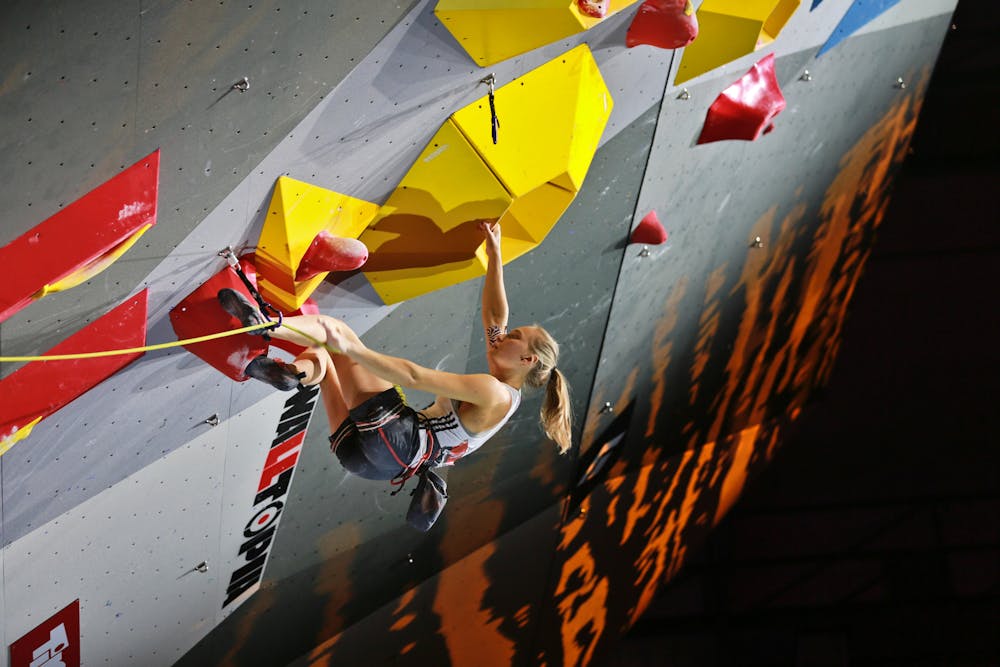
Rock climbing is a rapidly growing sport in the United States and across the world. Once a niche activity with an underground, die-hard community, rock climbing is breaking out into the mainstream. Now, rock climbing gyms are popping up everywhere and the sport just had its debut in the 2020 Tokyo Summer Olympic Games. Many people have tried climbing at a birthday party or as an outing with friends — but if you’ve only tried it once and never paid it more mind, you are missing out on an incredibly dynamic and exciting individual sport.
In 2007, competitive climbing was formalized through the creation of the International Federation of Sport Climbing, now known as World Climbing. World Climbing hosts 13 to 16 competitions around the globe during their season, which runs from early spring to late fall, as well as a world championship every two years. Unlike most professional sports, every competition is free to watch live or after the fact on YouTube. Each competition is split up into three different disciplines: bouldering, lead and speed.
Bouldering — the most popular form of climbing — involves scaling a short but highly technical and physically demanding problem on the wall. Boulder problems are only a few moves, but each move is highly intense, requiring delicate balance, crushing grip strength, coordination and explosive power. In the finals, competitors face four boulder problems, with two minutes of observation time and four minutes to attempt each problem. On each boulder, if you reach the “zone” hold, which is the halfway point in the climb, you get 10 points. If you reach the top hold, you get 25 points, with a 0.1-point deduction for each fall before you reach the top of the zone.
Lead requires competitors to climb a 60 to 80-foot section of wall (which gets progressively harder the higher you go) while clipping their rope into carabiners as they execute the moves. Finalists are only permitted one attempt with a six-minute time limit. Lead climbers are scored based on the highest hold they get to and given a plus if they are moving towards the next hold when they fall or time out. In the case of a tie, the climber who scored better in the semi-finals wins.
Speed climbing is a head-to-head race where competitors climb an internationally standardized route. The scoring for speed climbing is simple: the first to hit the finish button on the top of their climb wins.
The World Climbing Series is an incredibly exciting sporting event to watch. Not only are the climbers capable of mindblowing feats of athleticism, but climbing is such a dynamic sport that on any given climb, you might see each competitor approach it in a different way. Some climbers' strengths are the explosive power that allows them to launch through problems almost as if it’s parkour; others have greater technical skill that allows them to get into positions where they grip crimps smaller than the width of a pencil while balancing on a foothold that is almost too small to see — some will even pull their weight up with the assistance of a heel hooked on a hold above their shoulders. No matter how they do it, the best climbers in the world will find a way to blow your mind that is unique to their own climbing style and athletic ability. Watching climbing makes the competitions so much more engaging. As you watch, you will not only pay attention to your favorite climbers and cheer for them, but you will also pay attention to each climb, notice all the different ways it has been done and look forward to seeing how a new climber will tackle it.
These competitions are always packed with drama and continually developing stories. During the bouldering final, the eight finalists go out in reverse order of how they ranked in the semi-finals and there will typically be two climbers working on different problems at the same time. As each climber goes through in order, you start to get a picture of what the podium will look like and what score you need. However, by the time the first climber out has attempted all the boulders, the climbers who placed the highest in the semi-finals will have likely only tried one or two boulders. This leads to moments towards the end of the competition that will have you on the edge of your seat — often if a climber can do just one of the last boulders, they will make the podium and bump someone out who has already finished their competition. Keep in mind that while the spectators and the commentators are figuring out who has a shot at winning, the climbers are isolated from each other — the only way they can guess someone else's score is by how loud the crowd cheers.
In spite of this, the thing that makes watching competitive climbing truly distinct is that you will almost never find yourself rooting against anyone. If you want your favorite climber to win, you’re simply hoping that they perform the best they possibly can, not that any other climber does worse. Even when another climber completes a boulder or gets further on a lead route, it’s almost impossible not to be happy for them. The commentators and camera crew do an excellent job of capturing the athlete's emotion, and seeing the joy of anyone winning is so compelling that you have to be happy for them.
One of the best examples of this comes from the Wujiang women's lead finals that took place on May 10. Janja Garnbret, undeniably the best competition climber, has won 49 World Climbing gold medals in the lead and boulder divisions as well as two Olympic gold medals at only 27 years old, and put up an impressive performance in the Wujiang lead finals, scoring a 43+. This score rocketed her into first place, an entire 14 points above the next-best score at the time. However, there were still three climbers to go after her. The audience was granted a moment of relief after the next two climbers came out and gave it their all but could not surpass or even get close to Garnbret’s score. Then, the final competitor of the day came out. Annie Sanders, an American athlete was the only one to top out the semi-finals route. Sanders took a much slower approach to the climb, resting far more frequently along the way than Garnbret, who only used five of her allotted six minutes. Sanders fought through the section of the route where every climber but Garnbret had fallen off. After this extremely challenging sequence, Sanders found a position gripping a large hold and mostly supporting her weight on her feet, allowing her to shake out her arms one at a time. Sanders ran down the clock until she had 30 seconds left in her time and found herself with five extremely challenging moves until she reached where Garnbret fell. Noticing the clock, she miraculously managed to bring herself through a technical series of movements to the last hold that Garnbret was on, bringing her score to 43. Then, with just two seconds left on the clock, she leaped for the next hold but missed. As she is lowered to the ground, her score reads 43, and the commentators declare that Garnbret has won gold. But before Sanders even touches the floor, her score is upgraded to a 43+ — a perfect tie with Garnbret, and because she placed higher in the semi-finals, she won the gold medal. When I saw this, I was initially saddened because I had badly wanted to see Garnbret win her 50th gold medal. But then, seeing the look of happiness on Sanders' face and learning that at the age of 18 she had just won her first World Climbing Series gold medal, I was overcome with joy for her achievement.
It is moments like these that make competitive climbing one of the most exhilarating sports to watch. If you find yourself looking for your new favorite interest, it’s an amazing time to start watching World Climbing. Their season is just beginning, and if you start now, you will almost certainly be able to witness the greatest competition climber in history win her 50th gold medal — a moment that will surely be remembered for decades.

Please note All comments are eligible for publication in The Justice.