
The city speaks: Humanities research at Brandeis
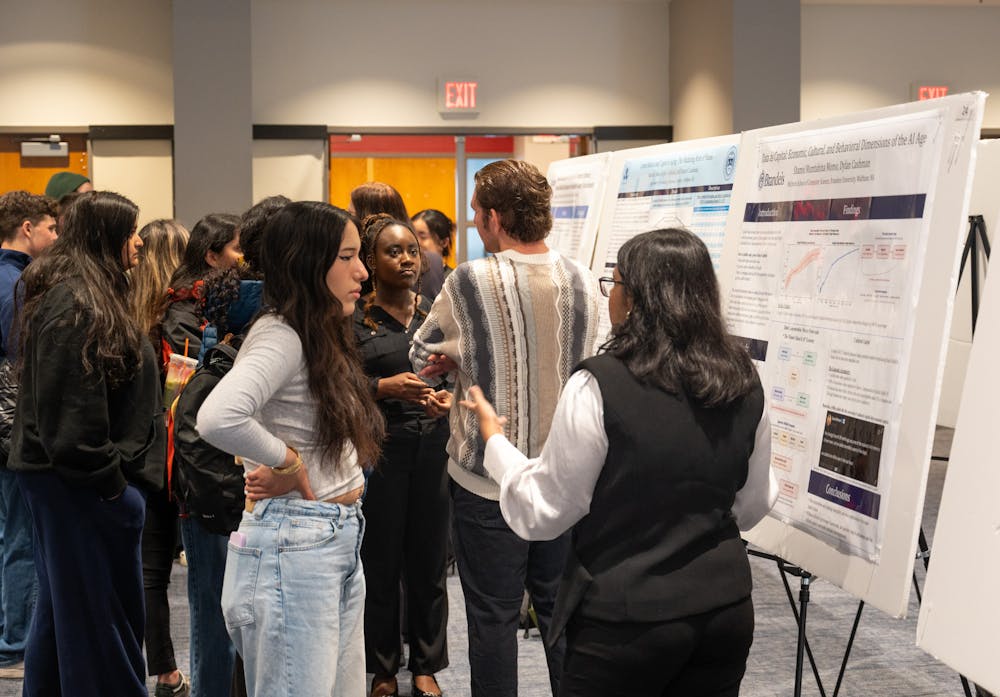
On April 30, the Brandeis Undergraduate Research and Creative Collaborations hosted its spring research symposium. This annual symposium brings together undergraduates who, with the help of faculty and other student mentors, have the opportunity to present research they have completed on a topic of their choosing. To participate, students pick their method of research delivery, whether it be an oral presentation, a poster or a multimedia display. The URCC program offers students a range of academic, professional and personal benefits and connects students with faculty mentors to pursue original research or creative projects, often with access to funding, course credit or paid positions. One of the biggest advantages in participating is skill development: Students build strong research, critical thinking and problem-solving abilities while also improving their writing and presentation skills. These experiences can help students further along in their academic careers. URCC participation also supports career and graduate school preparation. By working closely with faculty and presenting at events such as the URCC symposium, students gain hands-on experience, mentorship and professional connections that strengthen their resumes and applications. Finally, the program provides tangible support, including grants and fellowships (some up to $5,000), enabling students to focus on meaningful projects across disciplines from the sciences to the arts. URCC is a valuable opportunity to explore your interests deeply, gain real-world experience and stand out academically and professionally.
Importantly, the symposium also highlighted the arts’ role as a form of research and inquiry. Artistic and humanities-based projects demonstrated that research at Brandeis is not confined to laboratory settings or quantitative analysis; rather, it can also involve creative interpretation, cultural critique, storytelling and visual expression. In many cases, art functioned as both a research method and a medium through which students communicated complex social and historical ideas to broader audiences. Across all disciplines, the common thread among presenters was their uninhibited passion for their work and their eagerness to share their research with others. This broader understanding of research became even clearer in a interview on April 30 with Evelyn Bagley ’27. Bagley is a junior dual majoring in Anthropology and Politics, with a minor in the History of Ideas. Their research at the symposium was conducted under the Anthropology department, and their presentation was called “Dialogue of the City.” This project was an extension of some fieldwork that Bagley completed in Poland and Czechia during the summer of 2025.
During our interview Bagley shared their leading research question: “In urban spaces, why [do] certain submarks, or inscriptions and graffiti remain visible, but kind of disappear in other places?” This question led Bagley to analyze the markings on different buildings in various cities, in an attempt to understand the discourse we have with the buildings around us. They explained, “I was in three cities: Krakow, Warsaw [and] Prague, and as I was walking around, I noticed that, for example, in Krakow, the city center is pretty much free of graffiti and inscription, but all around it, sites featured different art forms.” As part of their presentation Bagley had three stone tablets, inscribed on them were Bagley’s reprinting of the inscriptions they saw outside of Krakow city center. Bagley’s research does well to emphasize Brandeis’ commitment to interdisciplinary research.
Bagley’s research discusses how art is all around us, but is also tied to cultural and religious beliefs. They stated, “There is quite a bit of graffiti, so it led me to realize that this absence is not random, it’s very spatially patterned. There were churches...Catholic spaces, which is a big part of the culture, and it wasn’t just like people weren’t creating inscriptions there, it was that there was also surveyance. So there’s security cameras... that are kind of like regulating that absence.” They discussed their experience sitting with the absence of graffiti in these religious spaces and how the lack of art was art in itself. Bagley emphasized a discussion around art and creativity being regulated, further commenting on how art is oftentimes censored or created in certain spaces in order to convey a message.
Furthermore, Bagley discussed their time in Poland and what they discovered about Polish graffiti and how it is presented. They said, “I noticed that there are a lot of the sites where you would expect there to not be graffiti like churches and things like that, [but] there was graffiti. So I was able to kind of think about this as part of a Polish context and think about how different cities regulate visuality and absence.” The true beauty in Bagley’s search of graffiti through different cities is how cities speak to us through art and how different people use art to voice their broader desires in the world. This is in contrast to the STEM-focused initiatives of many schools and allows Brandeis to shine as a uniquely social justice-oriented university
This priority is evident through the many new initiatives on the part of Brandeis’ administration. President Arthur Levine ’70 seems to be endeavoring to re-establish Brandeis as a school for the liberal arts, a project that harkens back to Brandeis’ social justice-focused origins. Through the implementation of the microcredential and the inclusion of the humanities in the URCC, Brandeis has been creating opportunities for both STEM and liberal arts students to showcase their interests and research. Additionally, as seen in Brandeis’ redesign of the core curriculum, career development initiatives and second transcripts that highlight career readiness by showcasing student strengths, the University seems to be pivoting from a majority STEM-focused marketing strategy to a broader appeal, highlighting how disparate fields can work together. This is most evident in the URCC — a highlight of our experience at the symposium was seeing how students from diverse fields had equal opportunities to conduct research on their theses and present them. Students had posters showcasing Alzheimer’s research, public health and anthropological studies of graffiti; the one commonality among all presenters was their uninhibited passion for their work and their eagerness to share their research with others. This institutional shift allows students like Evelyn Bagley `27 to transform everyday observations into powerful academic work. Through their study of graffiti and the patterned absence of inscriptions in religious and public spaces, Bagley demonstrated how the seemingly ordinary can reveal profound insights about culture, surveillance, memory and expression. Their project showed that the mundane is never truly mundane — with curiosity and careful analysis, even the walls of a city can become a text that tells stories about the societies that shape them. By investing in humanities research and recognizing artistic practice as a legitimate form of scholarship, Brandeis is encouraging students to look more closely at the world around them and to find meaning in places others might overlook. In doing so, the University is honoring its liberal arts roots and empowering a new generation of scholars to uncover beauty, significance and social insight in the everyday.
The spring URCC symposium has shown how Brandeis is embracing a broader and more inclusive understanding of what research can be. Whether students are conducting laboratory experiments, analyzing historical archives, composing original artwork or studying the visual language of city streets, Brandeis is creating opportunities for undergraduates to pursue questions that matter deeply to them.
Correction: An earlier version of this article miscapitalized the title to read "The City Speaks: Humanities Research at Brandeis."

Please note All comments are eligible for publication in The Justice.