
The Los Ratones experiment
The rise and fall of an esports enigma.
Esports can be a complicated subject when discussed in relation to other sports. Most people would not even define esports events as a sporting event, given the general lack of physical exertion. What gives esports credibility is the competitive integrity that supports the structure of various tournaments. “League of Legends” stands alone as the pinnacle of this competitive integrity, with leagues spanning six continents and a year-round tournament bracket ending in the world championship, “Worlds,” every November. Unfortunately, the competitive integrity comes in a package deal with formality, which can make the sport hard to watch for some. A large draw of most sports is having favorite players and being able to latch on to their personalities. League players are often depicted as unfeeling machines with the all time greatest player, Lee “Faker” Sang-Hyeok being the blueprint for the stone-cold archetype. This lack of personality is where Los Ratones was born.
Marc “Caedrel” Lamont began his League career as a professional player, but quickly pivoted to casting after his retirement. Caedrel had a meteoric rise to popularity as a caster: even his live streams from his home commentating on matches would rival the viewership of the actual live stream of the match, sometimes even having double the online views. The reason for Caedrel’s popularity is simple: He shows his personality. A match being cast by Caedrel is a rollercoaster, where viewers get a vicarious experience of high highs and low lows, not a straightforward play-by-play of the obvious. So, when Caedrel brought up the idea of starting his own competitive team on one of his streams, fans showed an immediate interest. Shortly after, he announced that his team would be entering the Northern League of Legends Championship for the 2025 competitive season, with Caedrel as the head coach.
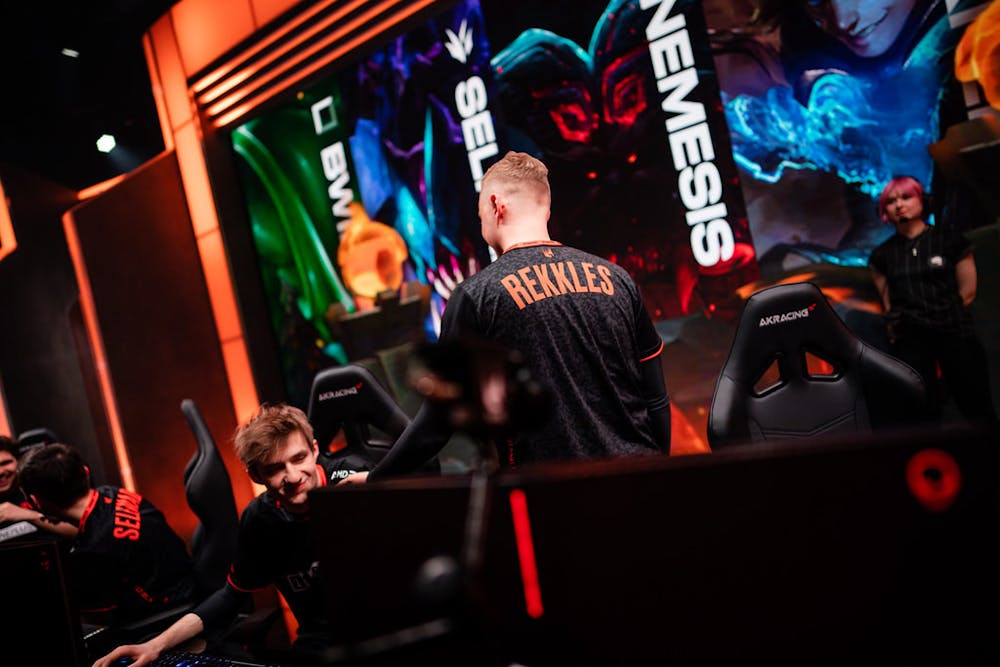
Caedrel was not the only appeal for fans as the rest of the roster was composed of very popular players. Jungler, Veljko “Velja” Camdzic and bot-laner Jus “Crownie” Marusic, were both players who had been in and out of the competitive scene but were both popular for their livestreams of solo climbing the ranked ladder. Then there’s midlaner Tim “Nemesis” Lipovsek and support Carl Martin Erik “Rekkles” Larsson, both content creators who are also renowned European players. Rekkles himself was coming off of a victory at Worlds as a member of the most decorated esports team of all time, South Korea Telecom 1, or T1, which is of course led by none other than Faker. Arguably the biggest draw for fans was Los Ratones’ top-laner, Simon “Thebausffs” Hofverberg, or, as he’s known among the League community, Baus.
Explaining the phenomenon of Baus to those who are unfamiliar with League is incredibly difficult because he finds his success by taking the rules that define the game and throwing them out the window. To win a game of League, you have to destroy the enemy’s base — that’s it. What many players focus on is achieving this mission through killing the opponent as many times as possible; however, fighting is not a mandatory part of League. In fact, you could win without even killing your opponent once. Baus became famous as a top-laner for winning his matches in an unconventional way: by dying over and over again. Normally, dying is considered a setback in League, as you have a set amount of time where you are away from the match where the opponent has time to get a lead in gold and experience. However, Baus played Sion, a character that has a brief revival on death where they can freely move and attack, and he would use this time to push his wave as far in as possible, meaning the enemy laner was often stuck under their own tower despite getting a kill. Baus would also use an extremely finicky technique called proxy-farming, where he would go past the enemy’s tower and farm for gold in the middle of the lane, which leaves him open to being killed by the enemy jungler and top-laner, but Baus planned on that. He would be able to get a lot of farm, and his presence between the enemy’s towers would distract both the top-laner and the jungler, meaning they would both miss out on farm and kills. The enemy team would be able to kill him, but the more you die in League the less gold you’re worth, so at a certain point he would get more gold for dying than the people who killed him.
Much more could be said about Baus and his various playstyles, but what’s important is that he broke the game in ways that even the developers did not know how to fix. Many updates and balance patches were even specifically targeted at his “win by dying” playstyle, but he always adapted because he is not just a lucky person who figured out a glitch in the system, he is a genuinely mechanically gifted player. Naturally, fans were excited when they heard Baus was going to start playing on a competitive stage, since his playstyle seemed like everything that the competitive scene was not. Given his constant jovial personality and sneaky tactics, many said that Baus played just like a rat, giving the team their name “Los Ratones” which actually translates to “the mice” — but Caedrel said that “Las Ratas” didn’t sound as good.
The idea of a League of Legends team that exists purely for the enjoyment of fans sounds like a fantastic idea for community engagement, but critics were skeptical as to whether or not this team could actually win games. Baus had never played competitively before, and Crownie and Velja were also relatively untested. Los Ratones had their first ever game as an exhibition match against T1 at the “Red Bull League of Its Own” event in Paris, and they didn’t disappoint. Despite the fact that T1 players, including Faker, played in off roles and were missing their main support player, Los Ratones still gave a convincing victory that displayed the talent of the team, even as all of the players still used their usual shenanigans. At one point in the game, Baus was even able to kill Faker, a moment of irony given Faker’s nickname “The Unkillable Demon King” and Baus’ parodied nickname “The Very Killable Demon King.” This moment quickly went viral as it was one of the only times fans had ever seen Faker make an actual facial expression.
Next, Los Ratones competed in both the Northern League of Legends Championship (NLC) and the EMEA Masters, both smaller European leagues compared to the League of Legends EMEA Championship (LEC), Europe’s top league. They would go on to dominate both leagues, going undefeated in every split of the NLC and only losing in one split of the Masters, meaning they won four titles in their tenure of both leagues. Given these surprising results, fans began to believe that this could translate to the next level of competitive play, and Caedrel soon announced that given their record, they had qualified to join the first split of the LEC in 2026. The team additionally started a new trend that was soon adopted by other teams: live streaming scrimmage games, often called “scrims.” By showcasing their live communications during games and also inviting popular creators to play against them, fans were able to join in on the team's chemistry and the viewership reflected the popularity. It was not long before other teams copied the trend to try to boost the popularity and personality of their own players.
The team had now entered the highest form of competition in their region, but they could not just run through the teams they played anymore. They emerged from the main season with a five and six record, not a winning season, but still impressive given their rookie status. The unfortunate controversy came during the group stage, where Los Ratones had a four and five record, meaning they would’ve had a spot in the playoffs, as long as the other teams below them did not perform exceptionally well. Unfortunately, they were knocked out after three teams below them, G2 Esports, Movistar Koi and GIANTX won their matches and rose above Los Ratones in the rankings. However, all of the teams they faced, Karmine Corp, Natus Vincere and Team Heretics, went under fire for intentionally losing the games to knock Los Ratones out of the tournament. It’s true that these teams were high seeded so they could afford a loss and still have a guaranteed spot in the tournament, and that players and staff on some of the teams had been previously outspoken about how they consider Los Ratones an embarrassment to the LEC, but no teams were penalized for intentionally losing.
Shortly after their untimely exit, Baus and Caedrel announced that they would be leaving the team. They have since rebranded from Los Ratones to Team Witchcraft, but without the two main draws of Caedrel and Baus the viewership has declined. The team still seemed to have the last laugh, given that LEC viewership decreased to almost a third of its peak when Los Ratones was still in the tournament. Caedrel announced that he was overjoyed with the team's success, as he never thought he would make it to the LEC. The team may have burned out, but comets don’t fly forever and there’s something to admire about a seemingly impossible idea finding success, even if just for a moment.

Please note All comments are eligible for publication in The Justice.