
University honors graduate students in 2026 commencement ceremony
The ceremony included speeches from President Arthur Levine ’70, esteemed author and journalist Isabel Wilkerson and Jin Zhao ’26.
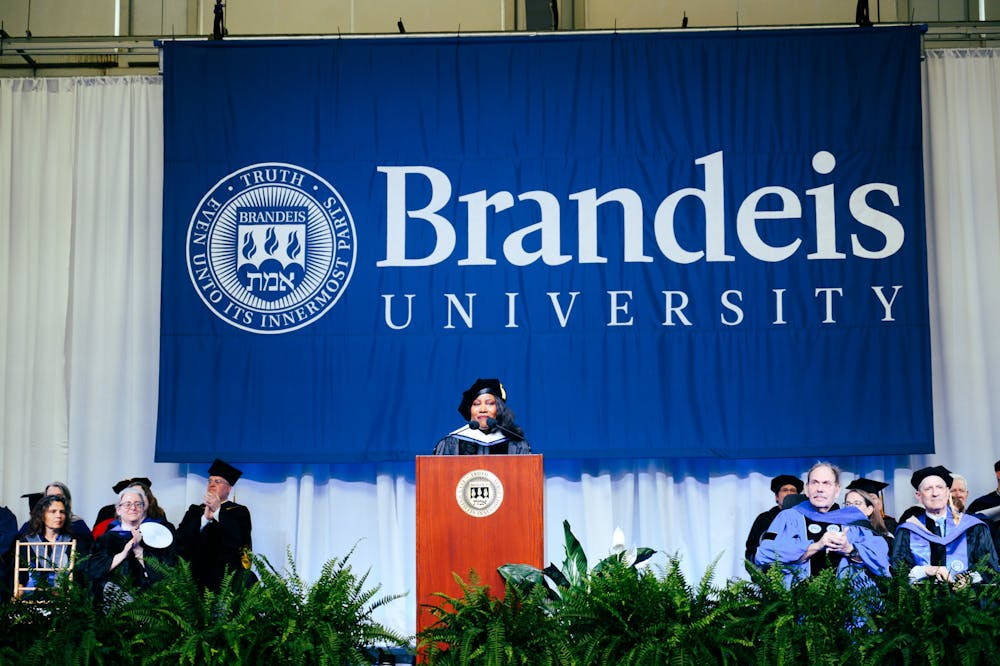
On Sunday, May 17 Brandeis held its graduate commencement ceremony, honoring students receiving their Masters degree, PhD and degree in leadership programs. The ceremony began at 3 p.m. and was moderated by Prof. Charles Golden (ANTH), Vice Provost for Graduate Affairs. Golden introduced Prof. Steven Cecchetti (FIN) as the ceremony’s Grand Marshal, after which Marshals of the Faculty processed. Golden then introduced the procession of the graduate class of 2026. Finally, Golden introduced the ceremony’s honored guests, the president’s party, speakers and the Board of Trustees.
Aaron Spevack, the University’s Muslim chaplain, led the ceremonial invocation. During his remarks, Spevack spoke about the pursuit of wisdom and quoted several sacred texts, including the Quran and the Book of Gospels. After Spevack’s invocation, Golden introduced Madyson Rose Buchanan ’26 to sing the national anthem. Golden then transitioned to faculty and staff recognitions, including retiring professors as well as recipients of this year’s teaching awards. He then introduced Lisa Kranc ’75, Chair of the Board of Trustees to deliver remarks. Kranc recognized the graduating class, as well as their families and friends. Kranc acknowledged some of the adversity the graduating class had to overcome, as they entered Brandeis shortly after the pandemic. She congratulated the group for their exceptional accomplishments and shared that she hoped each graduate found a “personal mission to pursue for the rest of your life.” She also recognized Brandeis’ landmark 75th commencement ceremony and spoke about the University’s founding by the American Jewish community, as well as the school’s longstanding commitment to Jewish values.
After Kranc spoke, Golden introduced President Arthur Levine ’70. President Levine described earning a graduate degree as “a team activity” and urged each graduate to thank their network of family, friends and loved ones for their support. He acknowledged that while the moment may be “bittersweet” for some, “this is not a solemn occasion” and implored attendees to cheer and clap for their graduates. President Levine also imparted three blessings upon graduates. He first spoke about the importance of hope and “hold[ing] tight to your dreams” despite adversity. President Levine then touched on the importance of responsibility as scholars and academics, which transitioned into his final wish of efficacy. He shared that he holds great confidence in the group of graduates and wishes to see them all succeed as leaders in both their respective fields and in the world. President Levine then spoke about Isabel Wilkerson, the keynote speaker, as someone who “embodies efficacy.” Levine concluded by wishing congratulations and success to the class of 2026.
The ceremony continued with the presentation of honorary degrees. The first degree was presented to L. Rafael Reif, accompanied by Marshal Ben Rogers, in recognition of his work in higher education as the former president of the Massachusetts Institute of Technology as well as his celebrated work as an electrical engineer; he was recognized with an honorary Doctorate of Engineering. The second degree was presented to Shai Reshef, accompanied by Marshal Ziva Hassenfeld, for his commitment to inclusion and equity as founder of the University of the People, a tuition-free online university which seeks to make education affordable and accessible. Reshef was awarded a Doctorate of Humane Letters. Finally, the third honorary degree was presented to Isabel Wilkerson, accompanied by Marshal Faith Smith, for her accomplished journalism at the New York Times as well as her achievements as the author of several bestselling nonfiction books. In 1994, Wilkerson became the first Black woman to receive a Pulitzer Prize in journalism. Wilkerson was recognized as a Doctor of Humane Letters.
Wilkerson then delivered her commencement address, and began by wishing congratulations to the graduates and their friends, family and loved ones. She spoke about the resilience and accomplishments of the African-American community, specifically during the the Great Migration in the 1920s. Wilkerson described the challenges in “existential crossroads we now face,” specifically as it pertained to racism and social justice in American society. She spoke about the current political and social climate and stated that “it is time for us to stop being surprised,” urging those in attendance to use their power and knowledge to address matters of injustice. Wilkerson also referenced Albert Einstein’s 1946 commencement address at Lincoln University, and how his willingness to speak at a historically Black university challenged the social norms of the time. Wilkerson urged students and attendees to use their voice and education to change the status quo in a similar manner to Einstein. “We are exactly where we’re supposed to be in the flow of human existence,” she concluded, and received a standing ovation from the audience.
Before the ceremony transitioned into the conferring of degrees, President Levine presented an honorary posthumous degree to the family of Connor Johnson, who was in the process of pursuing a PhD in Neuroscience before passing away in March of 2026.
First to present the graduates of their respective schools was Dean Harleen Singh, representing the School of Arts, Humanities and Culture. Dean Linda Bui presented students from the School of Business and Economics and Dean Susan Birren presented students from the School of Science, Engineering and Technology. Dean Sara Shostak then presented the students from the Heller School for Social Policy and Management, as well as the School of Social Sciences and Social Policy. Noting the large and enthusiastic group of graduates, Shostak stated she was “deeply proud” of the students. Finally, Carmen Aguilar, Vice President of the Rabb School of Continuing Studies, presented the graduates of the Rabb School.
The ceremony proceeded with the graduate student address from Jin Zhao ’26, a PhD student in computer science. Zhao spoke about the importance of language, inclusivity and bridging cultural divides. Reflecting on her own experience speaking a different language at home, Zhao spoke about the ways in which Brandeis taught her how to better understand others and become more empathetic. “Understanding doesn’t begin with agreement. It begins with curiosity,” she said. Her hope for the future, she shared, is that we continue to use developing technologies to include people of various backgrounds, and that “we carry forward the Brandeis way,” by learning across differences and humanizing those who may be unknown to us. Zhao wished congratulations to the class of 2026 and received a standing ovation from the audience.
Golden introduced Amy Cohen ’85, the President of the Brandeis University Alumni Association, who gave brief remarks. Cohen shared that the graduates will join the association’s network of over 70,000 alumni and urged them to remain connected with other Brandeis graduates.
The ceremony continued with the presentation of degrees, which were awarded to students by the deans of their respective schools. Finally, the ceremony concluded with a brief benediction by Chaplain Karl LaClair, Coordinator of Christian Life, who wished the graduates luck in their future endeavors and urged them to use what they had learned at Brandeis as they move forward.
After the recession of the graduates, the ceremony then concluded at approximately 5:45 p.m.

Please note All comments are eligible for publication in The Justice.