Speculation that East may be torn down in coming years rises
The University has repeatedly asserted it has no long-term plans for the space, though the student body has heard otherwise.
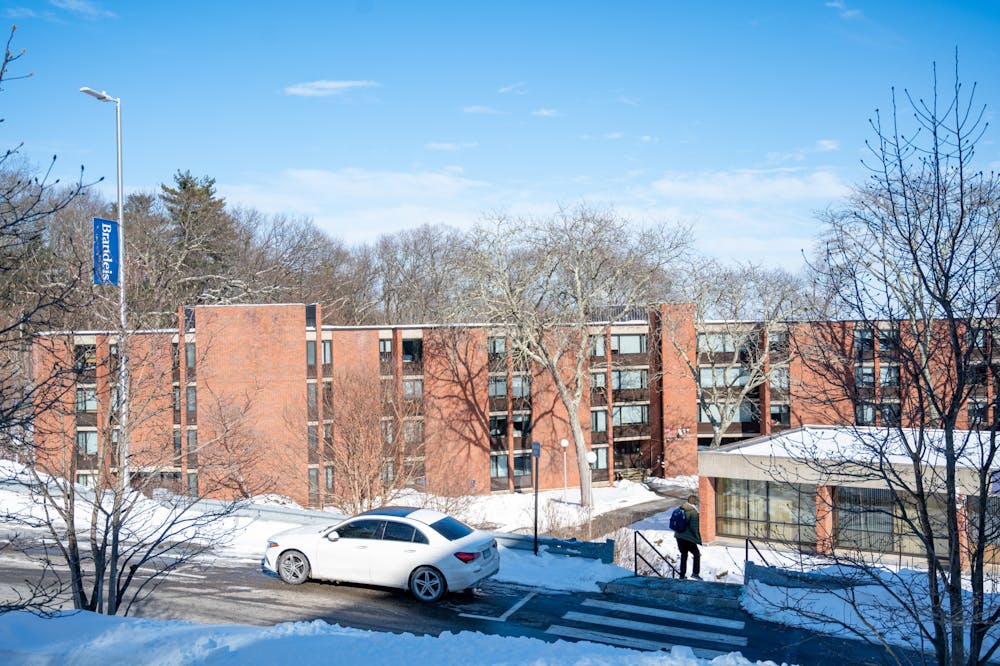
Speculation has arisen about the future of East Quadrangle following the 2026-27 school year. East is divided into four halls: Hassenfeld-Krivof, Shapiro House, Pomerantz-Rubenstein and Swig. Over the years, the residential quad has gained a negative reputation among the community, with students reporting unsanitary living conditions and complaints about the facilities. While the University has yet to comment publicly on the space’s future, many students have speculated that the living area will be torn down following the 2026-27 academic year.
“No decisions have been made by the University regarding the long-term disposition of the East Quad space,” a university spokesperson shared in a Feb. 24 email to The Justice. “The new residence hall scheduled to come online next year will have capacity to house significantly more residents than East, which could present the opportunity to reimagine the East space for future residences and dining facility opportunities,” they wrote. The Justice confirmed this statement in email exchanges with the Department of Community Living’s Assistant Dean of Student Affairs, Tim Touchette, and the University’s Sr. Campus Space Analyst, Liz Pawlack — neither of whom provided additional comment. As of press time, Brandeis’ Director of Campus Planning, Sarah Holton, has not responded to The Justice’s request for comment.
In a Feb. 27 interview with The Justice, Isla Edwards ’28 spoke about her experience as a Community Advisor in East Quad. She stated that spring 2027 is the last semester students will be able to live there — its closure will coincide with the new residence hall’s opening to mitigate housing shortage concerns. The new residence hall is currently in the midst of construction behind the Spingold Theater and is set to open in fall 2027. It is expected to house approximately 650 students. East has the capacity to hold about 400 beds, though students have reported that many rooms remain vacant, as many students opt to live elsewhere during their sophomore year. Those who do live in East, however, are primarily sophomores, alongside a few mid-year transfer students and first-year students. Conversely, the new residence hall is expected to be a living space for upperclassmen.
When asked about the future of East Quad, Edwards said that before the beginning of the year, a University official spoke to Community Advisors and shared plans to tear down East Quad following the 2026-27 school year. The Justice could not confirm which official spoke to Community Advisors as of press time. “East will be coming down after spring 2027,” Edwards said. Before the buildings are demolished, she shared that the University will first have to determine what to do with the various furniture and appliances inside the buildings.
When asked about East’s reputation among students, Edwards was candid, stating that “Brandeis students hate East.” She reflected on hearing negative sentiments about East as early as her first year at Brandeis, recalling that her initial impression of East was not positive. She shared that East’s dated design — the University constructed it in 1964 to embody the period’s Modernist style — has limited it in several ways, especially in comparison to Skyline Residence Hall’s contemporary look. For instance, she described, that East lacks elevators, the pipes are noisy, the walls are thin and the hallways are quite narrow. “We can feel that the building is old and due to be torn down, but it has a rustic charm,” Edwards said. She stressed that she personally enjoys living there, the best aspect being its proximity to prominent buildings on campus such as the Intercultural Center, the Brandeis Counseling Center, Gosman Sports and Convocation Center, Usdan Student Center and the Rabb steps.
As a CA, she shared that she enjoys working at the quad because it is not an incredibly taxing job and she does not have as many residents to provide support to, as opposed to the role of a first-year CA. She mentioned that while she is supposed to be servicing a certain number of students, many rooms on her floor are unoccupied, making her role less stressful.
Edwards also clarified how DCL oversees the area. Currently, East and Skyline are supervised by the same Area and Assistant Area Coordinators in what is known as a joint area called “Eastline.” She explained that CAs from both East and Skyline often work alongside one another, as well as the area supervisors. As of press time, Matthew Wuerthele, East Quad’s Area Coordinator, has not responded to The Justice’s request for a comment. Following East’s demolition, Edwards shared, North Quad and Skyline will be combined into a joint area. Edwards noted that this was an “interesting” decision, as North serves first-year students while Skyline is primarily sophomore housing. However, she shared that she thinks this decision will ultimately better serve both areas and is “excited to see how that plays into student engagement.”
Students have also raised concerns about the future of the Intercultural Center — which is housed in Swig Hall’s lower level — should East face demolition. Edwards’ main concern about East’s possible demolition is how it could impact the ICC’s operations, though she does not think the center will be demolished when “East comes down.” She believes there could be plans to relocate it and trusts that DCL has considered the necessary logistics. In a March 6 statement to The Justice, ICC Director Peter Rojas affirmed that the University has not made any decisions regarding future plans for East, which includes the ICC. Edwards also expressed concern about the future of wildlife living around East Quad, given the area’s proximity to the woods, and noted that many residents often see animals in or around the quad.
Edwards was unsure about the future of the area, though she believed University officials mentioned plans to convert the space into potential office buildings or classrooms. As the University has not released an official statement about these plans, the area holds potential to service students in various ways outside of its current role as a residence quad. As the University continues to build its new residence hall in hopes of attracting prospective students and modernizing the campus, questions about the future of East Quad remain unknown to both current residents and the student body at large.

Please note All comments are eligible for publication in The Justice.