
A sea of green
Students join thousands at the South Boston St. Patrick’s Day Parade celebrating the city’s Irish roots.
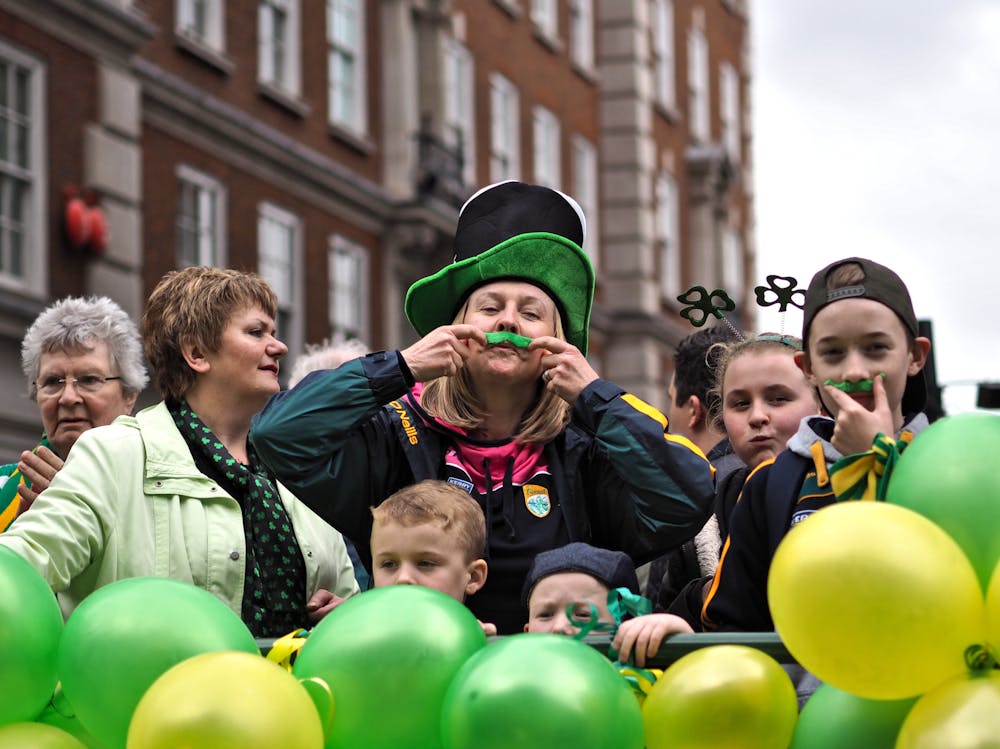
Each March, the South Boston St. Patrick’s Day Parade draws large crowds of local residents, tourists and college students to one of the city’s most well-known celebrations. The parade, held this year on March 16, is a cultural tradition, neighborhood event and citywide social gathering.
Boston’s connection to the holiday traces back to one of the earliest St. Patrick’s Day celebrations in North America in 1737. The South Boston Parade is also tied to Evacuation Day, which commemorates the British withdrawal from Boston in 1776.
For many students, the parade felt like a shared Boston experience. “It was really great to see a lot of Brandeis students there,” said Arnav Srivastava ’28 in a March 16 interview with The Justice. “We were walking around, and . . . we ended up running into a bunch of people. That was really nice. It's nice to see that so many of us went out.”
Srivastava said that what stood out most was how involved the crowd felt in the event itself. “It’s a really interactive thing. Everybody wanted to be a part of it, and you could tell it was really high energy and that’s really great,” he said. He added that the parade did not feel limited to one age group or one kind of attendee. “There were parents, there were old people, there was everybody. And so it was [a] for-everybody type of celebration.”
The massive amounts of support and participation for St. Patrick’s Day comes from Boston’s historical connections to Irish culture. The city’s strong identification with Irish heritage comes from centuries of immigration and settlement, especially during the 19th century, when Irish immigrants became a major part of Boston’s community. Today, that history still influences the identity of neighborhoods like South Boston and contributes to the scale of the celebration each year.
Students who were new to the festivities said the size of the parade and the mood around it made it feel distinct from other city celebrations. “This is the first year that I went. I think it’s the first year my friends went as well, and I think we all agreed that this is definitely something we want to keep doing for the next year as well,” said Srivastava.
For Ellie Ji ’28, who also attended last year’s parade, this year felt more controlled and easier to navigate. “The cops were very diligent this year. They weren’t letting people cross certain areas. They were trying to break up fights very quickly,” Ji said in a March 16 interview with The Justice.
She said the difference was noticeable compared to last year: “Overall, the parade was much more well-managed this year in comparison to last year. Because people seemed to get the gist this year, maybe because it was cold . . . there weren’t always places to go, so there was less shoving, less stomping. There were also just more cops in general, and they were clear about which streets were blocked.”
Even with the heavy crowds, Ji said the event still felt social rather than chaotic. “It’s just a few hours of insanity where you get to meet a lot of people who are proudly Irish and will tell you about it. But also just people from other schools, other local areas,” she said. Ji said the parade’s appeal was the atmosphere around it. “I think it’s a very communal environment and there are a lot of people supporting each other.”
Boston brands St. Patrick’s Day as part of its public identity, particularly in sports culture and local tradition. The holiday overlaps easily with symbols that already define Boston, from South Boston itself to the Boston Celtics’ green color scheme.
Tara Powell ’28, who grew up in the Boston area, described St. Patrick’s Day as something that had always been present in local life, even outside the parade. “Boston has always been super [into] St. Patrick’s Day. It’s patriotic,” Powell said in a March 16 interview with The Justice. She continued that celebrations for the holiday typically begin before the parade. “There would be little pop-up stores when you walked around Boston that sold merch of being Irish [or] of the Celtics.”
Powell said that growing up around the holiday made its local importance feel obvious. “I get patriotic about it, because . . . it’s been around me my whole life in the Boston area,” she said. “People sell it. This is a Boston thing.”
For students from outside Massachusetts, that local intensity stood out. Ji compared Boston’s St. Patrick’s Day culture to what she had observed in California. “I think that this is maybe more of a Boston thing in comparison to the Bay Area,” she explained. “I guess San Francisco has a bit of this culture. But they do not go nearly as hard as Boston does.”
Students pointed to the actual procession, not just the crowds, as one of the most interesting parts of the day. “My favorite part [was] seeing some random floats, some random attractions,” Ji reflected. “They had a school for Irish dancing and these kids were dancing down the street. That was cute. They had red coats.”
Mark Sheehe ’28, a student at Purdue University with an Irish heritage came to Boston to celebrate the holiday. Sheehe pointed to similar details. “My favorite thing was, there were a bunch of tap dancers, or like Irish dancing. There [were] people our age doing it, which was really cool to see,” Sheehe said in a March 16 interview with The Justice. He also connected the parade’s popularity to the city’s history. “I think it’s cool to be in Boston, because Boston has a background of being Irish. So there’s some history there with that.”
For many, the combination of history, energy and local identity is what makes the parade feel specifically Bostonian. Srivastava said the event recognized Irish traditions and culture. “It’s beautiful to see. There’s a very thin line between appropriation [versus] appreciating a culture, and I feel like nobody dipped into [appropriation],” he said. “Everybody was appreciating the culture, and it didn’t feel like anybody was stepping over the boundaries.”
The event brought together people from different institutions, neighborhoods and backgrounds. Ji summed the event up in simple terms: “Have fun. Be Irish. Bring a coat. And definitely make sure you go next year. It’s definitely a good Boston experience for any college student or anyone here.”
—Editor’s note: The Justice Layout Editorial Assistant Ellie Ji ’28 is a source in this article, but did not otherwise edit or contribute to this piece.

Please note All comments are eligible for publication in The Justice.