
“We can’t sit this one out”: Prof. Sabine von Mering reflects on December arrest
Massachusetts police arrested Prof. Sabine von Mering and three others outside ICE's New England Regional Headquarters as the group was attempting to deliver humanitarian aid.
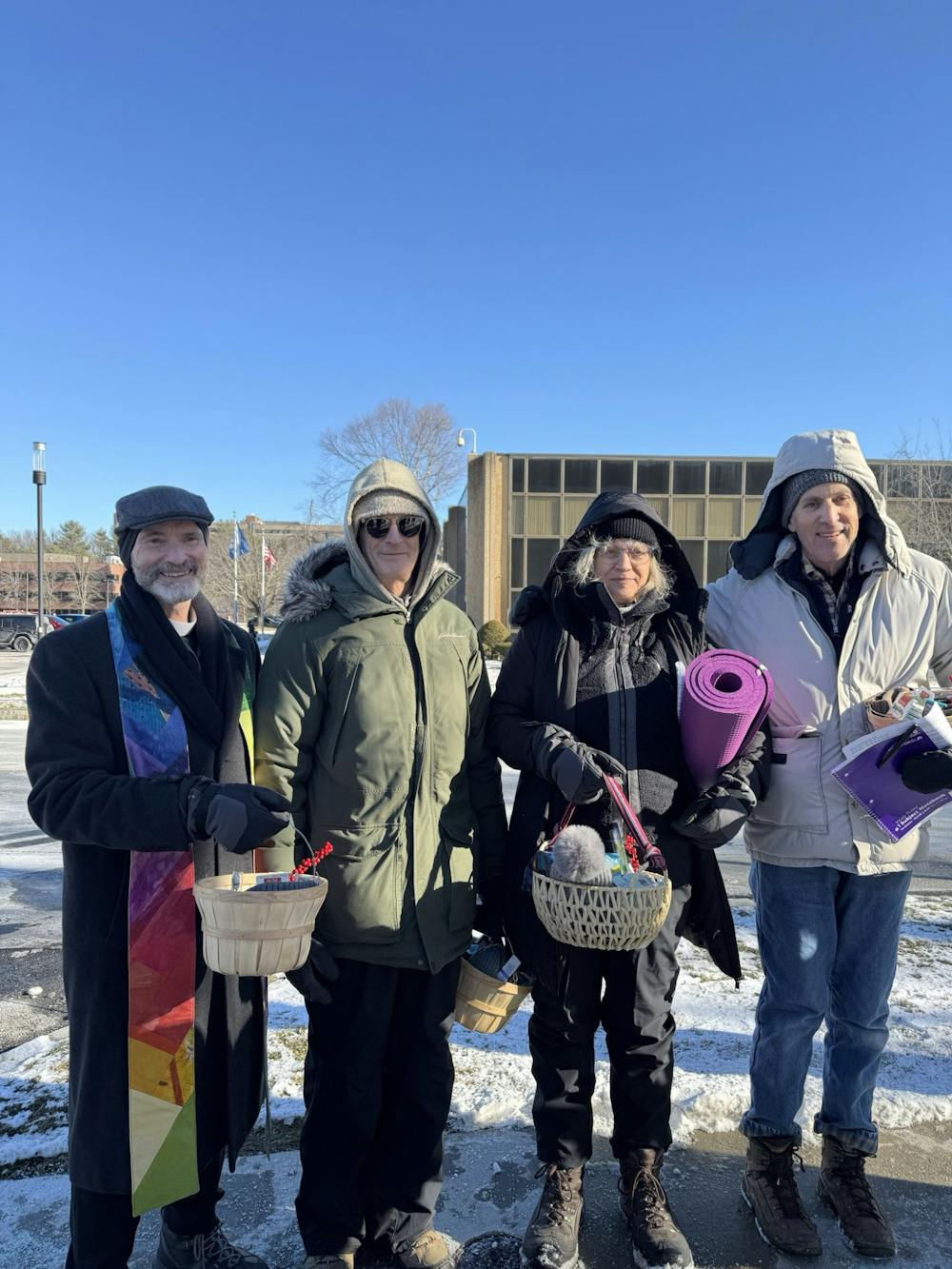
On the cold morning of Dec. 16, Prof. Sabine von Mering (WGS/CEGS), Fred Small, Eric Segal and Roger Rosen arrived at Immigration and Custom Enforcement’s New England Regional Headquarters in Burlington with the intent to deliver aid to individuals detained inside. Within hours, the group found themselves in handcuffs, facing two civil court charges: trespassing and disturbing the peace.
“We wanted to make sure that here in Massachusetts, we live our values and especially during the holiday season,” Prof. von Mering said in a Jan. 23 interview with The Justice. The care packages included food, water, menstrual products, medicine, thick socks and hats. “It’s tradition. You give gifts, you bring things, you care for each other. You express your love for each other,” she said.
Prof. von Mering frequently heard updates regarding dismal conditions inside the Burlington center, specifically through attending vigils hosted by Bearing Witness New England. These updates were informed by eye-witness accounts from U.S. Representative Seth Moulton’s visits in June and November, as well as news of an aid group’s September arrest outside the facility.
As of press time, ICE has not addressed concerns from civilians nor representatives, having illegally denied Representative John Larson from entering the center on Jan. 29. The center is an administrative building that was not built to detain people for long periods of time and lacks washing, medical and sleeping facilities, leading to reports of “inhumane” and “humiliating” conditions.
The above sources corroborated that the regional headquarters were not intended to be a detainment facility, a sentiment confirmed to WickedLocal in 2007 by the then-New England regional director of ICE, Bruce Chadbourne. According to WBUR, Chadbourne has not responded to recent requests for comment.
“This is disturbing my peace. This should be disturbing all our peace, the fact that this is happening in our midst, that is so disturbing,” von Mering said in light of the allegations of inhumane conditions and the increasing violence committed by ICE officers — such as ICE officers fatally shooting civilians Renee Good and Alex Pretti on Jan. 7 and Jan. 24, respectively.
Prof. von Mering said that her group arrived at the New England Regional Headquarters early and that it didn’t take police officers long to arrest them. GBH News states that the Burlington Police confirmed it arrested four adults at 11:15 a.m. for “trespassing and disturbing the peace.” In a statement to GBH Boston, Police Chief Thomas Brown said that the group was “told repeatedly to disperse from the front entrance and refused to do so after multiple attempts.”
“When you’re in that situation, you don’t pay attention to the time,” von Mering said. “I just know that I sat in the police car for a long time — very uncomfortably — because they handcuffed me behind my back with metal handcuffs.” She was handcuffed for approximately an hour, the duration of the ride back to the police station. The officers removed the handcuffs at the courthouse, replacing them with shackles around her ankles.
“We had to wait another hour or so, and then they took us into the courtroom and brought us before the judge. We had to walk upstairs with the ankle shackles, which was an interesting experience,” Professor von Mering said. As she was charged with trespassing and disturbing the peace, her next pre-trial hearing has been scheduled for March 24 in the Woburn District Court.
As von Mering reflected on her arrest and legal proceedings, she expanded on her perspective as a Germanist and her family’s ties to Germany, given the country’s history of fascism. Both of her grandfathers served as German soldiers, though one who was a Lutheran pastor joined the Confessing Church, a Protestant resistance movement opposing Adolf Hitler’s manipulation of churches as vehicles for propaganda. Although she once believed her grandfather did not take enough action in protest of Hitler’s ideology, these recent events have caused her to reconsider.
“I’m thinking, what am I willing to risk? Professor von Mering asked. “I see him very differently now, and I’m learning from that.” When she considers her grandfather’s efforts, she reflects on the millions of Germans who dissented with Hitler but were too afraid to take action. She pointed to a lack of “democratic muscle” present in Germany at the time; whereas, modern American society has more experience in understanding and upholding democracy.
To von Mering, this experience is what drives people to engage in mutual aid efforts, hold vigils and protest. “Democracy is not a spectator sport, and I learned that from Americans,” she said.
“There is a lot we can do — all of us — and I want people to be encouraged to try to stand up, to try to speak out, to try to participate in the many, many ways in which people are pushing back against this regime,” said von Mering. She asserted that Trump’s cabinet is a regime, rather than an administration as their efforts have “hollowed out” the structures put in place to restrict the government. She cited the mass layoffs enacted by the Department of Government Efficiency in 2025 as eliminating anyone in government capable of upholding these protective measures.
“We can’t sit this one out,” Prof. von Mering asserted. To her, the ability to uphold democracy stems from active organization and engagement, often requiring a degree of personal risk. As her case progresses, she hopes her arrest is perceived as an act of encouragement, to show others that activism is well within reach.
— Correction: An earlier version of this article misstated the name of a reporting outlet cited. “Great Blue Hill Boston” now reads “GBH News.”

Please note All comments are eligible for publication in The Justice.