
Surviving Through Art
Graphic narratives at the Kniznick Gallery show how Holocaust survivors documented their experiences through art.
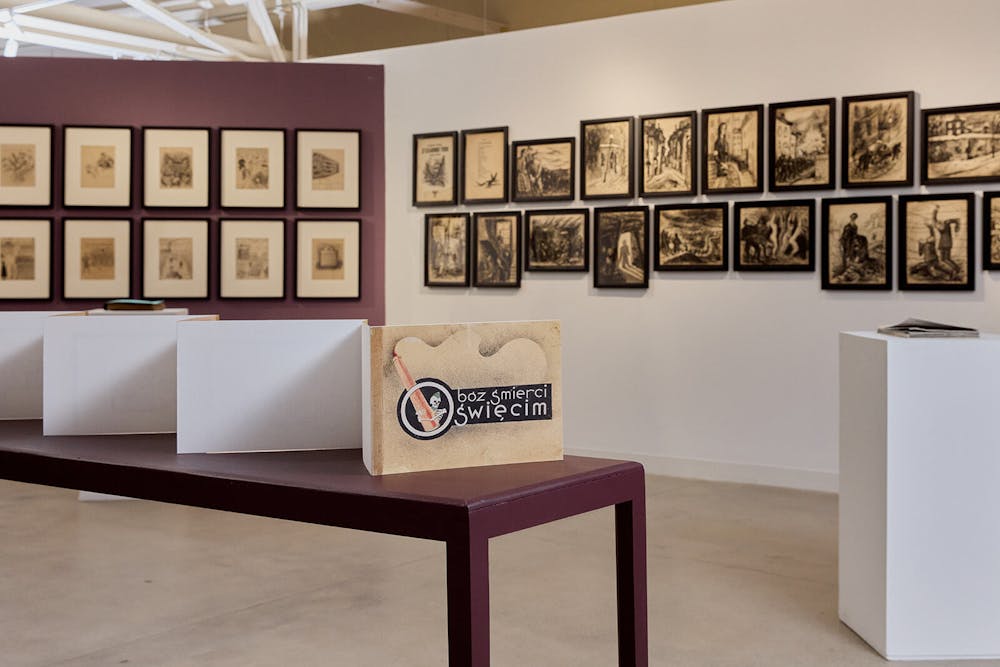
On the edge of Brandeis University’s campus, sits the Kniznick Gallery, located within the Women’s Studies Research Center. Each year, the gallery hosts an exhibition organized by the Hadassah-Brandeis Institute, a research institute dedicated to promoting scholarship at the intersection of Jewish studies and Women’s and Gender Studies.
This semester, the gallery is hosting “Who Will Draw Our History? Women’s Graphic Narratives of the Holocaust, 1944-1949,” an exhibition featuring graphic narratives created by women during and immediately after the Holocaust. The exhibition highlights the work of 10 Jewish women who survived to tell their stories through art. The exhibit opened Jan. 27, International Holocaust Remembrance Day.
Rachel Perry, a scholar in residence at the Hadassah-Brandeis Institute and guest curator of the exhibit, led the research and curatorial work behind the exhibition. She hopes the exhibition encourages students to reflect on the range of experiences represented in the artwork. “What I want students to take away from it is how diverse their experiences were, and then their artistic responses to it,” Perry said in a Feb. 5 interview with The Justice. “They’re describing some of the same things, but in very different ways, with different means and different approaches.”
Amy Powell is Senior Assistant Director for Communications and Engagement at the Hadassah-Brandeis Institute. Powell believes the exhibition reflects the core mission of the Hadassah-Brandeis Institute. “All of this is important in terms of HBI’s mission, which is that we promote and create scholarship at the intersection of Jewish studies and gender studies,” Powell said in a Feb. 5 interview with The Justice. “Often, women’s narratives get lost. So part of our mission is that we want these stories known, and that’s why this exhibition is so important to our mission.”
The centerpiece of the exhibition is the “Auschwitz Death Camp” album created by Zofia Rozenstrauch, later Naomi Judkowski (1920–1996). “Rozenstrauch is kind of the backbone of the exhibition,” Perry said. The album is created in an accordion-fold format that unfolds laterally to span 30 feet. It is displayed at the center of the exhibition, spread out so viewers can see each panel in sequence. The accordion-fold structure guides viewers through the testimony step by step.
Furthermore, this piece was used as forensic evidence. A monitor behind the work shows the 1961 trial of Adolf Eichmann, a convicted war criminal and one of the major organizers of the Holocaust. “You can see he [the prosecution] is carrying the same album into the courtroom and asking her to describe her experiences in Auschwitz,” Perry said. “Using the album as evidence, asking ‘is this how it was?’ And each time she says, ‘yes,’ it was exactly like this.”
Beyond its artistic value, this piece was especially significant because it provided one of the only ways prisoners could document their experiences. “Prisoners, victims did not have cameras in the camps. They couldn’t record anything,” Perry said. “I think people will be really interested in how art is being used in this function that we usually think of as photography serving.”
Rozenstrauch herself never knew her paintings were used in the trial. She left her work in Warsaw after the war. She married and changed her name, meaning it wasn’t until 2005 that Rozenstrauch was identified as the author of the works.
Unlike many other postwar documentation efforts, many of the creators of these pieces were amateurs or artists in training, with some only beginning to make art in the ghettos and camps. Some of the artists, including Rozenstrauch, Lichter and Liebermann-Shiber, even attributed their survival to their artistic skills.
Perry refers to these women as “first responders,” documenting their experiences before there was even language to describe them. “This predates the creation or use of the term Holocaust,” Perry said. “The word Holocaust can’t be found in any of these works.”
The exhibition required a significant amount of work and collaboration to bring together. “There was a huge amount of collaboration for this exhibition,” Powell explained. “We gathered an enormous number of University partners, and partners from outside the University, like local partners. Additionally, we created a host committee of collaborators from the community who helped us identify funders and make donations to support the exhibition. And we also applied for and successfully received a grant from the Delmas Foundation.”
Students were also involved in the curation process. Elizabeth Cross ’27 is a student docent at the gallery. “As docents, we are responsible for showing people around the gallery, answering any questions they have and making sure they have an informative experience at the gallery,” Cross said in a Feb. 5 interview with The Justice.
Cross believes Brandeis students have a responsibility to pay attention to issues like this. “We are inheritors of Brandeis’ legacy, which is to support minority communities, including Jewish communities,” Cross said. “That is part of why the work we do at HBI is so important and why this exhibit is so important.”
The exhibition also places students in conversation with Brandeis’ founding and its historical context. “Brandeis was founded in 1948, at a time when antisemitism was extremely high, and World War II was only very recent history,” Cross said. “These works talk about the postwar period and the efforts that these women made to preserve their memories and the memories of others in the form of graphic narratives. I think it’s important for Brandeis students to come see it and understand that we are contributing to the legacy of preserving these stories.”
Tal Pemstein ’26 is the Weinberg Arts Intern for the Kniznick Gallery. “I work with both the WSRC and HBI to do basically all of the arts-related programming and work,” Pemstein said in a Feb. 5 interview with The Justice. “For this particular exhibit, my responsibilities have ranged from editing interpretive materials like labels and wall text to physically hanging the work on the walls.”
Pemstein believes this exhibit is like no other. “It’s been a really powerful experience to get to see these particular works in this exhibit,” Pemstein said. “As a Jewish person who has been in a lot of spaces of learning about the Holocaust and engaging with topics around the Holocaust, I actually don’t think I’ve ever seen something quite like this, where the content has all been, or for the most part, been created after the fact, but so soon after the fact that there’s this sense of continued processing and this immediate response to incredibly traumatic events, both for the individuals and for the community.”
Powell said she hopes the exhibition will help personalize the Holocaust for viewers and make its history more immediate and tangible. “Even though none of these women knew each other, and they didn’t all have the same experience, there’s many frames from different artists that show the exact same thing,” Powell said. “Maybe in a different artistic style, but you can see that it must have happened. To be told something happened, and then to see a picture of somebody throwing rocks, or frozen water on a person, or a pile of bodies, it makes it real.”
Powell added that the graphic format makes the exhibition especially accessible to viewers. “It’s also really accessible,” she said. “It’s almost this weird juxtaposition of a cartoon, or comic strip, but with such a serious and gruesome subject matter.”
The impact of the exhibition comes not just from the stories it tells, but from the experience of seeing the works in person. “The tangibility of these works is extremely important,” Cross said. “Even while in captivity, or while just recently having escaped captivity, these women were working with whatever they had, with poor materials, very few materials, to try and tell a story with a great deal of urgency. It’s important to come see that in person and understand that part of it.”
Powell said the exhibition was also designed to allow visitors to engage directly with the work and experience it as a whole. “We have a lot of original work, but we also have copies of that work so that people can touch it and look at it sequentially and really get involved with it tactically,” Powell said. “I think that’s important, to take some time to really dig into the work, and also to see the way the room is set up, to see it together, to see how it’s kind of in conversation with each other. It is the first and only time that all this work’s been displayed together anywhere.”
Pemstein said the exhibition offers an experience that cannot be replicated through books or online images. “It’s easy to process if you’re just looking at it in a book, or if you’re just looking at it in the online images,” Pemstein said. “And there’s something about standing in the gallery and seeing it in person.”
Additionally, the exhibition focuses specifically on women’s perspectives, bringing attention to experiences that were not always preserved in traditional accounts. “Often history has been written by men,” Powell said. “They favored their own narratives, and in this particular case, where things were released immediately after, a lot of the narratives that existed were those of the perpetrators or those of the liberators, but not necessarily the victims.”
Powell said the exhibition also highlights the circumstances under which these works were created. “I think it shows that, in the midst of incredible hardship, displacement, grief, poor health and no resources, people managed to create something, which is remarkable,” Powell said.
Powell hopes visitors will reflect on the exhibition in their own way. “I just hope when people experience it, they experience it fully, in its historical context, and then make any connections they want to make about whether it resonates with them or connects to events they’re seeing around the world now,” Powell said.
Perry said she hopes the exhibition will challenge common assumptions about how and when survivors began documenting their experiences. “My big intervention here is that, first of all, people created right after the war,” Perry said. “It’s not true that there was a silence, and that survivors only started doing this later. No, they did it almost the day that they were freed. This compulsion, this mandate to record what they had seen, what they had endured and also witnessed.”
The structure of the works is also essential to understanding their purpose. “All of these works are not single works, like a single image, but they’re meant to be read as a narrative, as a sequential narrative, taking you from a beginning to a middle to an end, and to pull you along on this journey,” Perry said.
The Kniznick Gallery is open Monday through Thursday from 10:00 a.m. to 4:00 p.m. and Friday and Sunday from noon to 4 p.m. The exhibition will remain on view through April 30, 2026.
—Editor’s Note: The Justice Features Editor Alyssa Wu ’29 is employed by the Kniznick Gallery, and wrote this article.

Please note All comments are eligible for publication in The Justice.