
Community Circle: what colleges can do to support students and their wellbeing
Students engaged in empowering conversations with an administrator and guest speaker who not only listened but promised change.
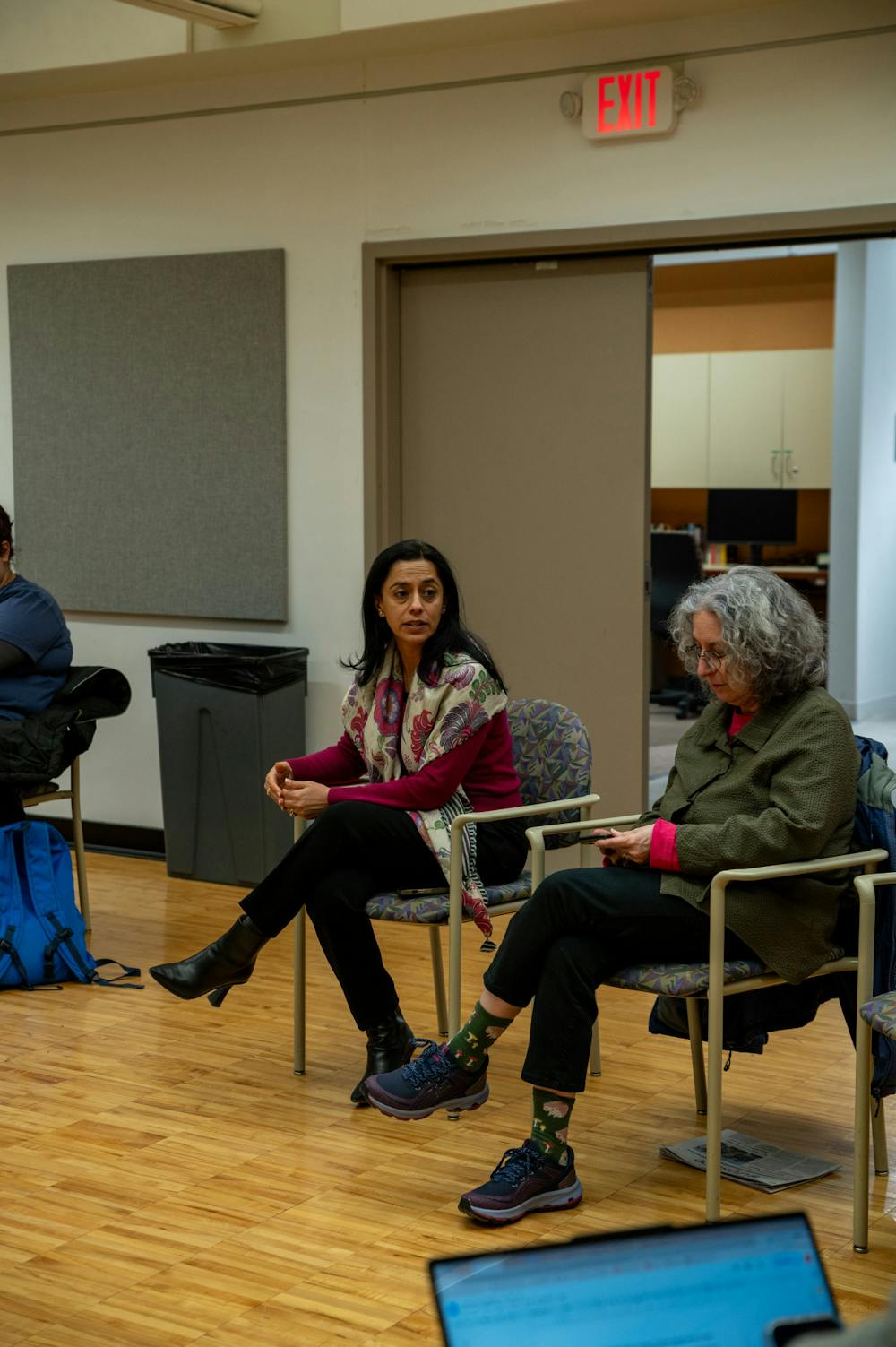
On Wednesday, Feb. 4, the Women’s Studies Research Center hosted a community circle in collaboration with the Student Union. The focus of the event included a discussion of what colleges can do for students’ wellbeing, with special emphasis on student life at Brandeis. Led by the Dean of the School of Arts, Humanities and Culture, Harleen Singh (WGS), as well as author and Brandeis alum, Michelle Bowdler ’86, the event was an inviting space for students to share their experiences. Bowdler, also preparing for her 2026 book release, focused on the change in data regarding youth wellbeing in relation to current events — and is also looking for relevant insight from students.
Inside the studio-esque room of the Epstein Building, chairs were assembled into a circle that seated students and speakers together. Naim Kim ’26, the WSRC Communications and Program Intern, introduced Dr. Singh and Bowdler with friendly-fire jokes regarding Singh going in and out of the room for a bite of AK’s pizza.
Bowdler, using her previous experience as a higher education professional at Tufts University, initiated the conversation with a sense of understanding. “The admissions process is so stressful in itself and everyone is promised that you’re going to have the best time ever,” Bowdler prefaced to the students in the room. She shared that the reality of college is that things aren’t always sunshines and rainbows, no matter how much you’re promised they will be.
Dr. Singh continued the conversation, tying in her experience as Associate Professor of Literature and Women's, Gender and Sexuality Studies as well as a dean. She added that prospective students may be ill prepared to, “navigate yourself, and your feelings, and your emotions, and how that is not something you can be educated out of or educated into.” She emphasized that one’s feelings aren’t understood through education or experience alone but rather a continuous journey of both. “You live, you get older, and you put one foot in front of the other,” she explained.
One student asked how to navigate sharing one’s feelings with friends. With insights from overseeing a counseling center, Bowdler answered, “It’s okay to have a conversation where you’re really encouraging someone to tell you the truth.” She described scenarios where friends of a student were worried about them and sought counseling for themselves, which is universally relevant across all college campuses.
Reflecting on the intrinsic good nature of people, Singh explained, “I think that in some ways, being good has preoccupied us so much that … we’re hesitant always about how to live … You learn sometimes by making a mistake.” She emphasized that our individual moral compasses should not become a burden that paralyzes us from living, but rather a reminder that making mistakes is normal.
Another student asked a question about creating boundaries and building healthy communication with family. Singh introduced a running South Asian joke that Indian comedians like Zarna Garg often reference: the idea of trouble deriving from feelings. Underneath this layer of “poking fun,” Singh mentioned, “It’s important to realize what that kind of cultural practice, that kind of understanding of emotions or relationships has meant for you, but also meant for the generations before you.” As a mother herself, she reflected on how parents sometimes pass on what they learned to their children without thinking about how it oppresses certain feelings.
From these cultural commonalities, the room sparked with conversation and a sense of feeling seen. The topics shifted from navigating friendships to communicating with family within cultural contexts seamlessly. Singh suggested that sentiments of acknowledgement, gratitude, humility and growth are vital to create and develop boundaries. Additionally, Bowdler shared her liberating transition from high school to college after she came to terms with not always getting perfect grades.
As the conversation proceeded, laughs and experiences permeated the air. However, the conversation wasn’t solely limited to student wellbeing and relationships, but also actions administration can take to better support these issues. People started unpacking the student perspective one after another: the institutional facade of resilience that is overcome by institutional liability, the lack of awareness and access to our administration, inconvenient facility hours, the costly expenses for tuition and housing, as well as false promises from other administrators.
One student pointed out the previous town halls that didn’t amount to much because of the inconvenient times or indifferent attitudes. This was not the case for this event that embraced compassion and promised action.
Dr. Singh reassured students that their concerns were not just words but also affirmations of change: “It’s a privilege for me to be in your world … because it helps me shape what I would like to say to Jeffrey [Shoulson] or Arthur [Levine ’70] and to other people in the administration who have a more direct impact on your lives.” Not only did both women share intimate advice and explanations, but also a humble sentiment. The event served as inspiration for a more positive student-administrator relationship in the future.

Please note All comments are eligible for publication in The Justice.