
Beyond the Frame
A deeper look at Danielle Mckinney’s past exhibit at the Rose Art Museum.
Last semester, if you attended the Brandeis Rose Art Museum and walked down the stairs to the left, you’d find a porcelain-colored room illuminated by soft minimalist lighting. Around the museum, paintings carefully placed on white walls made the room seem less empty, perhaps even less lonely. Various skillfully painted women surrounded me and each painting looked like it was from a world of its own.
On Nov. 7, 2025, emerging artist Danielle Mckinney’s private showing of her newest art series titled “Tell Me More” felt both meditative and serious. The quiet of the Mildred S. Lee Gallery was so sacred that even as late guests rushed into the gallery, their footsteps softened, blending into the hushed whispers of the crowd. Soon visitors drifted around the room with their hands clasped tightly behind their backs, silently observing the stillness of each painting.
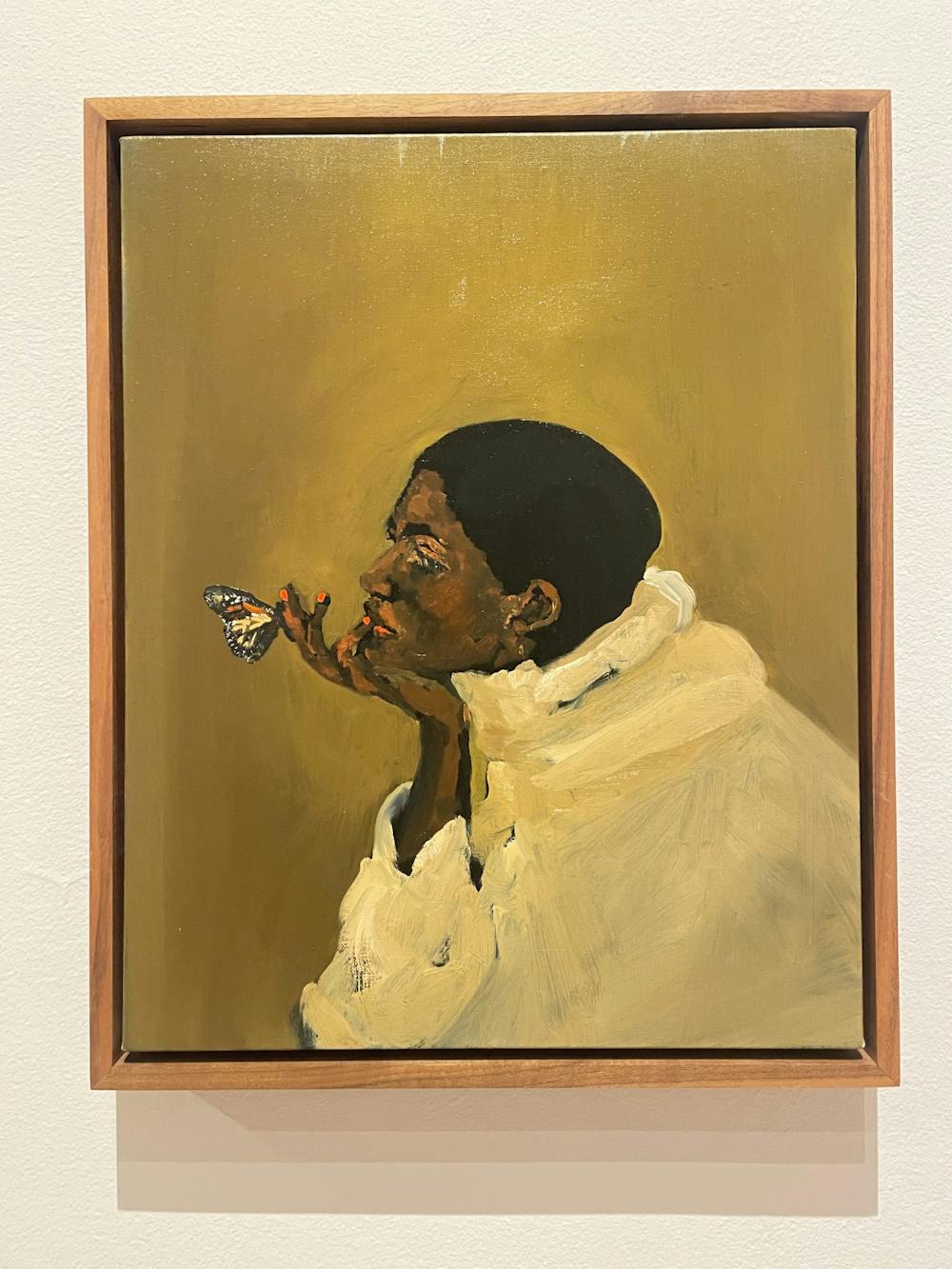
Nestled carefully among the other art sat a glossy painting of a woman holding a butterfly to her mouth. At first glance, it seemed the woman was upset about something; she sits to the side, aloof, looking off into the distance like an empress watching a jester in boredom. Her brown eyes peek over to the viewer in dissatisfaction, almost silently asking, “How dare you bring an unfunny jester to my palace?”
The painting’s informational panel read “Shelter 2023 Oil on Linen.” The woman’s short black hair and her dark skin are pigmented with several shades of brown, creating rich shadows on her hands. Her cheeks and lips are a warm rosy red clearly contrasting with her bright red fingernails. A monarch butterfly rests on her index finger. She wears a luxurious, fluffy cream coat which stands out against the golden olive background. Simple, elegant and feminine. The emotions of the character were hard to make out. She has a troubled microexpression suggesting that she’s trying to keep herself together, an expression that you would look at and ask, “What’s wrong?” but never receive a proper answer.
This painting is one of Mckinney’s most recognizable works, being both the cover page of her newest book “Beyond the Brushstroke” (2025) and also embroidered on a custom Christian Dior bag featured in Lady Dior Art #9, a limited edition collaboration where high-profile artists are challenged with recreating Dior’s iconic bag with their own spin. In this particular scene of the woman sitting in contemplation, a butterfly lands on the woman’s hand, depicting ‘the flight of imagination.’
There was silence until a woman at Mckinney’s side spoke up. It was broken by Prof. Gannit Ankori (FA/WGS), art historian and curator of the Rose Art Museum. She quickly introduced Mckinney, affectionately calling her by her middle name, Joy. Mckinney’s bright red fingernails matched that of the women in all of her paintings, a personal touch to her work.
Born and raised in Montgomery, Alabama, Mckinney was always fascinated by art. She explained, “When I was a little girl I would take a shoebox, cut it up and place figurines inside of it, creating a sort of domestic scene. It was very soothing to me; art always comes from a place that's very familiar.”
As a rising star in the contemporary art world, Mckinney’s work has been the subject of two international solo art exhibitions including “Fly on the Wall” at the Fondazione Sandretto Re Rebaudengo in Turin, Italy and “about a moment – in a moment” at the Kuntshal in Copenhagen, Denmark.
In addition, Mckinney’s work has been featured in permanent collections of major art museums such as the High Museum of Art in Atlanta, Georgia and the Metropolitan Museum of Art in New York. On the Rose Art Museum’s website you’ll find a rich description of Mckinney’s art. “‘Tell Me More’ offers a tantalizing entry point into the intimate world of a gifted painter whose powerful vision of Black femininity is expansive, contemplative and defiantly unhurried.”
The tour of Mckinney’s exhibit began with a few quotes pasted near the ceiling throughout the gallery. Mckinney pointed out her own quote that said, “Painting is a spiritual act for me.” Without hesitation, Mckinney began to expand upon this idea. “I’m not originally a painter. I spent 20 years studying photography so painting is a little scary.” She continued, “I realized that when the paint touches the canvas it does what it wants. I had to let go of control and surrender … and to me that is deeply spiritual.”
Standing in the gallery, surrounded by her work, it became pretty clear that these paintings are not about control or perfection. Instead, they are about the quiet moments that go unnoticed. In her work lies something vulnerable: her characters are allowed to be themselves, whether exhausted, contemplating or even bored. While these may not be positive emotions, they are all real. “Even now, as I stand before you guys, I still feel like I want to fix things.” She pointed to a medium-sized painting to the left of us and continued, “But if I fixed it, that wouldn’t be the point of my work.”
Guests wandered the gallery and observed the paintings that exclusively depicted Black women, leading viewers to wonder if any of Mckinney’s work had an underlying political inspiration. She began by explaining her background in photography and how she used to study photographers like Nan Goldin and sculptors like Paul Gauguin. She said, “In the beginning of my studies I wasn’t particularly looking for Black women, I was more focused on understanding composition and the psychology behind photography.” She continued, “But as I started doing more of my own work I was looking for references and I was like… where are all the Black women?”
Mckinney elaborated on detailing her experience at Parsons School of Design in New York. “I would go to all these art exhibitions and I would never see Black art or artists.” Mckinney remembers this being the moment she decided to feature Black women in her work. “Not seeing Black people in art really weighed on me, but it was never something that was supposed to be political. I like the way these women look and I want to showcase them.”
At this point in the conversation Ankori chimed in to inform the audience about art history. “Traditionally when we do see Black women in paintings we think of Edouard Manet’s ‘Olympia,’ where the Black woman is always a servant attending to her white employer.” She explained that Mckinney’s work offers a different interpretation of femininity and rest that just so happens to feature a Black protagonist.
Mckinney added on to Ankori’s point, “At first I was thinking to myself, ‘what am I doing? I’m adding these Black women and inserting them into these historical master paintings?’ But then I soon realized that no matter the color of my characters everyone should be able to look at them and relate.” She continues, “They’re not just my ladies, they’re yours too.”
Eventually the tour shifted to a painting on the far right side of the gallery. It showcases one of Mckinney’s familiar characters lying nude on a sofa. McKinney stood in silence for some time, allowing the audience to take it all in, and then she began to explain her artistic process. “I start with a black canvas so you can kinda see the background creating dark undertones. Next I paint her full body and then I work on the interior.” Mckinney paused before speaking. “Then I thought to myself, ‘what painting do I put above her?’” Referencing other paintings is a signature detail she likes to include in her work, and she explained that she looks in her old art history books for inspiration.
In this particular painting titled “Fly on the Wall,” she included “The Portrait of Marie-Thėrèse Walter,” Picasso’s 17-year-old muse and lover who inspired many of Picasso’s works. Mckinney explained her process: “I wanted to include this painting to add some color, but I soon realized it sort of sent the wrong message. I couldn’t help but think that I need to cover this lady up; that's why I added the flower vase.” These artistic choices set Mckinney apart from artists like Picasso and Balthus because she paints women beautifully without making them an object of desire. “I never want my ladies to feel… to be sexualized, I just don’t,” she stated.
Lastly, everyone arrived at the painting that inspired the entire art series. “Tell Me More” showcases a woman sitting on the bathroom floor looking absolutely drained. She's wearing a lime green robe which subtly stands out against the similarly green color palette in the bathroom. Her red fingernails add a pop of color to her figure.
The most prominent connection between all of Mckinney’s characters is their various states of rest. Mckinney’s inspiration was personal. She explained, “I was raised by my grandmother. She was a nurse that worked night shifts and when she would come home she would just sleep in the chair.” She continues, “I’m from the South. I grew up around people that were extremely hard working. They worked for barely nothing. I never saw them rest.” She continued, “I think that slowing down and resting is an active resistance. No one is telling you to do or be anything. You can figure out who you are in the chaos around you; that’s powerful.” With that, the showing came to an end. While trying to understand Mckinney’s characters, I learned that Mckinney’s ladies are special because they’re not trying to be special. Instead of performing for an audience they lounge aloofly, engaging in a somewhat silent resistance to traditional representations of women in contemporary art.
The day after the tour, the room felt different. The paintings were lighter, free of any of my preconceived notions. In the gallery stood Nikita Mangaru, a Brandeis alumna ‘24 MA’26 who now works at the Rose Art Museum. Mangaru was also present for Mckinney’s showing the night before.
Mangaru wears many hats. She was an MLK Fellow as an undergraduate, she’s finishing her MBA in marketing and strategy in three weeks and lastly, she works at the Rose Art Museum as a Gallery Assistant. She chuckled while explaining her job at the museum. “I’m basically a glorified security guard,” she told me. “I just make sure people are respecting the space.” But as I watched her speak about the work around us, it’s clear her role extends far beyond supervision.
Mangaru’s connection to art began long before Brandeis. She grew up immersed in creative practices, playing instruments and studying IB visual art in high school. It was there where she first encountered art history and began to understand visual art as a medium for self-expression. However, when she entered college, that creative side gradually faded into the background. “I was very focused on academics,” she said. “I even thought I wanted to be a surgeon. That idea went out the window pretty quickly.”
It wasn’t until she took a class on Black theater and performance and later decided to study abroad in South Africa that Mangaru felt pulled back toward creativity. “That experience made me realize that art needs to be a priority,” she tells me. When she returned, she began doing photoshoots, dressing differently and intentionally reengaging with creative work. “I stopped thinking about art as something that needed to be productive or finished,” she says. “Instead, I wanted to make art for the sake of art.”
When Magaru was asked about Mckinney’s exhibition, she perked up. “Tell Me More” seemed to resonate deeply with her on a cultural level. “Seeing Black women resting was extremely significant,” she explained. “We’re usually portrayed as strong, always doing something, always holding things together. A lot of the time we’re masculinized in the media.” McKinney’s work, she believes, disrupts that narrative. “Here, Black women are just allowed to be.” Mangaru was particularly struck by the nudity in McKinney’s paintings. “It’s not sexual,” she said. “It just reminds you that we’re human. You’re allowed to exist in your rawest form.” She paused before adding, “People have such a one-dimensional narrative of Blackness. Struggle is real, but it’s not the only part of identity that deserves attention. There’s so much more.”
Magaru herself felt a certain type of inspiration from McKinney’s work. She said, “I love the way Mckinney was able to take her photography background and mix it with painting. It just truly shows you the versatility within art. Personally I have many artistic interests. I would love to find a way to combine everything together and make something completely brand new.”
Mckinney’s newest exhibition “Tell Me More” offers an alternative narrative within the art world. Rest has the ability to inspire, educate and even change perceptions. Mckinney’s work doesn't end on the canvas, it lingers within the people that are lucky enough to encounter it.

Please note All comments are eligible for publication in The Justice.