
JustArts staff rounds up favorite exhibits
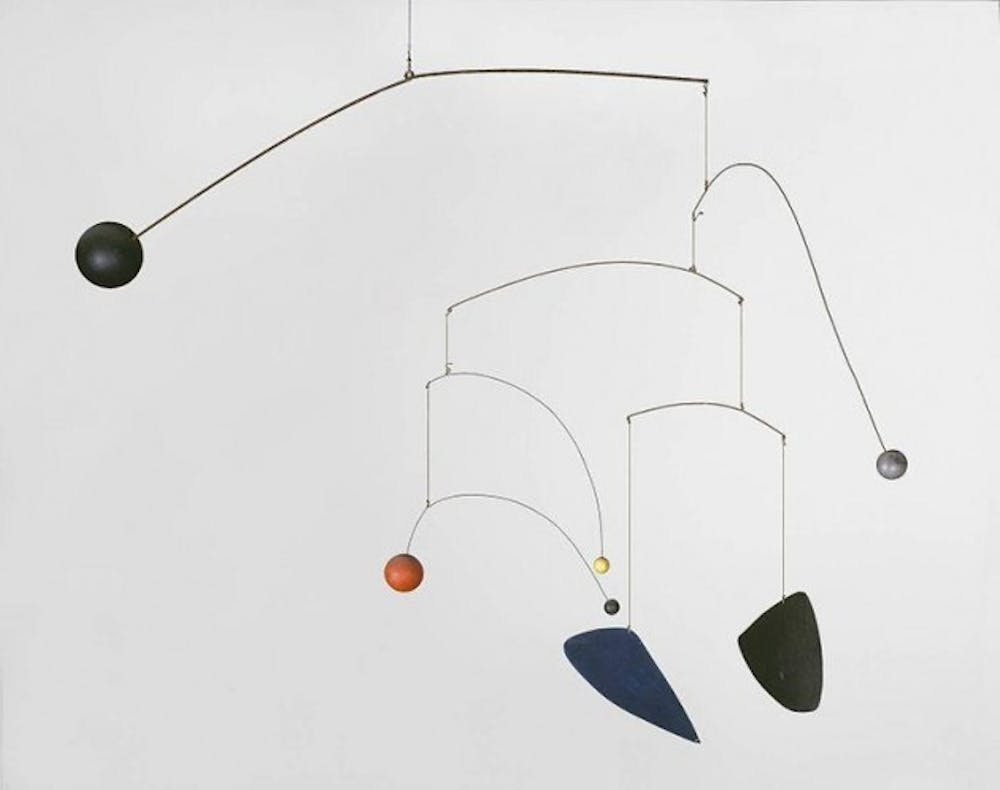
Over break, I visited one of the Los Angeles County Museum of Art's newest exhibits-Calder and Abstraction: From Avant-Garde to Iconic-which opened in late November and is the first Alexander Calder exhibit to appear at LACMA.
Calder, a 20th century American sculptor, is known for his geometric and colorful mobiles as well as his stables, the stationary works of art that he created in the later part of his career.
The layout of the exhibit actually seemed to mimic the artwork and at the same time provided an excellent forum that allowed the artwork to stand out. The layout was geometrical and maze-like, filled with small, narrow crevices that held just a mobile or two. Bold, bright and spinning, the pieces popped out among the gray walls.
Calder's work is highly abstract and reminded me of the idea of a Rorschach inkblot test: each viewer sees something different in the piece and there may be no "right" answer. I imagined everything from plants to stick figures represented in the pieces.
It seemed that Calder did have tangible inspiration for some of his works though. For instance, we know that much of Calder's inspiration came from outer space, especially the pieces in his collection, "Constellations."
The titles of his pieces give us some insight into his inspiration. Some of the titles were descriptive of what the piece represented such as "Blue Feather" and "Little Parasite." But a few titles paid homage to the materials used, such as "Little Pierced Disk," names that did not give clue to any inspiration and left room for an inkblot test perspective.
-Emily WIshingrad
*
Last month, I attended the de Young Museum in San Francisco's exhibition on David Hockney's latest work. David Hockney: A Bigger Exhibition opened at the museum on Oct. 26 and will end on Jan. 20. Hockney is known as a major contributor to the pop art movement of the 1960s and for his experimentation in portraiture, photo collage and set design.
I have never been an especially big fan of other Hockney exhibits I've been dragged to by my mother, and at first, I wasn't sure if I would enjoy this one. As I walked through the first room, which was packed full of eager guests, I thought that most of the paintings looked an awful lot like something an elementary school student would do. The colors were garish and the brush strokes thick. I changed my mind when I learned that Hockney made all of the displayed works on his iPad or through the paintbrush tools on Adobe Photoshop. For an artist who used photography as his primary medium for many years, I found it fascinating that he switched to tools that many people use for photo editing. About halfway through, the exhibit displayed films of Hockney creating his work. You could watch how his iPad screen went from blank to filled with lines and colors that somehow all came together into a detailed self-portrait or landscape. I also enjoyed a room that showed a timeline of major works in the Western art canon from the 13th century on and allowed the viewer to see where Hockney got his inspiration.
I still may not be a huge fan of Hockney's more mainstream works, but I did thoroughly enjoy David Hockney: A Bigger Exhibition. It was so unlike anything I had ever seen before, and the combination of art and technology took the art to the next level.
-Catherine Rosch
*
My favorite art exhibition of the 2013 year coincided with my first Justice article on the Museum of Fine Arts, Boston exhibition, She Who Tells a Story. The exquisitely curated show, displaying photographs of female artists from the Middle East, exposed me to the subtle nuances of the Middle East that are frequently forgotten in the Western media lenses.
Boushra Almutawakel's series "Mother, Daughter and Doll" depicted the tension over women's bodies in nine photographs. In the series, the smiling faces of a trio of female figures changes as their garb changes. The first image depicts three happy, colorfully dressed females and only the mother's head is covered. But, as time progresses, more and more black fabric is added to the trio's bodies resulting increasingly somber photographers. Finally, the three figures are draped in a black shroud. They no longer exist in the frame of the photograph and as such, cease to exist in society.
Yet, my favorite series in the exhibition was Gohar Dashti's "Today's Life and War" that portrays a newly married couple in a war-ravaged dessert in an unknown location. In the series, the couple celebrates their anniversary. They take a road trip. They hang their laundry up to dry in the wind. These scenes of domesticities in the midst of a battlefield create an image of war as an everyday reality that is not worthy of excess attention. War and violence have become normalized. The scenes of this newly married couple in a warzone pulled at my heartstrings. In a dystonic landscape the couple's commitment to each other, their perseverance, determination and commitment to normalcy, seemed oddly romantic and endearing. After a year of exhibitions, She Who Tells a Story is the one the show which I cannot help but to remember and reimagine.
-Kiran Gill
*
A two-hour drive away from both Seattle and the state's Twilight capital, Forks, my tiny hometown of Sequim is situated in the northwestern-most corner of the state of Washington. With approximately 7,000 residents today, Sequim has a similar heritage to countless small towns across the Pacific Northwest, which have risen from the roots of family-owned farms and prairie settlements in the last century.
Naturally, the artwork that comes out of places like Sequim comprises a very niche genre that is inspired by fixtures of everyday life in the Pacific Northwest-small towns, family operations and a close relationship with the area's splendorous nature and wildlife. Situated in the center of Sequim, the Blue Whole Gallery provides a home for a constantly changing collection of artwork created by locals, many of whom have spent most of their lives in the area. The Blue Whole Gallery was opened in 1997 and is now home to more than 35 artists from the Northwest. Functioning as a cooperative gallery, each of its members contributes through both monthly membership dues and commissions on works sold in the gallery.
The selection of works on view ranges in medium from oil on canvas to watercolor, photography to ceramics, sculpture to carvings to tactile mixed media. One can always count on nature as a common theme throughout the gallery. Some of my favorite pieces on view now are watercolor paintings of the Olympic mountain range, brightly painted wooden carvings of wild birds and oil paintings of the nearby Strait of Juan de Fuca.
The Blue Whole Gallery celebrates the spirit of small town communities and the beautiful land and life around us. If you are ever in the area, skip the vampire-themed tour of Forks and pay a visit to the local art scene.
-Rachel Hughes

Please note All comments are eligible for publication in The Justice.