
Footnote' roasts Jewish life
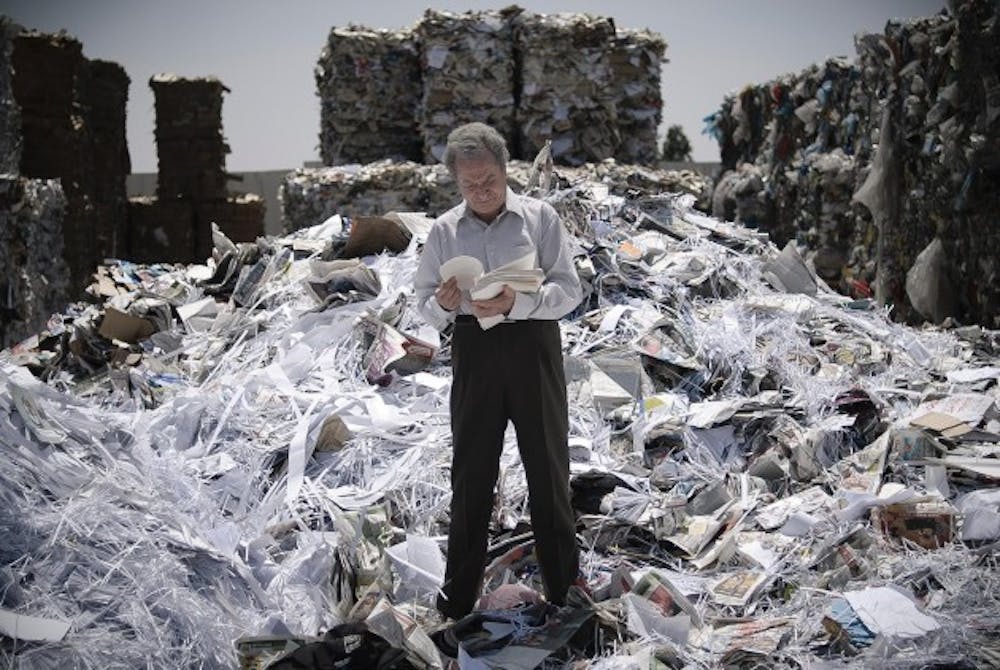
Footnote, written and directed by Joseph Cedar, begins with a rivalry between a father and son. But as the story unfolds, the increasing crises reveal more about the tension between humans in general. The audience experiences a chain of indignations where characters must hurt someone else to relieve their pain.
Nominated for Best Foreign Language Film at this year's Academy Awards and winner of Cannes Film Festival's Best Screenplay, this acidic-and hilarious-Israeli film begins with Uriel Shkolnik (Lior Ashkenazi) being accepted into the prestigious Academy of Sciences, as his father, Eliezer Shkolnik (Schlomo Bar-Aba), who is not a member, sits in bitter jealousy. These two men are rivals and both professors at the Hebrew University of Jerusalem and Talmudic scholars (though they approach their religious interpretations from different angles). Eliezer worked for 30 years on reconstructing a definitive version of the ancient Talmud, when, only a month before publishing his findings, Grossman (Micah Lewensohn) discovered the original binding of the Talmud, making Eliezer's work unnecessary. Grossman is praised; Eliezer is forgotten. For 20 years, Eliezer submitted his name for consideration for the Israel Prize, the nation's highest honor, only to fail every time. His only scholarly recognition, on to which he desperately holds, is a thank-you in a footnote of a textbook on the introduction to Talmud literature-hence the film's title. Eliezer regards with contempt any success his son gains.
Then an ironic twist occurs: Eliezer receives a phone call that he has finally been awarded the Israel Prize. Everyone is surprised and Eliezer is glowing. He is so changed that his son barely recognizes him.
Then another ironic twist occurs: the Ministry of Education made a mistake. The minister of education meant to call Uriel to award him the Israel prize, and she thought that she was talking to him when she spoke to his father. This presents a serious dilemma for Uriel: he must give up the prize so his father can have it after coveting it for so many years. This allows Cedar to set up another series of funny events.
It's delightful and hilariously ironic to watch Footnote's characters respond to the awkward situations, which often occur when one character knows something that another doesn't. These characters receive what they don't deserve. I often laughed as the son tries to keep his composure as he watches his father celebrate his award, or as one character tries to help another while the other tries to harm him.
Irony gives us a strange vision. Who has the upper hand? Who is the underdog? And what happens when the situation is suddenly reversed? We understand the characters in ways that would have been impossible before the crises as they react to situations that uncover the dynamics of their relationships. The misadventures of the film's characters are all accompanied by perfect orchestral music, highlighting the capricious nature of the events, which quickly turns to a menacing tune that reflects the cruel irony of the situation.
All of the actors handle their parts brilliantly. They balance on a tightrope of awareness. They understand the story as actors but remain involved as characters in their anger and pains. They make moments shine in hilarious awkwardness, yet remain entirely true to the logic of their characters.
Overall, this film challenges the meaning of family. To confront his father means that Uriel may potentially sever their relationship. But then are these people still a family if they must hide the truth in order to function?

Please note All comments are eligible for publication in The Justice.