
Mochila bids musical farewell to founder
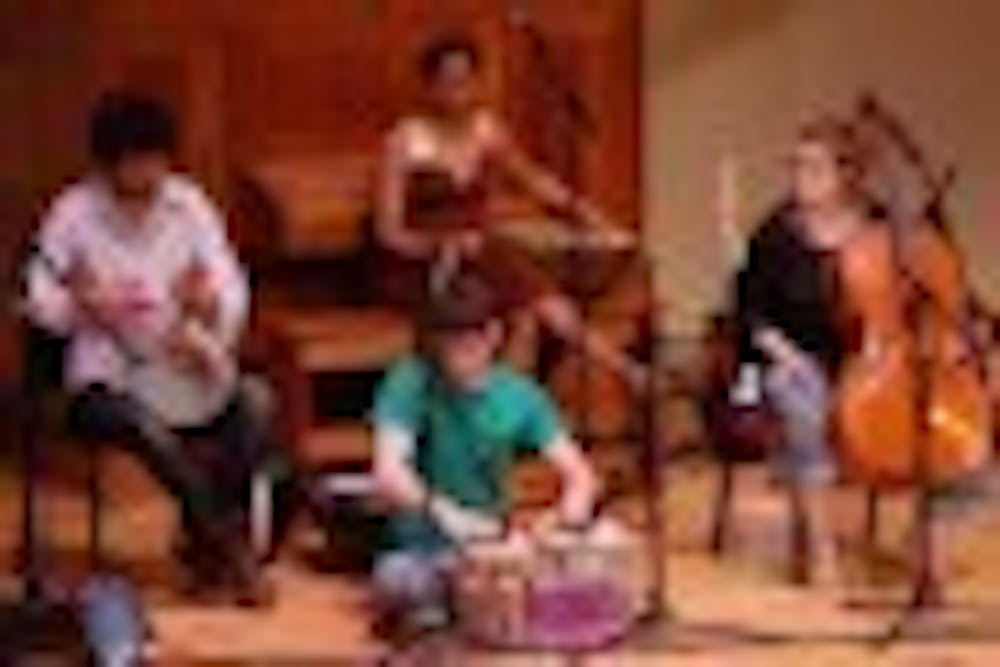
Introduced by the program pamphlet for the Leonard Bernstein Festival of the Creative Arts as "Brandeis's favorite student band," Mochila indeed exceeded expectations with its unique compositions, "unique, compelling fusion of Arabic, jazz, reggaeton, and more" and magical harmonies on May 2. The majority of the audience members in the Slosberg Recital Hall were students, eyes gleaming with anticipation of and excitement for the forthcoming benefit concert for Haiti. As Will Chalmus '07 came out, jumping around the stage and encouraging people to get pumped for the concert, the audience cheered and hollered. As I peered through the program notes, I was struck by graduating senior and founder of the ensemble Mohammad Kundos' '10 humble introduction about what the group represents.
Mochila, which in Spanish means "backpack," boasts a fascinating combination of various elements that each instrument exhibits, working together to create one united identity. Its mission, as fans already know, is "Create. Appreciate. Discover. Combine. No matter where you are from. Don't be Afraid. Shout. Out. Loud." Kundos wrote, "Mochila brings together different cultures, different identities, different languages on one state to play the universal language of music." On the same note, he proudly announced the group's new initiative to launch a Mochila in Haiti in July as "part of a summer camp that is being held in Hinche, where [they] will be working with musicians from the city [so that] together [they] aim to work on rebuilding a united identity between the people in Haiti and those who were displaced after the earthquake." The group plans to combine traditional Haitian elements with popular music to unite the generations, ensuring total inclusion for all ages. While the Haiti effort was recommended to the Student Emerging Artist foundation for a grant totalling $2500, album sales and donations gathered at the concert will provide invaluable financial support.
Not only was this the farewell concert for Kundos, but it was also Mochila's second album recording. Thus, the group asked the audience to show much love by clapping and screaming, which it gladly did. Overall, the performance was superb and pleasant to watch, as the ensemble successfully interacted with the audience, inducing some of them to get up from their seats and dance to the beat in the aisle.
The various acts consisted of the original ensemble playing its signature music; a duet consisting of slam poetry and violin; a Zayde Buti performance; Usman Yasin Hameedi's '12 spoken word; a joint performance with Indian Tabla drum by Ethan Geringer-Sameth '12 and Kathak, a classical dance from North India by Ashni Dave '12; and "Arabic Coffee" and B'yachad. My favorite performance was "Eternal Spring," which began with piano and viola, performed by Jae Kyo Han '10 and Emily Gelb '11, respectively, soon joined by everyone else, with refreshing drum beats from Kundos, Geringer-Sameth and Lopez, and beautifully ended with the Carnatic violin.
Although every artist was phenomenal, I was particularly intrigued by the Indian classical violin (or Carnatic violin) played by Siddhi Krishna '12, because I had never encountered such style before, as well as the Kundos' oud, a pear-shaped stringed instrument commonly used in Middle Eastern music. Other well-known instruments, such as piano, drum set, saxophone, trumpet, viola, violin, cello and voice, also defied the traditional boundaries of their stereotyped genres and flaunted their eccentric rhythms and original tone qualities.
Despite the seemingly odd combination of various instruments, which consists of partly Indian, Arabic and Western instruments, the best asset of the performance was the exceptional unity and harmony of the group.
Everyone was in sync and engaged in the music, all with same desire to become one within the music. I wish the best of luck for Mochila's effort to execute its newest project in Haiti, and if its performance was any indication of the group's unity, dedication and potential, I have no doubt in the success they will gain.
Editors Note: Justice staff writer Wei-Huan Chen is a member of Mochila

Please note All comments are eligible for publication in The Justice.