
From Faustus to philosopher
Prof. Andreas Teuber (PHIL) discusses his passions
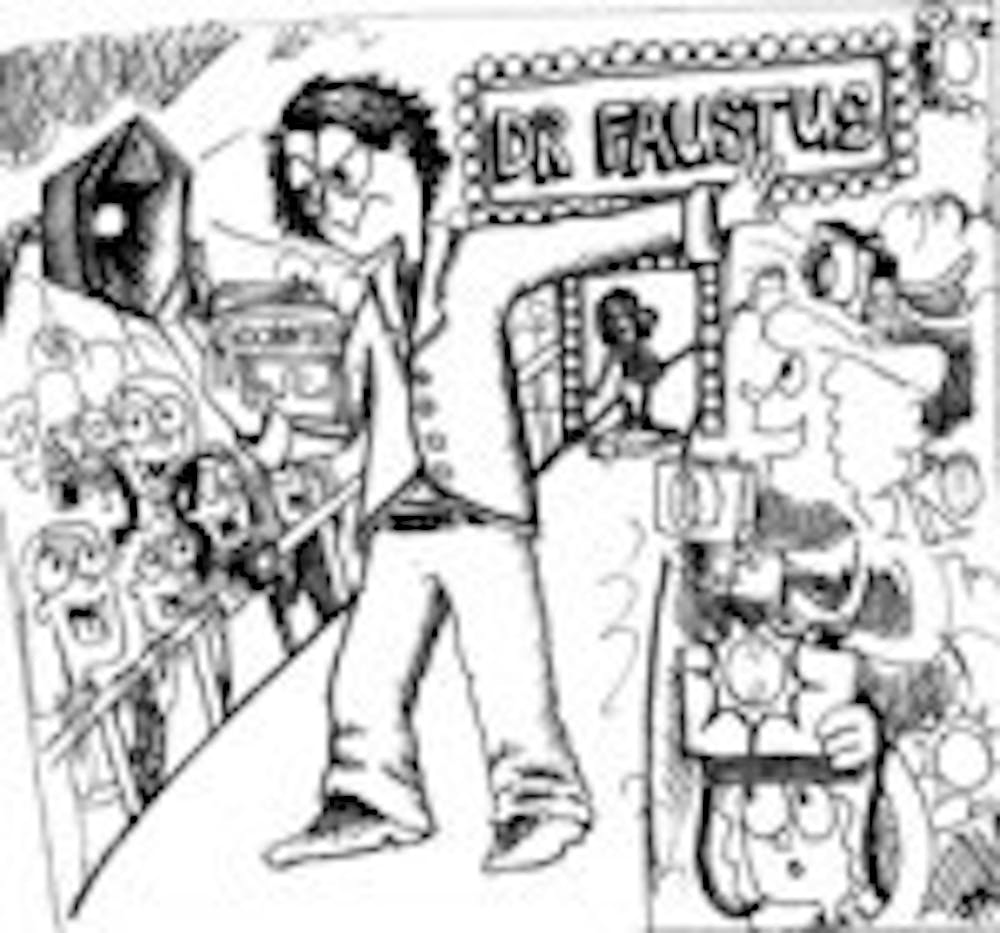
Prof. Andreas Teuber (PHIL) would describe himself as a philosopher. He spends his time contemplating the world around him and looking into abstract matters. He applies this thinking to create a dynamic classroom environment in which he uses students' ideas to gain fresh perspectives.Prof. Teuber, however, once used a different kind of audience to gain fresh perspectives .
Before Teuber began teaching at Brandeis, he pursued his interest in acting and channeled his philosophical ideas into the various characters he played.
Teuber once worked with such acclaimed actors as Elizabeth Taylor and Richard Burton.
While an undergraduate student at Oxford University, Teuber was part of the Oxford University Dramatic Society.
As part of a plan to raise money for a workshop, the society decided to ask Richard Burton, seen in acclaimed Broadway productions such as Camelot and in movies such as Cleopatra, to be a part of a production.
Burton decided to put on a play; Christian Marlowe's Doctor Faustus. Elizabeth Taylor, his then-wife, played Helen of Troy, and Teuber was cast as Mephistopheles, a devil disguised as a friar.
"So there I was, this little kid, acting with Richard Burton and Elizabeth Taylor on a stage at the Oxford Playhouse," Teuber remembers.
Later, when this play was turned into a movie, Teuber was cast as Mephistopheles.
Teuber says that Taylor and Burton helped him understand what movie acting was. After appearing in Doctor Faustus, Teuber featured as a guest actor on a number of television series, among them I Spy and The Big Valley.
Although cinema could be exhilarating, Teuber realized early on that his true passion was theater.
"After spending a number of months in Hollywood, I thought, 'I don't think I want to do this,'" he says.
Since both Teuber's parents were academics, he was encouraged to pursue a career in philosophy.
Teuber excelled in philosophy as well, as he obtained both his B.A. and his Ph.D., though he never completely gave up theater.
"I think it's important to go back and forth. For me the theater, the acting part, was much more like rowing. Like doing tennis. It was like getting to the right place in the court and hitting the ball. Not about thinking so much," says Teuber.
Teuber always thought it was important to keep his artistic and philosophic sides somewhat separate.
He never got involved in a theater production at Brandeis because he claims to have "a rather conservative view about something like theater."
"If you want to do theater, you do it out in the world. It happens in the world," he says.
Teuber was recently involved in the creation of a piece at the Guggenheim Museum in New York that incorporated elements of acting and philosophy.
The exhibit consisted of participants of different ages stopping people walking up the museum's ramp to ask them philosphical questions based on the theme of progress. The goal of the exhibit was to "bring philosophy out into the world," Teuber says.
"That's how philosophy started, with philosophers stopping people in the streets to ask them questions," says Teuber.
The exhibit ran from Jan. 29 through March 10, 2010.
Any random visitor at the museum was approached by a kid, a graduate student or a philosopher and asked:
"What is progress?" At the same time, visitors walked upwards in a counterclockwise ramp so that, even though they were being elevated, they were simultaneously going back in time.
"The cleverness of such a conflict," says Teuber, "is that you start to think." Teuber says he was able to balance his passions for theater and for philosophy.
"[I] always thought you just go do what you want to do, and if you want it enough you're going to be able to do it," he says.
Even though Teuber had success in the acting world, he remains humble in the classroom.
"After watching his performance as Mephistopheles, I have to say I was a bit surprised by his ability to play such an evil character because it is so opposite of his personality.
[You'd think] Prof. Teuber would be arrogant, but he's actually really humble and modest, [and] he knows how to get students' attentions," says Caitlin Abber '13, Teuber's student, in an e-mail to the Justice.
"You really cannot evaluate a life; this is something you can only do at the very end looking back," says Teuber.

Please note All comments are eligible for publication in The Justice.