
Gatz' is a great retelling of classic
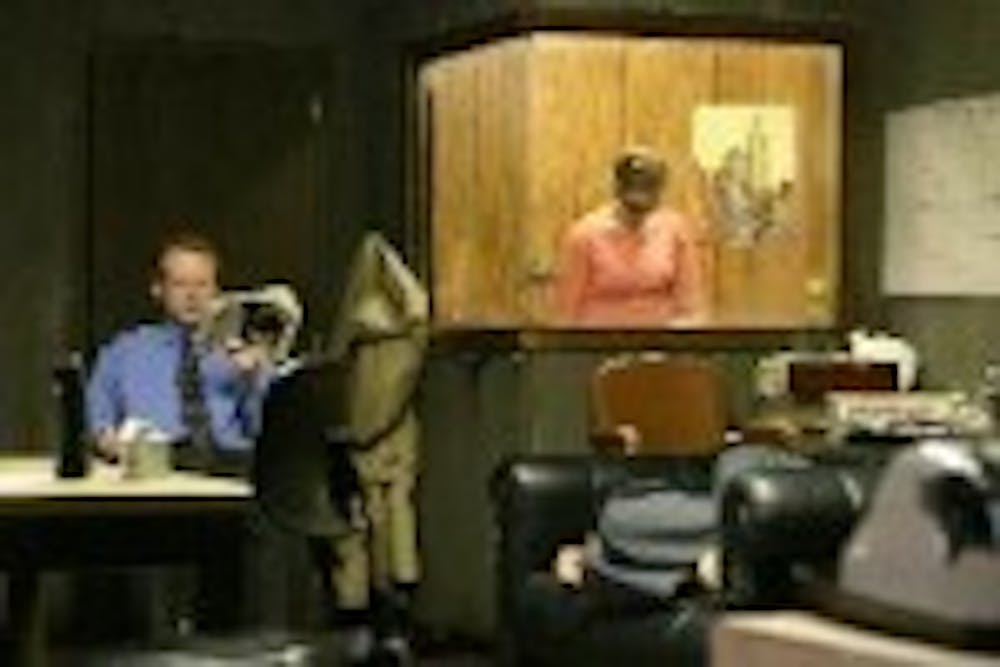
The Great Gatsby is one of those books on everyone's assigned reading list in high school. It may also be one of the few they actually read. There is something about it-Fitzgerald's beautifully crafted prose probably has a lot to do with this-that remains appealing. Beyond the glamorized lives of its protagonists, it's the tragedy of the story and the way it mourns the lost American dream that ensures its place in the canon. When I heard that a six-hour production titled Gatz was being produced by Elevator Repair Service at the American Repertory Theater in Cambridge, and that it basically consisted of the entire book being read out loud, I was a little wary of the time commitment but mostly eager to experience the book again in a new way. Instead of taking place on a lavish movie set with period costumes and crystalline lights, Gatz begins in the grungy basement of an anonymous '90s-era office. An employee finds an old copy of The Great Gatsby in a Rolodex, and when his computer persists in failing to turn on, he begins to read the book aloud, gradually becoming more and more absorbed with its world, as do his co-workers. Eventually, they morph into the characters of The Great Gatsby, and although they enact much of the dialogue, every other word is narrated by Nick (Scott Shepherd), including every "he said" and "she said." True, at times, the production feels like an audiobook, especially during some of the more introspective passages. But that's not a bad thing, considering Shepherd's amazing performance, a real tour de force. There's not just the physical feat of reading what must amount to over four hours of prose (all of which he memorized), but the way he manages to really become Nick, the eternal recipient of confessions of other people's lives. The particular, untraceable cadence of his voice brings you back to another age, and although you can guess at his patrician past, you can also see his slowly mounting distaste for the lives of his wealthy friends, and the disillusionment is as painful for the audience as it is for him.
Nick is the best part of the production, but nearly all of the actors also stand up quite well. Gary Wilmes is excellent as the boorish Tom Buchanan, and he even manages to instill a faint sympathy (or is it contempt?) in the audience's heart by the second half. His mistress, Myrtle Wilson (Laurena Allan), is also well cast, and she brings the necessary vitality to her character, a kind of vivaciousness verging on hysteria. I found her husband, George (Frank Boyd), less convincing, mostly because I found the actor's appearance off-putting. He looked much too young for the role, and the odd presence of facial hair coupled with his hangdog attitude seemed to intimate a sense of mere shabbiness, not the downtrodden, lifeless ghost of a man he was supposed to have been. Sibyl Kempson, who plays Jordan Baker, brings a sense of humor to her role that I had forgotten existed in the book, but I preferred her when she was less dramatic. Victoria Vazquez tries very hard to be Daisy Buchanan, and she comes very close, but frankly, given Fitzgerald's abstract representation of Daisy as the ultimate idealization of Gatsby's American dream, no actress could actually live up to the text. And finally, we have Gatsby himself (Jim Fletcher), who in appearance was not quite what I expected but who eventually won me over while maintaining an enigmatic distance.
Hearing the entire text of The Great Gatsby does make you notice certain things, especially specific descriptions or words Fitzgerald repeats. And there is certainly a kind of awkwardness when one tries to visualize literary phrases such as, "There was a pause." However, the company forges mercilessly ahead, gleefully acknowledging the limitations of the theatrical medium and even attempting in a "meta" kind of way to gamely perform metaphorical language as if it were a game of charades. Mostly, this works. Sometimes a phrase meant to be wry in Fitzgerald's text devolves into slapstick with the appropriate level of audience laughter, but I suppose this was necessary in a six-hour production. I appreciated this winking at the audience, but the production was really at its best when it very much imitated a traditional play.
The second half ratchets up the drama, plot and dialogue, and there is an extended scene in a dimly lit hotel room, after everyone has figured everything out, when the production achieves its ultimate goal-a state of suspended anticipation. I forgot it was set in an office, and I forgot that these people weren't really Nick, Daisy, Tom and Gatsby. And even though I knew what was going to happen, the visceral dread was just as affecting. The very end of the novel took a much more circuitous route than I remembered, but when Nick Carraway started talking about the green light, and the orgastic future, and running faster and stretching our arms further, I realized it was about to end, and I was disappointed.
As a rule, I generally don't believe in standing ovations. I think they're overdone and that standing after every performance you see simply dilutes the import of whatever a standing ovation should mean. But after Gatz, remarkably, it was the first thing I wanted to do. I wasn't alone. The entirety of that small theater's audience stood up behind me in seconds-not reluctantly, not in that peer pressure-influenced kind of way where the audience timidly steps up after looking around-we stood up immediately because it was that remarkable.
Gatz is playing at the Loeb Drama Center in Harvard Square, 64 Brattle St., until Feb. 7. Part 1 (Chapters 1-5) is 3 hours, 20 minutes long, which includes a 10-minute break. Part 2 (Chapters 6-9) is 2 hours, 40 minutes long, which includes a 10-minute break. If you choose to see both parts in one day, there is a hourlong dinner break between Parts 1 and 2.

Please note All comments are eligible for publication in The Justice.