
Porn or art?
ROMP magazine earns mixed reviews
The staff of the latest addition to the Brandeis literary scene were stumped. They needed a moniker for their magazine, something that conveyed the whole of their mission: something fresh, clever and insightful-and something erotic. They considered names like Uncut, Innermost Parts and Bawdy Deis and eventually settled on something simple: ROMP.It's a name that, with connotations both frolicsome and salacious, conjures no single interpretation. Maybe that's because even the magazine's staff remains confused over where ROMP-the 23-page publication that hit campus newsstands last week-fits in the scheme of "adult" reading. Is it porn? The staff insists "no," but some on campus find that term an appropriate shorthand. Ilya Okunev '07, the magazine's creator, cottons to the term "sexuality magazine."
Call it what you like, but it caught the attention of Playboy editor Rob Walton. Walton contacted The Hoot, which ran an article about the magazine's debut, for Okunev's contact information. Okunev assumes that Walton plans to report on collegiate sexuality magazines in general; it was the national coverage of Harvard University's H-Bomb and Boston University's Boink that inspired ROMP.
The debut issue featured black-and-white nude and semi-nude photo shoots, articles, poetry and a comic.
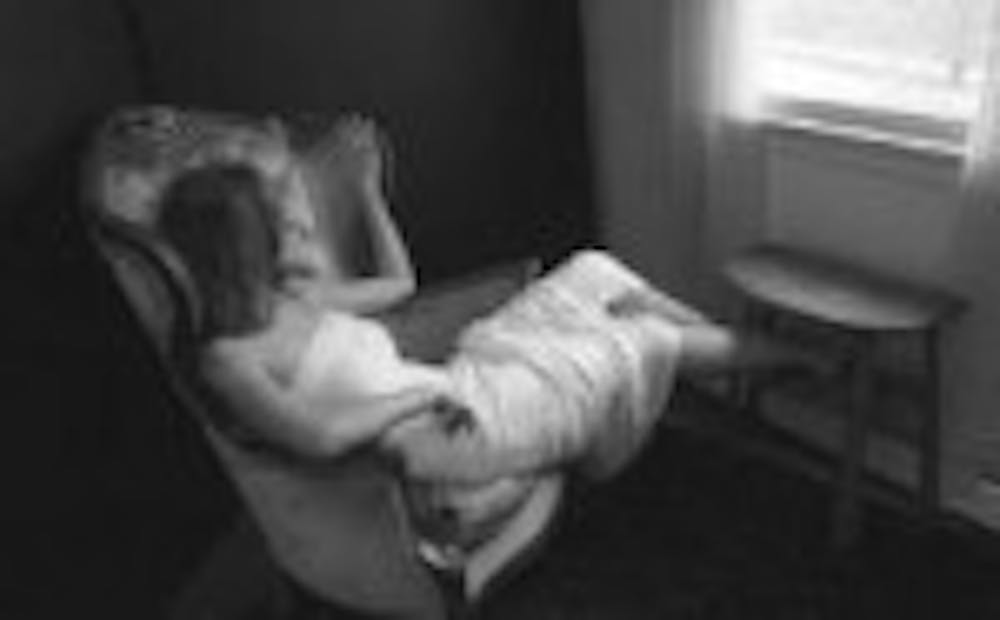
The sections the reader flips to first are the two eye-catching photo spreads, one elegant section featuring Natalia (whose last name Okunev declined to give) draped in jewelry and lounging in her undergarments on a plush chair. The other spread is a fun and irreverent semi-nude "ROMP through a castle," featuring Amy Tsao '10 and Dinah Lofgren '08 in cotton underpants, striped knee socks and little else. None of the models are named in the magazine.
Okunev defended the magazine from critics on campus who say his publication is comprised of nothing but lewd images. "People are trying to express themselves. Calling it porn would cheapen it. The difference [between ROMP and porn] lies in thought process and work," he said.
ROMP has encountered a mixed reception on campus among students and administrators.
Students remain unimpressed with ROMP's content and message. Rayna Grossman '08, a member of Triskelion and a coordinator for Student Sexuality Information Service, wrote in an e-mail to the Justice, "I didn't find [the articles] very interesting or anything different [or] any more progressive [than] anything else on campus, but it was the first run and I think [and] hope that when people see it more people will contribute."
Rob Foster '08, also a coordinator for SSIS, echoed this sentiment, but added that he was unconcerned about the magazine's apparent target audience of heterosexual men. "As far as campus politics is concerned, I do not think [Okunev] is under an obligation to make it more viable for women. It's his publication," Foster said.
But Jonathan D'Oleo '08, a member of Brandeis Christian Fellowship, argued passionately that ROMP is wildly inappropriate for publication. Although he agreed the pictures featured in ROMP are not overly risqu, he voiced his concern that its publishers or readers will try to find more and more hardcore content.
Tsao's snappy response to the question of ROMP's pornographic content came without a pause. "It's cheesecake pin-up," she said. "We're not even fully naked." Lofgren and Tsao are veteran semi-nude models and both are pictured on SuicideGirls.com, an alternative porn site that features punk- and goth-style models.
Their ideas of sexuality, Lofgren and Tsao said, differ from the mainstream, which is why they're willing to defy societal norms and model nude. Lofgren wants these pictures to help people "think and accept" conceptions of sexuality. "Making it taboo forces nudity to be equitable to vulnerability," Lofgren wrote in an e-mail to the Justice. "If people took the time to understand that and overcome it, then, clichd as this sounds, the world would be a better place."
On a smaller scale, Tsao wants her pictures to have a positive effect on the way people think about their bodies. "People will look at pictures of me and think, 'That girl's fatter than me!' or 'That girl has a smaller chest.'"
Emily Moignard '09, a coordinator for Student Sexuality Information Services, said that she was unimpressed by the models featured in ROMP. "I've seen these people naked so many times," she said. "It's not that appealing."
Some articles in the magazine address how one might overcome sexual shame and taboos. Ben Douglas '07 wrote an article titled "Sexuality in a New Reality," in which he states that "each generation has a new kind of sexuality," and that for our generation, it is digital reality. He writes that this generation's "sexual reality" includes a virtual world in which one can explore taboo fantasies without shame or repercussions. The "real world" and the virtual world are different, Douglas writes, cautioning readers to be "mindful of the differences." What is pleasurable and appropriate online, he writes, may not be so in reality.
"Think With Your Dick: Become a Feminist," an article by Jake Daniels '07, encouraged men to refrain from calling women derogatory sexual names like "slut." He argued that making women feel ashamed of their sexuality is out-it decreases women's enjoyment of sex and willingness to have sex because they're worried about their reputations. In his article he posits: "In our contemporary post-industrialized world this practice becomes vestigial, joining the likes of other modern peeves like wisdom teeth and the appendix."
The final article of the issue, written by Rebecca Ramo '08, is the cleverly titled "Lifetime, Pornography for Women." Ramo writes that "female pornography contains both aspects of sex: the emotionally intimate and the primitive." Her article, like Daniels', is geared toward explaining sexuality to men. And because the photo spreads are saturated by a female cast, ROMP seems like a fairly exclusive look at sexuality and sexual preference.
Moignard agreed that the magazine did seem to cater to a heterosexual male audience. "It wasn't [geared] to an all-inclusive audience," she said. "It wasn't very erotic for heterosexual females. And there wasn't anything homosexually appealing."
Okunev defended his magazine in an e-mail, explaining that "the magazine consists of the contributions it receives." He added: "Personally, I wish some guys would have posed for our readers' pleasure as well. It didn't work out for the first issue. If anyone would like to see the magazine go in a different direction, they should contribute."
Tsao and Lofgren agree that every issue will be different. Lofgren did not get a chance to write an article, and neither Tsao nor Lofgren recruited some of the writers they had wanted to contribute. Douglas said that "social expectations and trends" had prevented more men from stepping forward to model.
Lofgren predicted that ROMP will be "mostly ignored, but people who are already interested will appreciate it. It won't change people's minds." As it happened, Okunev ran out of his first 150 copies very quickly, and he staggered the distribution. The demand for the magazine has since decreased.
Dean of Student Life Rick Sawyer said he wasn't surprised the magazine didn't make a bigger splash. "I don't think on this campus it's going to be a mushroom cloud," Sawyer said. "[There is] a certain numbness to that art form."
"Don't judge pornography by it's pictures," D'Oleo said. "Judge it by its fruits-its consequences."
Okunev was pleased with his magazine, but admitted he would have preferred it to be a little more sexually explicit. There isn't enough time to print another issue this semester, Okunev said. But what about next year? Who will take over after he graduates? With a smile Okunev replied, "At the moment, I'm taking applications."
-Hannah Edber and Rachel Marder contributed reporting.

Please note All comments are eligible for publication in The Justice.