
As Brandeis clarifies its generative AI policies, some questions remain among students
Despite new language clarifying the University’s generative AI policies, a small-scale student survey suggests that uncertainty remains about when and how students can use AI.
On Aug. 21, the Brandeis student body received an email from the Dean of Students Office outlining 2026-2027 revisions, including further clarifications on generative artificial intelligence policies. Section 4 of Rights & Responsibilities outlines that “instructors are expected to articulate an official AI use policy for each of their courses.” If a professor does not provide official guidance on AI use in class, generative AI is prohibited.
The University provided four sample AI syllabus statements, ranging from most restrictive to most permissive, including policies that allow AI tools for certain uses, such as reviewing course material or refining written work. However, the statements prohibited students from submitting “AI-generated work as if it were your own.”
Instructors are also encouraged to develop their own AI syllabus statements. In a Sept. 15 written statement to The Justice, Alexandra Rossett, Assistant Dean of Student Rights and Community Standards, said the development of AI prompted the University to revise the code of conduct.
“For students, our aim is to help them have a clear understanding of what our policies are and why. Faculty are trying to navigate a complicated and rapidly changing landscape, and the university wants to make sure that it is supporting them in figuring out the best ways to engage with students about appropriate or inappropriate uses of AI,” Rossett wrote.
The revisions to Section 4 of Rights & Responsibilities were a collaborative effort of the Committee on Teaching, Learning and Assessment; the Center for Teaching and Learning; Student Rights and Community Standards; Rights & Responsibilities Committee; the Provost’s Office; school deans and some members of the AI Steering Council.
When determining whether a student has used AI tools in violation of the course’s policy, Rossett said that suspected AI use should not be based solely on AI-detection software, which can produce inaccurate or inconclusive results. “Faculty should consider the totality of the available information. Things faculty might be considering may include, but would not be limited to, the student’s work, the assignment requirements, the student’s process and explanation of their work, factual inaccuracies or logical inconsistencies, lack of citations, or fabricated citations,” Rossett said.
To inform this article, The Justice conducted a small-scale survey from Sept. 20 to Sept. 27 about how Brandeis students understand these generative AI policies. The survey received 31 responses from Brandeis undergraduate and graduate students, 94% of whom were undergraduates. At the beginning of the survey, students were asked whether they knew if Brandeis’ academic integrity policy includes specific rules on AI. Seventy-one percent of respondents said they were aware but had not read the policy.
Respondents were given a hypothetical situation in which a professor had not provided written permission to use generative AI in the syllabus or assignment instructions. Fifty-eight percent of students said that, to their understanding, AI can be used to some degree, or may be used unless the professor specifically prohibits it. Only 42% correctly identified that AI tools may not be used unless the professor gives written permission.
Without written permission from an instructor, respondents believed they could use AI tools for purposes such as brainstorming, researching, checking spelling and finding sources. Students were given various statements about AI use and had to indicate whether each use is permitted, not permitted or unclear.
Sixty-eight percent of respondents said that using Perplexity or another AI tool to identify possible sources, but then reading and citing the original sources yourself, is a permitted use of AI. Another 61% of respondents saw “using ChatGPT or Claude to summarize an assigned reading to help you understand it” as another accepted use of AI tools.
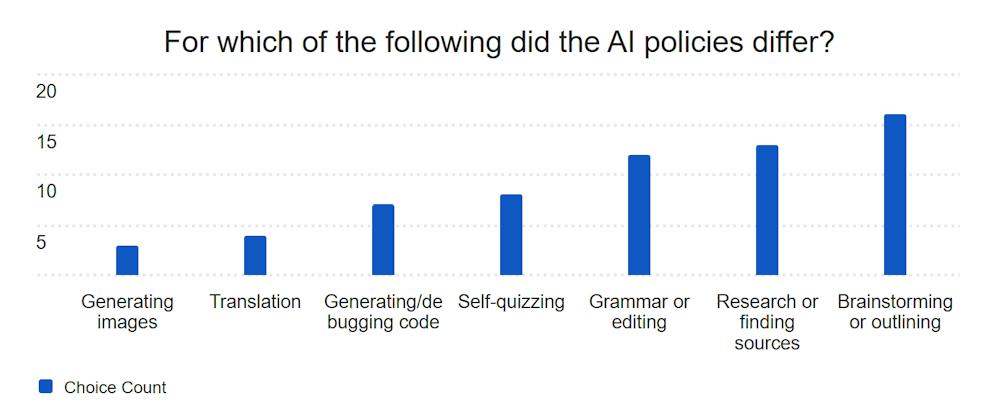
At the same time, 87% of respondents reported that all or most of their courses now include AI syllabus statements. Seventy-seven percent of respondents shared that AI policies differ across courses, depending on whether or not professors allowed AI use for brainstorming, source-finding and grammar (Figure 1).
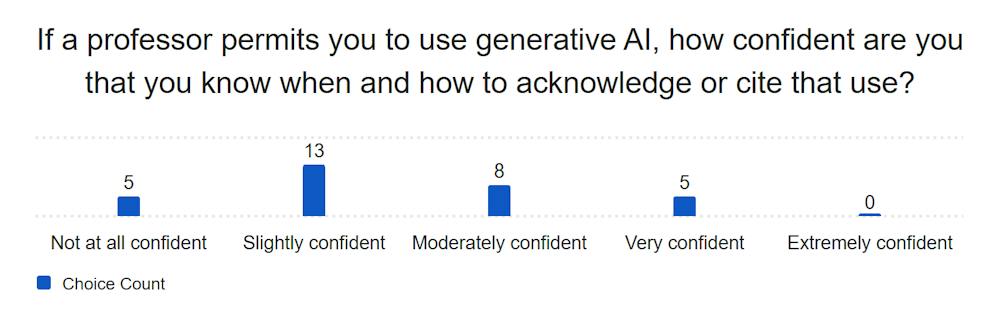
When generative AI use is allowed, the survey received mixed responses about whether or not students felt confident in how to acknowledge or cite it (Figure 2). Forty-two percent of respondents said they felt “slightly confident” and 16% felt “not at all confident.” Only half of the students said that they received guidance in class on how to cite the use of AI.
At the end of the survey, students were shown the relevant language from Section 4 of Rights & Responsibilities. After reading, some students found the language clear, while others still found it ambiguous. Some respondents suggested setting AI-use expectations at the department level to make standards consistent for students. Others found the policy “vague” and needed further clarification, noting that “blanket policies always have exceptions and it is hard to keep track of them.” A student also reported that a university-wide AI policy, rather than leaving it to instructors’ discretion, is needed.
Some departments have responded to the variation in AI policies by developing shared approaches. For example, the Journalism department has adopted a common AI policy, leaving room for each professor to interpret it.
“Our policy, our approach to AI, has been not to shut it down completely and pretend that we live in a world where AI doesn’t exist … What is open for debate is how you use this really powerful tool of generative AI to make your reporting more robust. If journalism is about looking for information and under rocks, then you can use technology to look under more rocks than is humanly possible,” Neil Swidey (JOUR), director of the Brandeis Journalism department, said.
Swidey said that students should be transparent about AI use, while maintaining autonomy over their work. In their class “The Road to September 11th and Beyond: History and Media,” Swidey and Prof. Naghmeh Sohrabi (POL) adopted an oral final exam to test students’ knowledge and understanding of the material.
Other uses of AI remain prohibited in journalism classes. “The non-negotiable with AI is not using AI to generate words that then you put your name to … As a journalist, if you allow a machine to do what you are supposed to do, which is come up with the words and the thoughts and the sentence structure, then you have no business being a journalist,” Swidey said.
AI use also varies by discipline. Zoe Weinstein, a humanities librarian, said she has seen a decrease in AI use in humanities over the past two years, while colleagues have reported an increased interest in business, economics and computer science. Weinstein described herself as an “AI pessimist,” and shared she is skeptical of how useful generative AI is for research in the humanities and social sciences. However, she noted its potential value in limited brainstorming uses.
“Most of what’s happening when students rely on generative AI for gathering resources, for summarizing resources, for determining what a source is about, they are doing what is called cognitive offloading, where they just take what you could do with your own brain, and they say, ‘well, somebody else can do it.’ And that theoretically saves time and effort, and in reality makes it so that you don’t know what you are getting,” Weinstein said. She also shared that University librarians are available to answer AI-related questions and the library provides students with a guide to citing AI.
Although Brandeis has clarified its generative AI policy language and most students in the survey reported that their courses have written AI statements, the survey suggests that confusion remains about when AI can be used and how to properly acknowledge it.

Please note All comments are eligible for publication in The Justice.