
Third spaces
How common rooms affect first-year living.
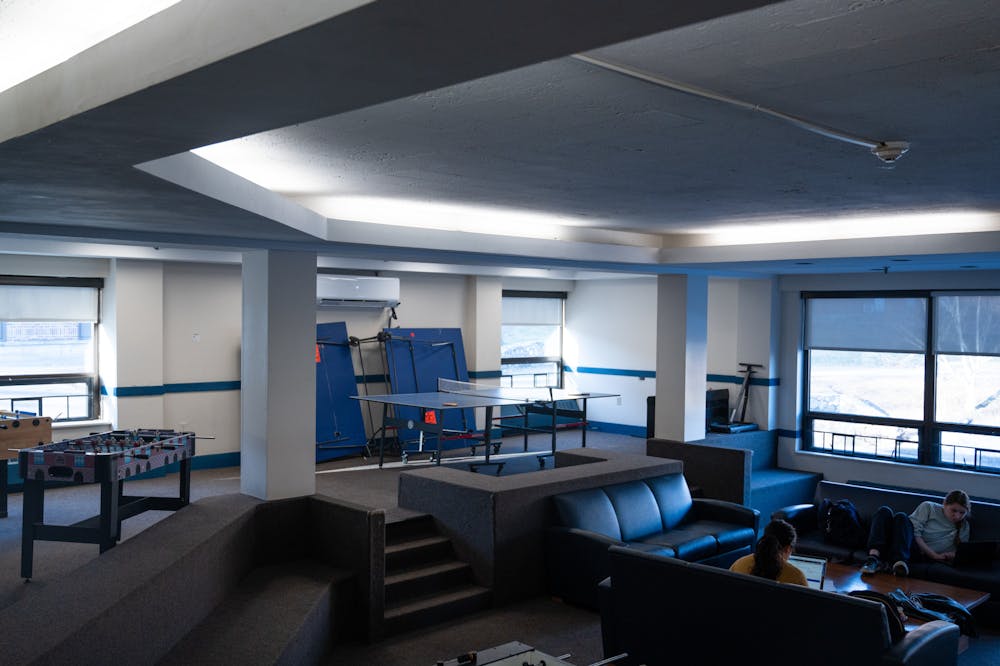
The options for first-year dorms can vary from location to location, but one common factor is the presence of some type of lounge or common room. North Quad’s Scheffres Hall and Gordon Hall have the Polaris Lounge. Massell Quad’s Shapiro Hall also has the Shapiro Lounge, affectionately dubbed the “Schlounge.” These spaces play an important role in a students’ lifestyle as well as give first-years a starting point for their college experience. However, it’s possible that they’ve fallen under disrepair and misuse.
Some upperclassmen look back on their experiences in the first-year common rooms with mixed feelings. Trisha Roy ’26 said in an interview with The Justice on March 15, “I remember seeing so many crazy things in my freshman common room. Improvised pong tables, religious ceremonies and couples breaking up.” Roy continued, “It’s kind of like a space of endless possibilities because it’s a non-performative space. I think it’s a rite of passage to be in there at your absolute worst.” Common rooms should be spaces where students feel comfortable to be themselves.
Offering another perspective, Samuel Roselin ’27 said in an interview with The Justice on March 15, “I remember just going there and setting up a projector with my friends and watching movies.” However, when asked about the long-term use of the common rooms, he replied, “we only used that room for the very beginning of freshman year, and then we just went to each other's dorms.” When asked why he and his friends preferred dorm rooms over the common rooms, Roselin said, “The common room was kind of lifeless, y’know? It didn’t feel lived in. Like look around us — referring to the spot in the library where we were sitting — there’s lamps and paintings and the wall is painted red. There’s a lot of personality and I don’t remember the common room where I lived having that.”
Current first-years also have mixed takeaways about their experience so far. Moira Koleno ’29 said in a March 15 interview with The Justice, “It’s nice to have a place to step out for a second, from your dorm. It can be hard not knowing your roommate and sometimes you just need a second to walk out and take a phone call or do homework or something like that.” However, she continued saying, “I live in Renfield and I just wish our common room was separate from the kitchen because it is always smelly. Someone’s always leaving full pots of food out there and no one cleans up.”
Other first-years echo similar issues with their shared spaces. Abby Finkelstein ’29 said in an interview with The Justice on March 15, “I like the space, but there isn’t really a good place to study and that’s what I want to use it for. There aren’t any desks or tables and I need some sort of space other than my dorm to do work. I can go to the library, but it’s not that close to me so I don’t always have the energy to walk there and especially not late at night.”
Finkelstein also commented on the cleanliness of the common rooms, “People always leave their used pots and pans out there, it’s really gross.” She continued, “I see the facilities people in there all the time and they clean as much as they can but it’s usually still dirty, the kitchen anyway. And the kitchen isn’t really their responsibility, it's ours, and no one cleans up their stuff.” When asked if decorations, such as more furniture or something on the walls would make her want to spend more time in the common room, she said, “Oh my god yes, the vibes would be so much better.”
Roy described the common room as a “third space,” a place other than home or work since those two places hold too much weight, or in a university setting, outside of the dorms and the classrooms. Roy said, “I believe that Americans are kind of obsessed with ‘third places’ and that’s kind of why they come to college, to just be away from home and make friends and meet new people.” It’s true that American culture can revolve around these third spaces — libraries, gyms, restaurants and movie theaters. At Brandeis, this concept includes spaces such as the dining halls and other public venues on campus like the Shapiro Campus Center or Levin Ballroom.
The most frequent use of these first-year spaces or third spaces is for Community Advisor events. These events usually revolve around some sort of activity that serves to educate the student body about campus fundamentals and also come with free food. These events are mandatory for CAs to hold and can have a good turn out depending on location. A CA in Massell Quad, Summer Abdelreim ’28 said in an interview with The Justice on March 16, “If I hold an event with a couple other CAs we can get upwards of 20 people.” The common rooms can also be reserved for events by any student, although the events first need to be approved by the University Events team who will assign an Events Manager to supervise.
When Roselin was asked how his common room functioned as a place to meet friends, he answered, “I think the idea of meeting people and making friends with the people in your building is nice, but I don’t think I ever met a friend in the common room. I just stuck with people I already knew.” When asked how it could be used as a third space, he said, “From my understanding of what a third space is, you need some sort of activity. Like people come to the library to study or go to the gym to work out and there’s not really anything to do in most of the common rooms other than cook something.”
The Justice also asked Koleno about whether the common rooms function as a place to meet friends and as a third space. Koleno said, “I guess at the beginning they were kind of like that, before everyone joined clubs and things like that, but now I feel like they’re pretty empty. It kind of helped us adjust to living at college I guess.”
When asked the same question, Finkelstein said, “I mean in mine there’s not a lot there other than a few couches, so I’ve never really seen anyone hang out there. [In] the lounge under Scheffres I used to see people playing ping pong a lot but I think the table broke.”
Brandeis’ common rooms have the potential to function as an ideal third space for students, given the proximity to their dorms, but they aren’t given the same attention as the rest of the campus. Most are bare, with minimal activities and decorations, and most suffer from issues of cleanliness given poor kitchen etiquette. These spaces are still used well by CAs and other members of the student body, but it’s possible that they aren’t living up to their potential.

Please note All comments are eligible for publication in The Justice.